The growing integration of connected technologies into industrial, automotive, healthcare, consumer, and urban environments is increasing demand for intelligent sensing solutions. Smart sensors combine sensing capabilities with processing, connectivity, and data interpretation, enabling organizations to monitor physical conditions and make faster, data-driven decisions.
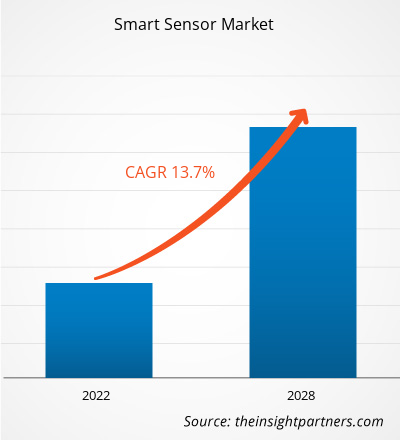
According to The Insight Partners, the Smart Sensor Market was valued at US$ 52.75 Billion in 2025 and is projected to reach US$ 148.22 Billion by 2034, registering a CAGR of 12.66% during 2026–2034. The rapid proliferation of the Internet of Things, Industry 4.0, artificial intelligence, machine learning, 5G, autonomous vehicles, and smart city initiatives is expected to support market expansion.
Key Market Insights
- Market Size in 2025: US$ 52.75 Billion
- Projected Market Size by 2034: US$ 148.22 Billion
- CAGR (2026–2034): 12.66%
- Key Technologies: MEMS, CMOS, and emerging sensing technologies
- Major Sensor Types: Temperature and Humidity, Pressure, Motion, and Others
- Key Growth Factors: IoT, Industry 4.0, AI at the edge, 5G, automation, and autonomous mobility
Get a Sample PDF Report: https://www.theinsightpartners.com/sample/TIPRE00010129
IoT and Industry 4.0 Drive Smart Sensor Adoption
The expansion of connected industrial environments is one of the major factors supporting demand for smart sensors. Manufacturers are deploying sensors throughout production facilities to monitor machinery, equipment conditions, temperature, pressure, vibration, and other operational parameters.
Smart sensors can process and communicate data, allowing organizations to monitor equipment in real time and identify potential performance issues. This capability supports predictive maintenance, production optimization, quality control, and improved resource utilization.
As industrial organizations transition toward connected factories, demand for intelligent sensing infrastructure is expected to increase across manufacturing and automation applications.
AI at the Edge Enhances Sensor Intelligence
The integration of artificial intelligence and machine learning into sensing architectures is creating a shift from basic data collection toward intelligent interpretation. Edge-enabled sensors can process information closer to the point where data is generated, potentially reducing latency and communication requirements.
This capability is particularly relevant to robotics, autonomous systems, industrial automation, smart infrastructure, and connected healthcare. Sensors capable of identifying patterns or anomalies locally can enable faster responses in applications where real-time decision-making is important.
The development of low-power processing capabilities is also supporting the deployment of intelligent sensors in compact and battery-powered devices.
Get the Premium Research Report: https://www.theinsightpartners.com/buy/TIPRE00010129
MEMS Technology Supports Miniaturized Sensing
MEMS remains an important technology for smart sensor development because of its compact form factor, scalability, and suitability for high-volume electronics applications. MEMS-based sensors are widely incorporated into automotive systems, consumer electronics, wearables, industrial equipment, and other connected devices.
CMOS technology is also gaining importance, particularly in imaging and applications requiring high-speed processing. Emerging technologies such as optical spectroscopy, NEMS, and quantum sensing could create additional opportunities in specialized industrial and scientific applications.
The development of smaller, lower-power, and higher-performance sensing components is expected to remain a central focus for manufacturers.
Automotive Applications Create New Growth Opportunities
The increasing adoption of advanced vehicle electronics is expanding the role of smart sensors in automotive systems. Connected and autonomous vehicles require extensive sensing capabilities to understand vehicle conditions and surrounding environments.
Smart sensors support functions related to vehicle safety, occupant monitoring, navigation, powertrain management, environmental monitoring, and advanced driver assistance systems. The transition toward electric vehicles is also increasing the need for intelligent monitoring of batteries, motors, thermal systems, and other components.
As vehicle architectures become more software-driven, sensor data is expected to become increasingly important for real-time vehicle control and diagnostics.
Healthcare and Smart Buildings Expand Demand
Healthcare represents another important opportunity as remote patient monitoring and connected medical devices become increasingly prevalent. Smart sensors can monitor parameters such as movement, pressure, temperature, and other physiological or environmental conditions.
In buildings, sensors are increasingly used to optimize HVAC systems, lighting, occupancy management, and energy consumption. Growing sustainability objectives are encouraging building operators to deploy intelligent monitoring systems that can identify inefficiencies and automatically adjust operating conditions.
These applications demonstrate how smart sensors are expanding beyond traditional industrial environments into connected healthcare and sustainable infrastructure.
Regional Outlook
North America remains an important region due to high IoT adoption, advanced industrial automation, strong healthcare technology infrastructure, and investment in connected buildings and autonomous technologies. The United States represents a key market supported by sensor innovation and increasing adoption across industrial and consumer applications.
Europe benefits from its established automotive, manufacturing, industrial automation, and sustainability ecosystem. Demand for smart sensing is supported by the transition toward connected factories, electric mobility, energy-efficient buildings, and advanced healthcare technologies.
Asia Pacific offers substantial growth opportunities due to rapid industrialization, electronics manufacturing, urbanization, and smart city development. The region’s growing adoption of connected devices, automation, electric vehicles, and 5G infrastructure is expected to support smart sensor demand.
South and Central America and the Middle East and Africa are also expected to create opportunities as industrial modernization, smart infrastructure, healthcare digitization, and connected technologies expand.
Competitive Landscape
Key companies profiled in the Smart Sensor Market include:
- Analog Devices Inc.
- Infineon Technologies Inc.
- STMicroelectronics
- TE Connectivity
- Microchip Technologies
- NXP Semiconductor
- Siemens AG
- ABB Ltd.
- Robert Bosch GmbH
- Honeywell International Inc.
Companies are focusing on miniaturization, energy efficiency, connectivity, sensing accuracy, embedded intelligence, and application-specific solutions to strengthen their competitive positions.
Smart Energy and Sustainability Create New Opportunities
The growing emphasis on energy efficiency and sustainability is opening new applications for smart sensors. Smart grids can use sensing technologies to monitor infrastructure and identify changes in operating conditions, while buildings can use sensors to optimize energy consumption.
Specialized sensing solutions can also support environmental monitoring, industrial safety, gas and leak detection, and other sustainability-focused applications. As organizations pursue energy reduction targets, demand for real-time physical data is expected to increase.
Future Outlook
The Smart Sensor Market is projected to grow from US$ 52.75 Billion in 2025 to US$ 148.22 Billion by 2034, registering a CAGR of 12.66% during 2026–2034.
The continued expansion of IoT and Industry 4.0, integration of AI at the edge, 5G deployment, autonomous and electric vehicles, smart city initiatives, and demand for low-power sensing solutions are expected to remain key growth catalysts. As sensing systems become more intelligent and connected, smart sensors are likely to play an increasingly important role in predictive systems, automation, digital twins, connected mobility, healthcare, and sustainable infrastructure.
Related Market Research Reports
Copper Cable Market Size, Share & Forecast by 2034
Yield Monitoring Devices Market Share, Growth & Demand by 2034
Disconnect Switch Market Share, Growth & Demand by 2034
Interposer and Fan-Out WLP Market Size, Share & Growth by 2034
About The Partners
The Insight Partners is a Insight global leader in market research, delivering comprehensive analysis and actionable insights across diverse industries. The company empowers decision-makers with data-driven intelligence to navigate evolving markets and accelerate growth.
Contact Us:
