The AI in Video Surveillance Market is experiencing rapid growth as organizations increasingly adopt artificial intelligence, computer vision, machine learning, and advanced analytics to improve security and monitoring capabilities.
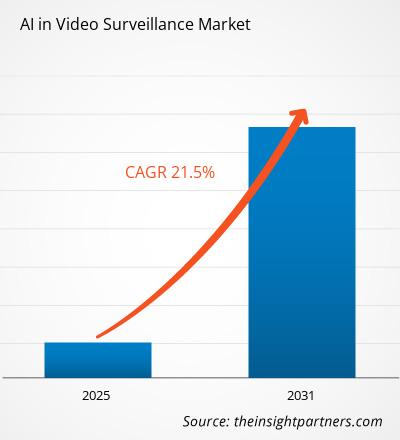
According to The Insight Partners, The AI in video surveillance market is expected to grow from US$ 8.91 Billion in 2025 to US$ 84.29 Billion by 2034, registering a CAGR of 28.36% during 2026–2034. Adoption is on an upward trend as firms, cities, transportation, and industries move from camera-based observation to automated events, notifications, and analytics-driven security systems.
Get Sample PDF of the report @ https://www.theinsightpartners.com/sample/TIPRE00039713
What Is Driving the AI in Video Surveillance Market?
Increasing Security and Public Safety Requirements
Growing concerns related to crime, unauthorized access, terrorism, workplace safety, and public security are major factors supporting the adoption of AI-enabled surveillance. Traditional surveillance systems often require security personnel to continuously monitor numerous video feeds, making it difficult to identify critical events quickly.
AI-based systems can automatically detect suspicious activities and generate alerts when predefined conditions occur. This capability helps security teams respond more rapidly while reducing dependence on continuous manual monitoring. Increasing investments in smart cities, transportation infrastructure, commercial facilities, and public spaces are further contributing to market growth.
Advancements in Computer Vision and Machine Learning
Rapid developments in computer vision and machine learning are improving the accuracy and functionality of AI surveillance solutions. Modern systems can identify objects, analyze movement patterns, recognize faces, detect unusual behavior, and extract useful information from video streams.
The combination of AI with high-resolution cameras, edge computing, cloud platforms, and connected devices is creating more intelligent surveillance ecosystems. Edge AI is particularly important because it enables video data to be processed closer to the camera, supporting faster responses and potentially reducing the need to transmit large volumes of raw footage.
Demand for Advanced Video Analytics
Organizations are increasingly seeking actionable insights rather than simply storing surveillance footage. Advanced video analytics enables businesses and government agencies to analyze patterns, monitor traffic, identify operational issues, and detect anomalies.
For example, retail organizations can use video analytics to understand customer movement, while transportation operators can monitor traffic flow and vehicle activity. Industrial facilities can use AI surveillance to identify safety violations and unauthorized access. This broader range of applications is expanding the addressable market for AI-based surveillance technologies.
What Are the Key Trends in the AI in Video Surveillance Market?
One important trend is the growing adoption of cloud-based and hybrid surveillance solutions. Cloud platforms provide scalability, remote access, centralized management, and flexible deployment options. These advantages are particularly valuable for organizations operating surveillance systems across multiple locations.
Another major trend is the integration of AI with Internet of Things (IoT) devices. Connected cameras, sensors, access-control systems, alarms, and other devices can exchange information to create integrated security environments. Such connectivity enables organizations to combine multiple data sources and improve situational awareness. The Insight Partners identifies IoT integration and expanding AI capabilities for real-time threat detection as important market opportunities.
The industry is also moving toward more intelligent cameras capable of performing analytics directly at the edge. This can reduce latency and improve real-time decision-making. At the same time, developments in natural-language video search and generative AI are opening possibilities for users to retrieve and interpret surveillance footage using more intuitive queries.
How Is the Market Segmented?
The AI in video surveillance market is segmented by offering, deployment mode, use case, and end user. By offering, the market includes hardware, software, and services. By deployment mode, it is divided into on-premises and cloud solutions.
By use case, the market includes weapon detection, facial recognition, intrusion detection, smoke and fire detection, traffic-flow analysis, parking monitoring, vehicle identification, and other applications. End users include commercial, residential, and industrial sectors.
Commercial applications are expanding as businesses seek stronger security while also using analytics for operational efficiency. Industrial facilities are adopting AI surveillance for worker safety, perimeter protection, and process monitoring. Residential applications are also developing through smart cameras and connected security systems.
What Challenges Could Affect Market Growth?
Despite strong growth opportunities, the market faces challenges related to privacy, cybersecurity, regulatory compliance, and implementation costs. AI surveillance systems may process sensitive personal information, making responsible data management essential. Organizations must establish appropriate safeguards for data collection, storage, access, and retention.
Cybersecurity is another important consideration because connected cameras and surveillance platforms can become targets for unauthorized access. Vendors therefore need to strengthen encryption, authentication, network security, and software updates.
Get the Premium Research Report @ https://www.theinsightpartners.com/buy/TIPRE00039713
Competitive Landscape
- Teledyne Technologies Incorporated
- Axis Communications AB
- Bosch Sicherheitssysteme GmbH
- Genetec Inc.
- Honeywell International Inc.
- Huawei Technologies Co. Ltd.
- Ivideo
- Milestone Systems A/S
- NEC Corporation
- Panasonic Holdings Corporation.
Future Outlook
Looking ahead, AI in video surveillance is expected to become increasingly intelligent, connected, and automated. The combination of AI, edge computing, IoT, cloud technologies, and advanced analytics will enable surveillance systems to detect threats faster and provide organizations with more actionable information. With the market projected to grow from US$ 8.91 billion in 2025 to US$ 84.29 billion by 2034, AI-powered surveillance is positioned to become an increasingly important component of modern security infrastructure.
About The Insight Partners
The Insight Partners is a global leader in market research, delivering comprehensive analysis and actionable insights across diverse industries. The company empowers decision-makers with data-driven intelligence to navigate evolving markets and accelerate growth.
Contact Us:
- Contact Person: Ankit Mathur
- E-mail: ankit.mathur@theinsightpartners.com
- Phone: +1-646-491-9876
