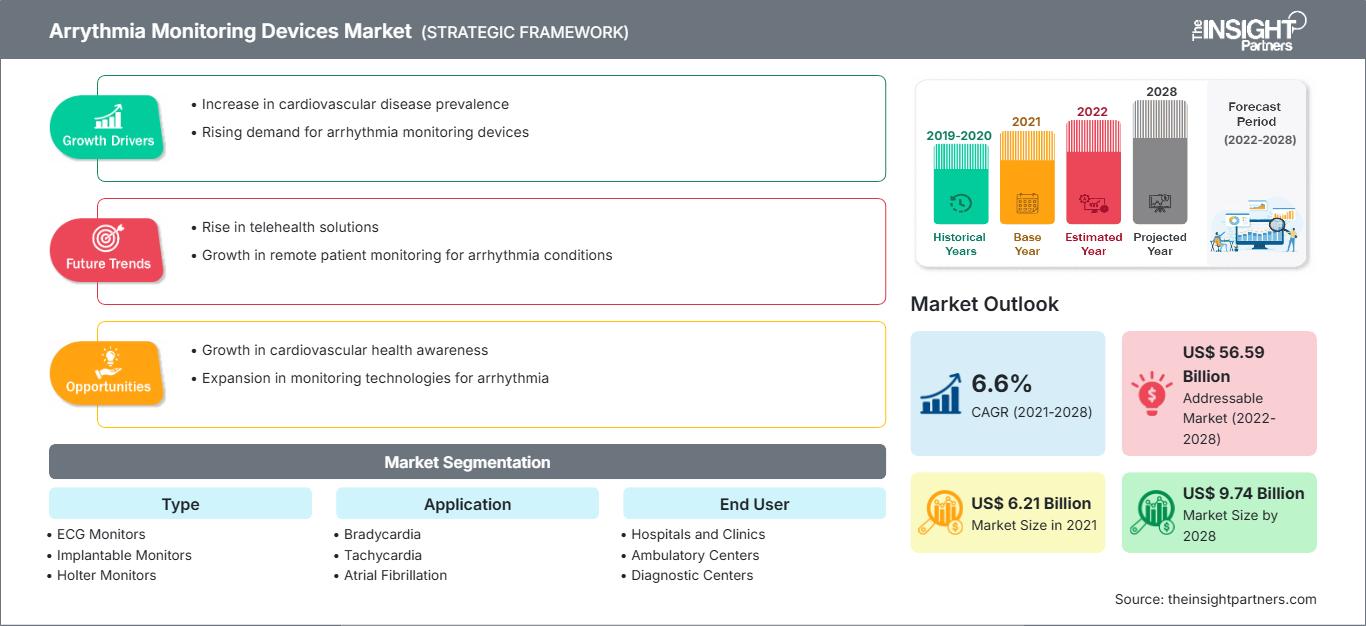
The Arrythmia Monitoring Devices Market is experiencing steady growth as the global burden of cardiovascular disorders and cardiac rhythm abnormalities continues to increase. Arrhythmias can affect heart rate and rhythm and may require continuous or intermittent monitoring for accurate diagnosis and treatment planning. Advances in cardiac monitoring technologies, increasing adoption of ambulatory monitoring, growing awareness of early detection, and improvements in healthcare infrastructure are supporting demand for arrhythmia monitoring devices across hospitals, clinics, diagnostic centers, and home-care settings.
The Arrythmia Monitoring Devices Market insights indicate that technological advancements, rising prevalence of cardiovascular diseases, and increasing demand for remote and continuous cardiac monitoring are creating attractive opportunities for market participants. The Arrythmia Monitoring Devices Market is projected to reach US$ 9,742.95 million by 2028, up from US$ 6,212.59 million in 2021, registering a CAGR of 6.6% from 2021 to 2028. Growing adoption of wearable monitoring technologies, improvements in wireless connectivity, and the integration of advanced analytics into cardiac monitoring systems are expected to further support market development.
Download Sample PDF: https://www.theinsightpartners.com/sample/TIPRE00004202
What Are the Key Arrythmia Monitoring Devices Market Insights?
One of the primary factors driving the Arrythmia Monitoring Devices Market is the increasing prevalence of cardiovascular diseases and rhythm disorders. Arrhythmias may occur intermittently and can be difficult to identify during a conventional clinical examination. Consequently, physicians increasingly rely on ambulatory and continuous monitoring technologies to capture abnormal cardiac activity over extended periods.
The market encompasses a range of monitoring technologies, including ECG monitoring systems, Holter monitors, event monitors, implantable cardiac monitors, mobile cardiac telemetry systems, and wearable monitoring devices. Each technology serves different clinical requirements, enabling healthcare professionals to select monitoring solutions according to symptom frequency, patient condition, and diagnostic needs.
The growing preference for minimally invasive and non-invasive diagnostic technologies is also supporting market expansion. Wearable and portable monitoring systems can allow patients to continue daily activities while their cardiac activity is recorded. This provides healthcare professionals with valuable information that may not be captured during a short clinical visit.
What Opportunities Are Emerging in the Arrythmia Monitoring Devices Market?
The increasing adoption of remote patient monitoring represents a major opportunity for the Arrythmia Monitoring Devices Market. Connected monitoring devices can transmit cardiac data to healthcare professionals, allowing clinicians to assess patients without requiring frequent hospital visits. This approach can be particularly valuable for individuals requiring long-term monitoring or those living far from specialized cardiac care facilities.
The integration of artificial intelligence and advanced analytics is another significant opportunity. AI-based systems can analyze large volumes of electrocardiographic data and identify patterns that may indicate abnormal rhythms. Such technologies can assist healthcare professionals in reviewing monitoring results more efficiently and potentially support earlier identification of clinically significant events.
Wearable technology is also creating new opportunities. Smartwatches, patches, chest-worn sensors, and other wearable devices increasingly incorporate cardiac monitoring capabilities. As these technologies become more sophisticated, they may expand cardiac rhythm monitoring beyond conventional clinical environments.
Market Overview
Arrythmia monitoring devices are used to detect, record, and analyze irregular cardiac rhythms. These devices are important diagnostic tools for identifying conditions such as atrial fibrillation, bradycardia, tachycardia, and other rhythm abnormalities. Early and accurate detection can help healthcare professionals determine appropriate treatment and reduce the risk of complications associated with undiagnosed arrhythmias.
Hospitals and specialty cardiac centers remain major end users because they provide access to cardiologists, electrophysiologists, diagnostic laboratories, and advanced monitoring infrastructure. However, outpatient facilities and home-care settings are becoming increasingly important as monitoring technologies become more portable and connected.
The development of compact devices with improved battery life, wireless connectivity, data storage, and remote transmission capabilities is enhancing usability. Manufacturers are increasingly focusing on patient comfort and simplified workflows to encourage wider adoption.
Competitive Landscape
The Arrythmia Monitoring Devices Market is competitive, with leading medical device companies focusing on product innovation, digital integration, strategic partnerships, and geographic expansion. Companies are developing monitoring systems that combine high-quality cardiac data collection with connectivity and analytics.
Key Players
- Abbott
- Koninklijke Philips N.V.
- General Electric Company
- Hill-Rom Holding Inc.
- Medtronic
- Biotronik, Inc.
- AliveCor, Inc
- ACS Diagnostics
- Medicalgorithmics
- OSI Systems, Inc
These companies are investing in ambulatory monitoring, wearable technologies, remote patient monitoring, and advanced cardiac diagnostic platforms to address evolving healthcare needs.
Key Growth Opportunities
The expansion of home-based cardiac care is expected to create significant opportunities. As healthcare providers seek cost-effective ways to manage chronic cardiovascular conditions, remote monitoring can support continuous observation while reducing unnecessary hospital visits.
Another opportunity lies in the integration of monitoring devices with electronic health records and digital healthcare platforms. Seamless data exchange can help physicians access relevant patient information and improve clinical decision-making.
Emerging economies also represent important growth areas. Increasing awareness of cardiovascular disease, expansion of diagnostic centers, and improvements in healthcare financing can increase access to arrhythmia monitoring technologies.
Purchase a Copy of this report: https://www.theinsightpartners.com/buy/TIPRE00004202
Future Outlook
The future of the Arrythmia Monitoring Devices Market is expected to be shaped by wearable technology, artificial intelligence, remote monitoring, cloud-based data management, and increasingly personalized cardiac care. Manufacturers are likely to prioritize compact designs, improved sensor accuracy, longer battery life, and seamless connectivity.
The increasing prevalence of cardiovascular disorders will continue to create demand for effective monitoring solutions. At the same time, growing consumer interest in wearable health technologies is likely to broaden the role of cardiac monitoring beyond traditional clinical settings.
As healthcare systems increasingly embrace preventive and remote care models, connected arrhythmia monitoring devices are expected to become an important component of modern cardiovascular management. Companies that combine clinical reliability, patient convenience, data security, and advanced analytics are likely to benefit from emerging opportunities through the evolving market landscape.
Also Available in: Korean | German | Japanese | French | Chinese | Italian | Spanish
Related Reports:
Intermittent Catheters Market Size and Competitive Analysis by 2031
Sternal Closure Systems Market Growth, Trends & Forecast 2031
About Us
The Insight Partners is a one-stop provider of actionable industry research and intelligence. We help our clients in getting solutions to their research requirements through our syndicated and consulting research services. We specialize in industries such as Semiconductor and Electronics, Aerospace and Defense, Automotive and Transportation, Healthcare IT, Manufacturing and Construction, Medical Devices, Technology, Media and Telecommunications, Food and Beverages, Consumer Goods, and Chemicals and Materials.
Contact US
Contact Person: Ankit Mathur
Phone: +1-646-491-9876
E-mail : sales@theinsightpartners.com
