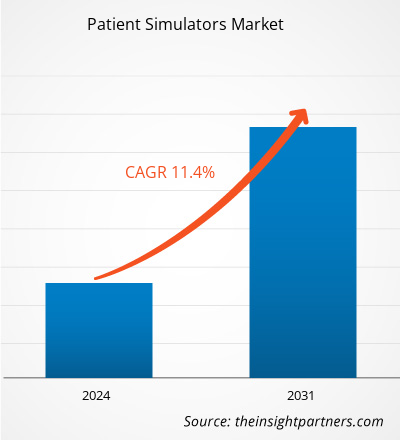
The global Patient Simulators Market is experiencing significant growth as healthcare institutions increasingly adopt advanced simulation technologies to improve clinical training and patient safety. According to The Insight Partners, The patient simulators market size is projected to reach US$ 1.23 billion by 2031 from US$ 0.57 billion in 2023. The market is expected to register a CAGR of 11.4% during 2023–2031.The growing emphasis on reducing medical errors, improving healthcare outcomes, and enhancing the competency of healthcare professionals is fueling market expansion worldwide.
Patient simulators have become an integral part of modern medical education, enabling healthcare professionals to practice complex procedures in a risk-free environment. Medical schools, nursing institutions, hospitals, and military healthcare training centers are increasingly investing in simulation-based learning platforms to improve clinical decision-making and procedural skills. The ability of advanced simulators to replicate real-life patient scenarios has significantly increased their adoption across healthcare systems globally.
Download Sample PDF – https://www.theinsightpartners.com/sample/TIPMD00002250
One of the primary drivers of the patient simulators market is the growing demand for effective medical training solutions. Traditional training methods often provide limited opportunities for hands-on practice, whereas patient simulators allow learners to repeatedly perform procedures without compromising patient safety. Rising concerns regarding healthcare quality, coupled with stringent accreditation requirements for medical professionals, have encouraged institutions to adopt simulation-based training programs. As healthcare procedures become increasingly complex, the need for realistic training environments continues to accelerate market growth.
Another major factor driving the market is the increasing prevalence of medical errors and the global focus on patient safety initiatives. Healthcare organizations are utilizing patient simulators to train physicians, nurses, and emergency response teams in critical care situations, reducing the likelihood of mistakes in real-world clinical settings. Simulation-based education has proven effective in enhancing communication, teamwork, and crisis management skills, making it an essential component of healthcare workforce development.
Technological advancements in patient simulators remain one of the most influential trends shaping the industry. Manufacturers are incorporating artificial intelligence (AI), virtual reality (VR), augmented reality (AR), and advanced sensor technologies into simulation systems. These innovations enable highly realistic patient responses, physiological monitoring, and interactive training experiences. AI-powered simulators can analyze learner performance and provide real-time feedback, helping healthcare professionals improve their skills more efficiently. The integration of digital technologies is expected to create substantial growth opportunities throughout the forecast period.
The increasing adoption of simulation training in nursing education is also contributing significantly to market expansion. Nursing schools are leveraging patient simulators to bridge the gap between theoretical knowledge and practical application. Simulators help nursing students gain confidence in performing patient assessments, administering medications, and responding to emergencies. As global nursing shortages continue to challenge healthcare systems, simulation-based training is becoming a critical tool for accelerating workforce readiness and competency development.
Furthermore, the growing demand for minimally invasive surgical procedures is creating additional opportunities for patient simulator manufacturers. Surgeons require extensive practice to master advanced techniques, and simulation platforms provide a safe and controlled environment for skill enhancement. Surgical simulators are increasingly being used for laparoscopic, robotic-assisted, cardiovascular, and orthopedic procedures, supporting the broader adoption of innovative surgical technologies.
Government initiatives and investments in healthcare education infrastructure are further supporting market growth. Many countries are allocating substantial resources to modernize medical training facilities and improve healthcare workforce preparedness. Funding programs aimed at strengthening emergency preparedness and disaster response capabilities are also driving the adoption of advanced patient simulation systems across academic and healthcare institutions.
The market is witnessing strong demand across developed economies, particularly in North America and Europe, where healthcare institutions maintain a high focus on quality improvement and professional training. Meanwhile, emerging economies in Asia Pacific, Latin America, and the Middle East are experiencing increased adoption due to expanding healthcare infrastructure, rising medical education investments, and growing awareness regarding simulation-based learning benefits.
Despite strong growth prospects, the market faces certain challenges, including the high cost of advanced simulation equipment and the need for specialized personnel to operate and maintain these systems. However, ongoing technological innovations and increasing affordability of simulation solutions are expected to mitigate these barriers over time. The introduction of portable and cloud-connected simulation platforms is further expanding accessibility for healthcare organizations of varying sizes.
Key Market Drivers
- Growing demand for simulation-based medical education and training.
- Rising focus on patient safety and reduction of medical errors.
- Increasing technological advancements in patient simulators.
- Expanding use of AI, VR, and AR technologies in healthcare training.
- Growing adoption of minimally invasive surgical procedures.
- Rising investments in healthcare infrastructure and workforce development.
- Increasing demand for competency-based nursing and physician education.
Leading Companies Operating in the Patient Simulators Market
Several prominent companies are actively contributing to market growth through continuous product innovation and strategic collaborations. Key players include:
- Laerdal Medical
- CAE Healthcare
- Gaumard Scientific
- 3B Scientific GmbH
- Simulab Corporation
- Kyoto Kagaku Co., Ltd.
- Limbs & Things Ltd.
- Surgical Science Sweden AB
- Mentice AB
- Intelligent Ultrasound Group Plc
These companies are focusing on developing technologically advanced simulation solutions that provide realistic clinical training experiences and improve healthcare outcomes.
Get Premium Research Report Market Size and Report at:
https://www.theinsightpartners.com/buy/TIPMD00002250
Market Outlook Through 2031
The future of the patient simulators market remains highly promising as healthcare organizations continue to prioritize training excellence, patient safety, and clinical competency. The integration of artificial intelligence, immersive simulation technologies, and data-driven performance assessment tools will further transform healthcare education. With increasing investments in medical training infrastructure and rising awareness regarding the benefits of simulation-based learning, the patient simulators market is expected to maintain strong growth momentum through 2031.
About Us
The Insight Partners is a one-stop industry research provider of actionable intelligence. We help our clients in getting solutions to their research requirements through our syndicated and consulting research services. We specialize in industries such as Semiconductor and Electronics, Aerospace and Defense, Automotive and Transportation, Biotechnology, Healthcare IT, Manufacturing and Construction, Medical Device, Technology, Media and Telecommunications, Chemicals and Materials.
Contact Us
Ankit Mathur | The Insight Partners
E-mail: ankit.mathur@theinsightpartners.com
Phone: +1-646-491-9876
Also Available in : Korean | German | Japanese | French | Chinese | Italian | Spanish
