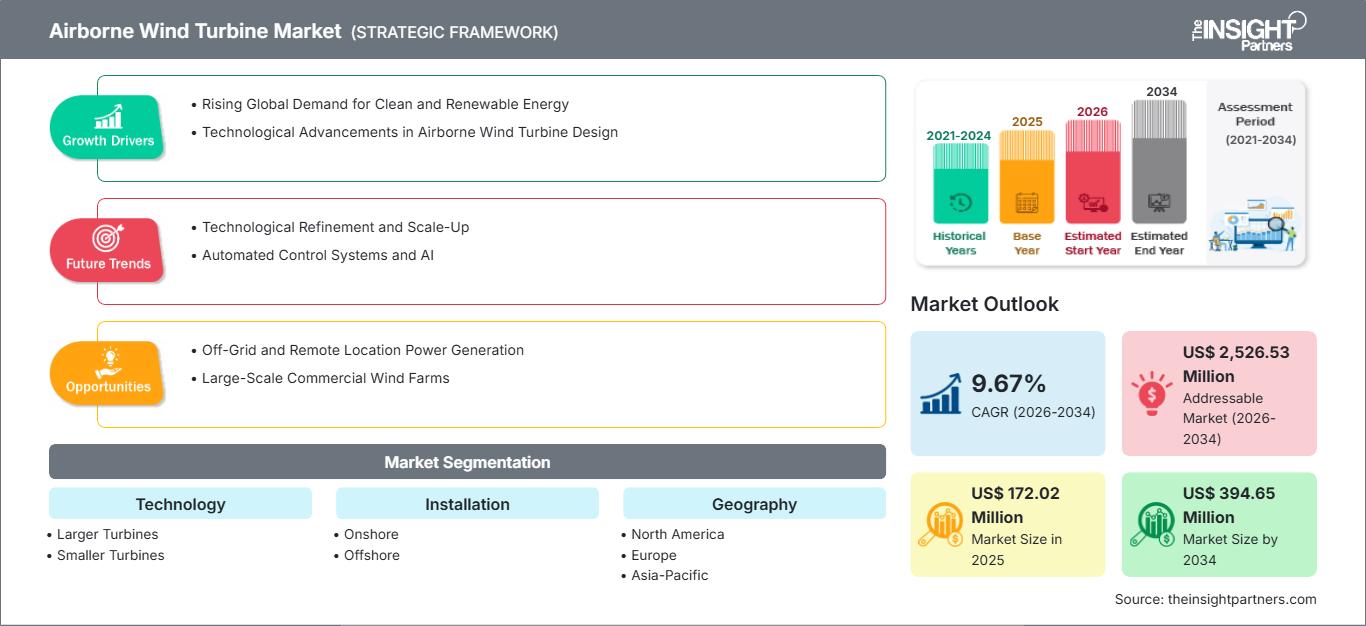
According to The Insight Partners, the Airborne Wind Turbine Market size is expected to reach US$ 394.65 million by 2034 from US$ 172.02 million in 2025. The market is estimated to record a CAGR of 9.67% from 2026 to 2034. This growth reflects increasing interest in alternative wind energy technologies, improvements in airborne system design, and the need for renewable electricity solutions that can operate across diverse geographical conditions.
The airborne wind turbine market is gaining attention as the global energy industry explores innovative technologies to improve renewable power generation and reduce dependence on conventional energy sources. Airborne wind turbines harness wind energy at higher altitudes using tethered kites, aerodynamic wings, and other flying devices connected to ground-based generators or power conversion systems. These technologies aim to access stronger and more consistent winds at elevations that conventional wind turbines cannot easily reach. With increasing emphasis on clean energy, energy security, and cost-efficient electricity generation, airborne wind energy systems are emerging as a potential complement to traditional wind power technologies.
Download Sample PDF – https://www.theinsightpartners.com/sample/TIPRE00021122
Airborne Wind Turbine Market Overview
Airborne wind turbines generate electricity by capturing wind energy through lightweight flying structures positioned at significant heights above the ground. Unlike conventional wind turbines that rely on tall towers and large foundations, airborne systems use tethers to control and stabilize flying devices. Depending on the design, electricity can be generated by ground-based generators as the tether moves or by turbines installed directly on airborne platforms. These configurations provide flexibility in system architecture and potential deployment.
One of the primary advantages of airborne wind energy technology is its ability to access stronger and more consistent winds at higher altitudes. Wind speeds generally increase with height in many locations, potentially improving energy capture. Airborne systems may also require fewer structural materials than conventional wind turbines because they do not depend on massive towers and foundations. These characteristics have attracted interest from developers seeking to reduce material requirements, simplify transportation, and expand renewable energy access in locations with challenging terrain or limited infrastructure.
However, the technology is still developing and faces challenges related to operational reliability, airspace regulations, tether durability, automated flight control, and electricity generation efficiency. Developers must demonstrate that airborne systems can operate safely and consistently under changing weather conditions while competing economically with established renewable energy technologies.
Key Drivers of the Airborne Wind Turbine Market
The global transition toward renewable energy is a major factor supporting the development of airborne wind turbines. Governments, utilities, and private energy companies are investing in technologies that can diversify electricity generation and reduce greenhouse gas emissions. Airborne wind energy offers an alternative approach to wind power, particularly in areas where conventional turbine installations face land, infrastructure, or logistical constraints.
Technological advancements are also contributing to market development. Improvements in lightweight composite materials, flight control software, power electronics, sensors, and automated operating systems are helping developers improve system performance. Advanced monitoring technologies can support flight stability, predictive maintenance, and operational safety. As these capabilities mature, airborne wind turbines may become more practical for commercial and specialized energy applications.
Demand for decentralized power generation is another potential growth factor. Remote communities, isolated industrial facilities, temporary installations, and off-grid operations often require reliable electricity without extensive infrastructure development. Airborne wind energy systems could provide an alternative renewable power source in suitable locations, although their commercial viability depends on local wind conditions, system performance, and installation requirements.
Key Players in the Airborne Wind Turbine Market
The airborne wind turbine market includes established wind energy manufacturers and specialized companies developing advanced wind power solutions. Market participants focus on improving turbine efficiency, expanding renewable energy portfolios, strengthening engineering capabilities, and developing technologies that can support the evolution of airborne wind energy. Competition and innovation across the broader wind energy industry may also influence the development and commercialization of airborne systems.
Key players include:
- Acciona, S.A.
- DeWind Co.
- Envision Group
- General Electric Company
- Kitemill
- Norvento Enerxía
- SkySails
- Suzlon Energy Ltd.
- United Power Inc.
- Vestas Wind Systems A/S
Emerging Trends in the Airborne Wind Turbine Market
One of the significant trends in the airborne wind turbine market is the development of automated flight systems. These systems use sensors, software, and control algorithms to maintain flight paths, manage tether movement, and optimize energy capture. Automation can help reduce the need for continuous manual intervention while supporting safer and more consistent operations.
Another important trend is the use of lightweight materials and innovative aerodynamic designs. Advanced composites and flexible wing structures can reduce system weight and improve portability. These features are particularly relevant for airborne wind energy technologies intended for remote regions, disaster response operations, and locations where transporting conventional wind turbine components is challenging.
Hybrid renewable energy systems are also creating potential opportunities. Airborne wind turbines could complement solar photovoltaic systems, battery storage, and other renewable technologies in suitable applications. Combining multiple energy sources may improve overall energy availability, particularly in isolated locations. However, successful integration will require effective power management, storage solutions, and dependable operating performance.
In addition, developers are exploring commercial applications beyond conventional grid-connected electricity generation. Potential applications include off-grid power supply, remote industrial operations, and specialized energy projects. The pace of adoption will depend on successful pilot projects, regulatory approvals, operating costs, and demonstrated performance compared with established renewable energy alternatives.
Airborne Wind Turbine Market Size, Share, Trends, Analysis, and Forecast by 2034
- Market Size: The market is projected to increase from US$ 172.02 million in 2025 to US$ 394.65 million by 2034.
- Market Growth: The market is expected to register a CAGR of 9.67% during 2026 to 2034, supported by growing interest in innovative renewable energy technologies.
- Market Trends: Advancements in autonomous flight control, lightweight materials, tether systems, and power conversion technologies are shaping market development.
- Market Analysis: Renewable energy investments, demand for decentralized electricity, and opportunities in remote locations are creating potential growth avenues.
- Market Forecast: Continued technological improvements, successful commercialization, and supportive renewable energy policies could strengthen market prospects through 2034.
Regional Analysis
North America: North America represents a potential growth market for airborne wind energy technologies due to investments in clean energy research, renewable electricity generation, and advanced engineering. Government initiatives and private-sector innovation may support the development and testing of airborne systems across suitable applications.
Europe: Europe is an important region for airborne wind energy innovation, supported by renewable energy targets, research programs, and technology developers exploring alternative wind power generation. Interest in energy independence and efficient renewable infrastructure may create opportunities for commercial deployment.
Asia Pacific: Asia Pacific offers potential opportunities through expanding electricity demand, renewable energy investments, and the presence of major wind energy manufacturers. Countries investing in clean power infrastructure may provide opportunities for testing and adopting emerging wind energy technologies.
South and Central America: Renewable energy development and demand for electricity in remote or geographically challenging locations could support interest in alternative wind energy systems. Adoption will depend on local wind resources, infrastructure availability, project economics, and regulatory conditions.
Middle East and Africa: Renewable energy diversification and the need for decentralized electricity supply may create opportunities for airborne wind energy systems in selected applications. Remote industrial facilities and isolated communities could represent potential use cases where technical and economic conditions are favorable.
Challenges and Future Outlook
Despite its potential, the airborne wind turbine market faces several challenges. Commercial deployment requires reliable flight operations, effective tether management, robust equipment, and compliance with aviation and airspace regulations. Weather variability, maintenance requirements, and the need to demonstrate long-term durability can also affect project feasibility.
Another major consideration is competition from conventional wind turbines and solar energy systems, which benefit from established supply chains, extensive deployment experience, and increasingly competitive costs. Airborne wind energy developers must demonstrate advantages in energy production, installation flexibility, operating costs, or access to otherwise difficult locations to gain wider market acceptance.
Get Premium Market Research Report Here: https://www.theinsightpartners.com/buy/TIPRE00021122
Looking ahead, the market is expected to benefit from continued research, improved materials, and advances in automation and energy conversion. Demonstration projects and commercial partnerships will be important in establishing the technology’s reliability and economic value. As developers address technical and regulatory challenges, airborne wind turbines may become a complementary option within the broader renewable energy sector through 2034.
About Us
The Insight Partners is a one stop industry research provider of actionable intelligence. We help our clients in getting solutions to their research requirements through our syndicated and consulting research services. We specialize in industries such as Semiconductor and Electronics, Aerospace and Defense, Automotive and Transportation, Biotechnology, Healthcare IT, Manufacturing and Construction, Medical Device, Technology, Media and Telecommunications, Chemicals and Materials.
Contact Us
Ankit Mathur | The Insight Partners
Email: ankit.mathur@theinsightpartners.com
Phone: +1-646-491-9876
Also Available in : Korean | German | Japanese | French | Chinese | Italian | Spanish
