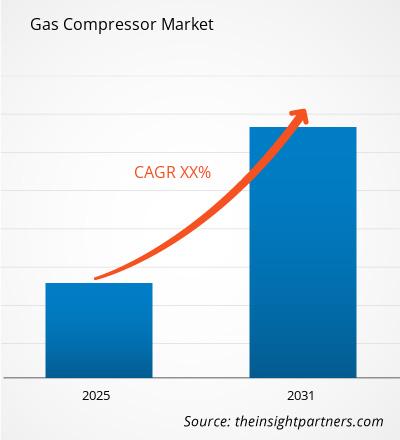
The Gas Compressor Market size is expected to reach US$ 17.32 Billion by 2034 from US$ 13.19 Billion in 2025. The global market is expected to grow at a CAGR of 3.07% from 2026 to 2034.
The latest released Gas Compressor Market study has evaluated the future growth potential of the global market and provides information and useful stats on market structure and size. The report is intended to provide Gas Compressor industry intelligence and strategic insights to help decision-makers make sound investment decisions and identify potential gaps and growth opportunities.
Get Sample Copy @ https://www.theinsightpartners.com/sample/TIPRE00029588
Additionally, the Gas Compressor report also identifies and analyses changing dynamics and emerging trends, along with essential drivers, challenges, opportunities, and restraints in the market.
Key Players Analysis:
Ariel Corporation
Atlas Copco AB
BAUER COMP Holding GmbH
Burckhardt Compression AG
General Electric
Hitachi Ltd.
HMS HYDRAULIC MACHINES & SYSTEMS GROUP PLC
Howden Group
Ingersoll Rand Inc.
Siemens AG
The Gas Compressor market report offers manufacturers, new businesses, and supply-chain stakeholders a structured assessment of industry sales and pricing performance. It provides insights into revenue, sales volume, and average selling prices across the total Gas Compressor market, with further analysis of individual companies, product types, applications, and regional markets.
Market Segmentation:
- Type (Positive Displacement, Dynamic Displacement)
- Industry Vertical (Oil and Gas, Power Sector, Petrochemical and Chemical Industries, Industrial Gases)
Gas Compressor Market Dynamics, Regional Outlook, and Future Analysis –
Market Drivers –
The gas compressor market is driven by natural gas production, pipeline transportation, gas processing, storage, refining, and industrial applications. Compressors maintain pressure and move gas through gathering systems, transmission pipelines, distribution networks, and processing facilities. Demand is influenced by energy infrastructure investment, LNG projects, industrial gas consumption, and the need to maintain flow rates as production conditions and pipeline requirements change.
Market Challenges –
Challenges include high capital and maintenance costs, energy consumption, mechanical wear, vibration, noise, and the need to prevent gas leakage. Compressor selection depends on gas composition, pressure ratios, flow requirements, and operating conditions. Volatile energy investment, raw material costs, skilled labor shortages, and increasingly stringent emissions requirements can influence project economics and equipment design.
Market Opportunities –
Opportunities include high-efficiency compressors, electric-drive systems, digital condition monitoring, low-emission equipment, and upgrades for existing pipelines and processing plants. Demand may grow in hydrogen blending, carbon capture and storage, and other emerging gas infrastructure applications where equipment compatibility is established. Suppliers can expand predictive maintenance, service contracts, and retrofit solutions that improve reliability and reduce unplanned downtime.
Regional Analysis –
North America benefits from extensive gas production, pipeline networks, and processing infrastructure. The Middle East is supported by gas development and industrial investment. Asia Pacific demand is influenced by gas imports, pipeline construction, LNG infrastructure, and industrialization. Europe has requirements linked to gas transportation, storage, and energy infrastructure modernization. Other regions offer opportunities as gas networks and processing capacity expand.
Future Analysis and Forecast –
The market is expected to be shaped by gas infrastructure investment, efficiency requirements, and demand for reliable equipment. Future development may emphasize variable-speed drives, advanced sealing systems, digital diagnostics, electrification, and reduced methane leakage. New applications involving hydrogen and carbon management could create opportunities, but adoption will depend on material compatibility, operating specifications, regulation, and project economics.
Recent Industry Developments –
Industry trends include development of energy-efficient compressor designs, digital monitoring, predictive maintenance, and improved sealing technologies. Operators are focusing on reliability, emissions reduction, and lifecycle operating costs. Compressor suppliers are also evaluating equipment needs for evolving gas infrastructure, including hydrogen-related and carbon management applications where technically appropriate.
Get Full Copy of This Report @ https://www.theinsightpartners.com/buy/TIPRE00029588
Gas Compressor Market Forecast
Overall, this Gas Compressor report provides a comprehensive perspective on the industry’s current performance, competitive landscape, and long-term development potential. By examining key trends, regional dynamics, growth opportunities, and emerging challenges, the study offers valuable insights into the factors shaping the future of the Gas Compressor market. These findings help manufacturers, investors, new entrants, and other industry stakeholders identify strategic priorities, assess business opportunities, strengthen their Gas Compressor market positioning, and develop informed strategies aligned with evolving industry requirements and future growth prospects.
About Us
The Insight Partners provide comprehensive analysis and insights into market trends that empower businesses to make informed decisions. Our reports are designed to equip stakeholders with the necessary information to navigate the complexities of various industries, including healthcare, technology, and finance. We are dedicated to delivering high-quality research that enables our clients to achieve their strategic objectives.
Contact Us:
Contact Person: Ankit Mathur
E-mail: ankit.mathur@theinsightpartners.com
Phone: +1-646-491-9876
