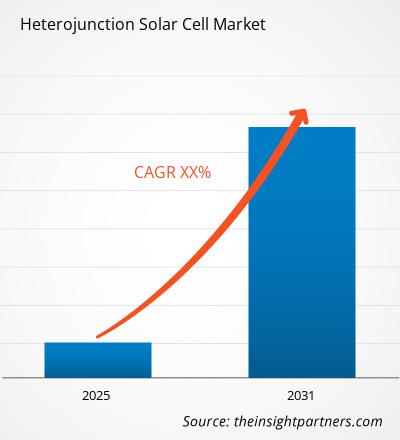
According to the latest market analysis published by The Insight Partners, the Heterojunction Solar Cell Market was valued at approximately US$ 1.7 Billion in 2025 and is projected to reach US$ 4.79 Billion by 2034, registering a CAGR of 12.22% from 2026 to 2034.
The Heterojunction Solar Cell Market Research study enhances the decision-making capabilities and helps to create potent counter-strategies to obtain a competitive advantage, says a latest research report at The Insight Partners. The Heterojunction Solar Cell Market analysis is provided for the international markets, including development trends, competitive landscape analysis, and key regions’ development status.
Receive Sample Copy @ https://www.theinsightpartners.com/sample/TIPRE00029563
Key Players Analysis:
Solar Electric Supply, Inc.
Meyer Burger Technology AG
Zhejiang Dongshuo New Energy Co, Ltd
KANEKA CORPORATION
Hanergy Thin Film EME B.V.
Hevel
CETC Solar Energy Holdings Co., Ltd.
JINERGY
Enel Spa
HELIENE Inc.
The market players from Heterojunction Solar Cell Market are anticipated to have lucrative growth opportunities in the future with the rising demand for Heterojunction Solar Cell in the global market.
Heterojunction Solar Cell Market Dynamics, Regional Analysis, and Future Outlook –
Regional Analysis:
Asia Pacific leads manufacturing activity, particularly through solar supply chains in China and Japan, while India is expanding its photovoltaic manufacturing capabilities. Europe supports adoption through renewable energy targets and demand for high-efficiency modules. North America offers opportunities through utility-scale and distributed solar installations. Other regions may adopt the technology as module availability, project financing, and renewable energy investment improve.
Market Drivers:
The heterojunction solar cell market is driven by demand for high-efficiency photovoltaic technology, increasing solar power installations, and the need to maximize electricity generation from limited installation space. Heterojunction technology combines crystalline silicon with thin amorphous silicon layers to reduce recombination losses and improve conversion efficiency. Growing investment in residential, commercial, and utility-scale solar projects supports interest in high-performance modules.
Market Opportunities:
Opportunities include high-efficiency rooftop modules, premium utility-scale installations, bifacial solar panels, and integration with building-integrated photovoltaics. Manufacturers can improve production yields, develop larger-format wafers, and optimize cell-to-module designs. Demand for high power output and improved temperature performance may support adoption in space-constrained installations and markets where lifetime energy generation is a key purchasing consideration.
Market Challenges:
Challenges include high manufacturing capital expenditure, complex production processes, specialized equipment requirements, and competition from TOPCon and other photovoltaic technologies. Maintaining high yields and controlling material costs can be difficult during capacity expansion. Technology adoption also depends on module pricing, reliability validation, manufacturing scale, and the ability to demonstrate sufficient lifecycle advantages over competing cell architectures.
Recent Industry Developments:
Industry trends include improvements in heterojunction cell manufacturing, bifacial module designs, wafer processing, and cell-to-module integration. Solar manufacturers are evaluating advanced cell architectures to improve efficiency and reduce electricity generation costs. Product development increasingly emphasizes module reliability, temperature performance, and manufacturing scalability as competition among high-efficiency technologies intensifies.
Future Analysis and Forecast:
The market is expected to benefit from continued demand for high-efficiency solar modules, although competition among advanced cell technologies will influence adoption. Future development may focus on improved conversion efficiency, reduced production costs, better bifacial performance, and manufacturing yield optimization. Market expansion will depend on technology reliability, supply-chain maturity, module pricing, and the relative economics of heterojunction compared with alternative photovoltaic designs.
The research report provides an in-depth analysis of the market, including key growth drivers, opportunities, restraints, challenges, competitive strategies, and recent developments. It offers insights into the factors influencing market growth, evolving consumer behavior, industry dynamics, and potential barriers that may affect market expansion, helping readers gain a comprehensive understanding of the current market landscape and future growth prospects.
Market Segmentation:
- Product Type (Silicon Heterojunction Solar Cells, Hetero-Junction Double-Sided Solar Cell)
- Application (Photovoltaic Power Station, Residential)
Get Full Copy of This Report @ https://www.theinsightpartners.com/buy/TIPRE00029563
This report delivers an in-depth evaluation of the global Heterojunction Solar Cell market, exploring sales performance, revenue generation, pricing patterns, and the competitive positioning of major industry participants. It further examines Heterojunction Solar Cell industry developments across key geographic markets and assesses industry performance by product type and application.
About Us
The Insight Partners provide comprehensive analysis and insights into market trends that empower businesses to make informed decisions. Our reports are designed to equip stakeholders with the necessary information to navigate the complexities of various industries, including healthcare, technology, and finance. We are dedicated to delivering high-quality research that enables our clients to achieve their strategic objectives.
Contact Us:
Contact Person: Ankit Mathur
E-mail: ankit.mathur@theinsightpartners.com
Phone: +1-646-491-9876
