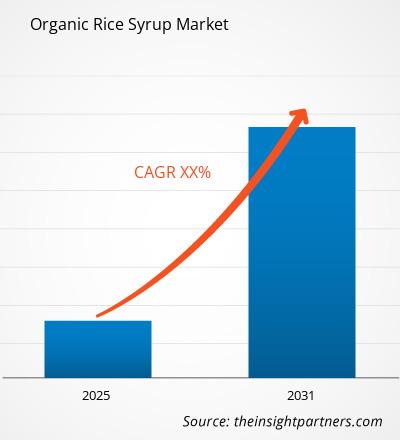
Sweetener shoppers are rewriting their lists, and rice is earning a place on them. Demand across the Organic Rice Syrup Market is building steadily, with valuation moving from US$ 16.87 million in 2025 to an expected US$ 28.26 million by 2034, a 5.9% CAGR over 2026-2034. That trajectory reflects a wider shift toward plant-based and clean-label ingredients, and the organic rice syrup market sits squarely inside it. Historic data from 2021 to 2024 sets the groundwork, while 2025 anchors the forecast.
What Is Organic Rice Syrup?
Organic rice syrup is a natural sweetener made by breaking down cooked rice starch with enzymes, then filtering and concentrating the liquid into a thick, amber syrup. Because the rice is certified organic, the product avoids synthetic pesticides and genetically modified inputs. Food makers value it for its mild flavour, its vegan profile and its role as an alternative to refined sugar and corn syrup.
Request a Sample Copy of the Report: https://www.theinsightpartners.com/sample/TIPRE00018916
What Is Driving Demand for the Organic Rice Syrup Market?
So what is pushing this niche ingredient forward? Start with the label. Shoppers read ingredient lists far more closely than they did a decade ago, and they reward products that look short, familiar and plant-derived. Organic rice syrup fits that brief neatly, which is why brands reformulating snack bars, cereals and baked goods keep adding it to their specifications. The organic rice syrup market benefits directly from every reformulation that swaps out a conventional sweetener.
Beyond that, the product earns its place on functional grounds. Organic rice syrup binds granola clusters, adds gentle sweetness without a dominant flavour, and helps retain moisture in baked items. Confectionery makers, beverage producers and infant and toddler food manufacturers also look to it when a neutral, plant-based sweetener is needed. This breadth of application gives the organic rice syrup market a steadier demand base than a single-use ingredient would offer.
Retail change plays its part too. Online stores now let small organic brands reach health-conscious buyers without securing shelf space in a national chain, and specialty stores continue to educate customers about alternative sweeteners. As these channels expand, organic rice syrup products become easier to find, compare and reorder. Higher visibility feeds repeat purchases, and repeat purchases keep manufacturers investing in capacity.
Cost remains the counterweight. Organic rice carries a premium over conventional rice, and certification adds compliance work for producers. Even so, a 5.9% CAGR suggests that buyers see enough value in the organic claim to absorb the price difference. For suppliers that manage sourcing well, the organic rice syrup market rewards consistency.
Segmentation Overview
The report examines the organic rice syrup market by source, distribution channel and geography.
By Source: Brown Rice and White Rice. Brown rice syrup keeps a deeper colour and a more pronounced, slightly nutty character, and it appeals to brands positioning around wholegrain or minimally processed credentials. White rice syrup is lighter and more neutral, which suits recipes where sweetness must not alter flavour or appearance. Manufacturers choose between the two according to taste targets, colour requirements and price.
By Distribution Channel: Supermarkets and Hypermarkets, Convenience Store, Specialty Stores, Online Stores and Others. Supermarkets and hypermarkets give organic rice syrup broad household reach, while convenience stores serve quick, small-pack purchases. Specialty stores attract informed shoppers who seek out organic and free-from lines, and online stores offer the widest assortment along with subscription convenience. The remaining channels cover foodservice and direct supply arrangements.
By Geography: North America, Europe, Asia Pacific, and South and Central America, each covered in the regional outlook below.
Key Market Players
- ABF Ingredients
- ADM
- Axiom Foods
- California Natural products (CNP)
- Cargill Incorporated
- Gulshan Polyols Ltd.,
- Nature’s One, Inc.
- Suzanne’s Specialties
- Wuhu Deli Foods Co. Ltd.
- Wuhu Haoyikuai Food Co. Ltd.
The competitive field in the organic rice syrup market blends global ingredient majors with specialist natural-food suppliers. Large players such as ADM and Cargill Incorporated bring scale, sourcing reach and established relationships with food manufacturers. Specialists including Suzanne’s Specialties, Axiom Foods and Nature’s One, Inc. compete on organic credentials and application support, while Asian producers such as Wuhu Deli Foods Co. Ltd. and Wuhu Haoyikuai Food Co. Ltd. draw strength from proximity to rice supply. Product quality, certification and reliable delivery decide most contracts.
Sustainability and Innovation Trends
Sustainability is becoming a selling point rather than a side note in the organic rice syrup market. Organic farming practices, traceable rice supply and responsible processing all feature more prominently in buyer conversations, particularly among brands that publish their own environmental targets. Suppliers that can document origin and certification hold a clear advantage when tenders are decided.
Innovation is moving in parallel. Producers are refining enzymatic processes to deliver more consistent viscosity and sweetness, and they are developing powdered and low-sugar variants to widen the range of food applications. Moreover, manufacturers are exploring ways to use rice by-products more fully, which supports both cost control and waste reduction. Expect these efforts to shape the next phase of the organic rice syrup market through 2034.
Buy Premium Report: https://www.theinsightpartners.com/buy/TIPRE00018916
Regional Outlook
North America is a mature, demand-led region where organic and free-from products enjoy strong retail support, and where established brands continue to reformulate toward cleaner labels. Europe follows a similar pattern, backed by firm organic regulation and consumer trust in certified products. Asia Pacific combines abundant rice supply with growing domestic interest in natural sweeteners, making it central to both production and future consumption. South and Central America is smaller but developing, as organic retail and online channels widen access to specialty ingredients.
Related Reports:
Sodium Benzoate Market Demand, Share & Growth by 2034
Aroma Chemicals Market Trends, Size & Forecast by 2034
Phosphate Salts Market Growth, Size, Share, Trends, Key Players and Forecast by 2034
About The Insight Partners
The Insight Partners is among the leading market research and consulting firms in the world. We take pride in delivering exclusive reports along with sophisticated strategic and tactical insights into the industry. Reports are generated through a combination of primary and secondary research, solely aimed at giving our clientele a knowledge-based insight into the market and domain. This is done to assist clients in making wiser business decisions. A holistic perspective in every study undertaken forms an integral part of our research methodology and makes the report unique and reliable.
Contact Us:
If you have any queries about this report or if you would like further information, please contact us:
Phone: +1-646-491-9876
E-mail: sales@theinsightpartners.com
Also Available in: Korean | German | Japanese | French | Chinese | Italian | Spanish
