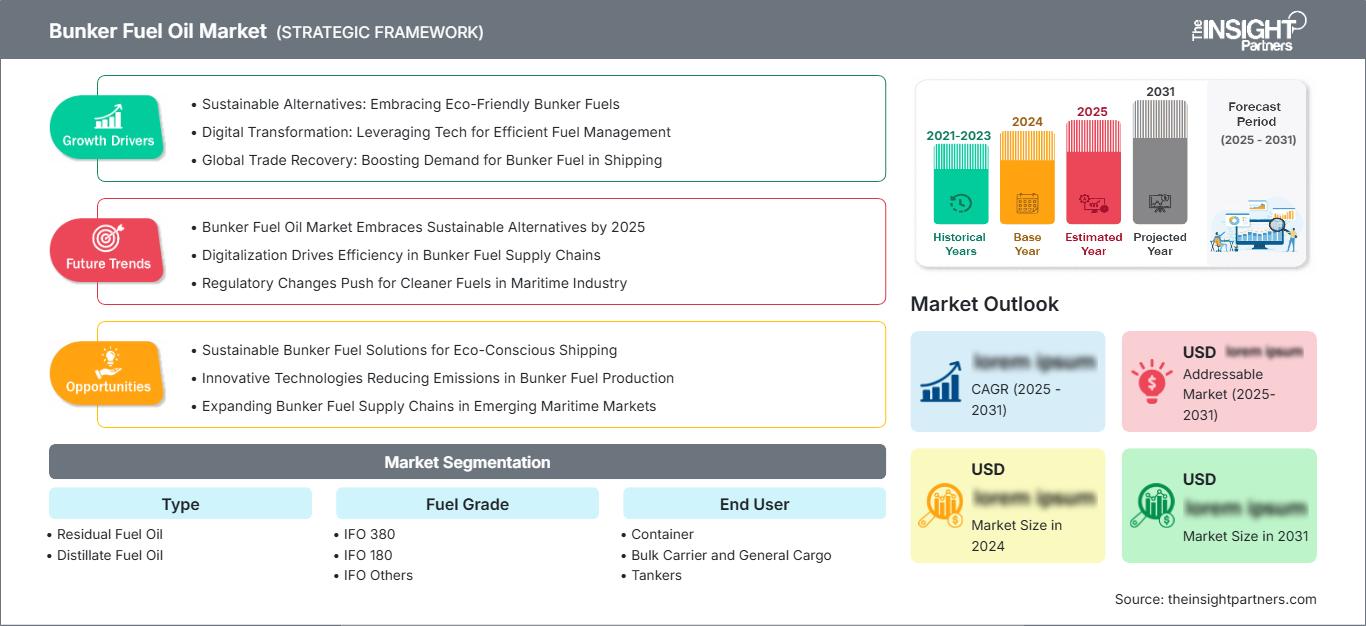
According to The Insight Partners, the Bunker Fuel Oil Market is expected to register a CAGR of 6.48% from 2026 to 2034, expanding from US$ 150.57 billion in 2025 to US$ 264.96 billion by 2034. This growth reflects the continuing importance of maritime transportation in international trade and the demand for reliable marine energy supplies. Increasing cargo movements, vessel activity, and the need to comply with international fuel-quality requirements are expected to influence market development throughout the forecast period.
The global Bunker Fuel Oil Market plays a vital role in the maritime industry by supplying the fuels required to power cargo vessels, container ships, tankers, cruise ships, and other marine transportation fleets. Bunker fuel oil is primarily used in marine engines and onboard power generation systems, making it an essential component of international shipping and global trade.
Download Sample PDF – https://www.theinsightpartners.com/sample/TIPRE00029499
The market is influenced by seaborne commerce, fleet expansion, port activities, and changes in maritime fuel regulations. As shipping companies seek to balance operational costs with environmental compliance, demand is evolving across conventional heavy fuel oil, marine gas oil, and lower-sulfur fuel alternatives. Technological improvements in vessel engines, fuel management, and emissions-control systems are also shaping purchasing decisions across the maritime sector.
Bunker Fuel Oil Market Analysis
The expansion of international trade is a major factor supporting the bunker fuel oil industry. Ships transport substantial volumes of raw materials, manufactured goods, agricultural products, and energy commodities between countries. As global supply chains depend on maritime logistics, shipping operators require dependable fuel supplies to maintain schedules and control transportation expenses. Bunker fuel suppliers therefore play an important role in supporting vessel operations at major ports and international shipping routes.
Another significant growth factor is the development of port infrastructure and marine fuel distribution networks. Ports with high vessel traffic create opportunities for bunker suppliers, refiners, and trading companies to expand storage, delivery, and fuel management services. Efficient bunkering operations help reduce vessel turnaround times and improve logistical performance. Digital fuel monitoring, improved delivery coordination, and enhanced fuel quality management are also contributing to changes in the competitive landscape.
Environmental regulations are transforming fuel demand across the industry. International maritime requirements governing sulfur emissions have increased the importance of compliant marine fuels. Ship operators may use low-sulfur fuel oil, marine gas oil, or approved emissions-control technologies, depending on vessel specifications, operating routes, and regulatory obligations. The adoption of scrubbers has also enabled some vessels to continue using higher-sulfur fuel oil where permitted. These differing compliance strategies create demand for multiple fuel categories rather than a single standardized product.
The transition toward lower-carbon shipping is creating additional opportunities and challenges. Liquefied natural gas, biofuels, methanol, and other alternative marine energy options are attracting attention as shipping companies assess pathways to reduce emissions. However, infrastructure availability, fuel pricing, engine compatibility, and supply reliability continue to influence adoption. Conventional bunker fuels are expected to remain important to many vessel operations during the transition, although the fuel mix may change over time.
Market participants must also manage crude oil price fluctuations, geopolitical uncertainty, shipping disruptions, and changing regional fuel requirements. These factors can affect procurement costs, margins, and the availability of marine fuels. Companies that maintain reliable supply networks, competitive pricing, and strong quality-control processes may be better positioned to respond to changing customer needs.
Bunker Fuel Oil Market Size, Share, Trends, Analysis, and Forecast by 2034
- Market Size and Forecast: The market is projected to increase from US$ 150.57 billion in 2025 to US$ 264.96 billion by 2034.
- Growth Rate: The market is expected to register a CAGR of 6.48% during 2026-2034, supported by maritime transportation and marine fuel demand.
- Market Trends: Demand for low-sulfur marine fuels, fuel optimization technologies, and alternative marine energy sources is influencing industry development.
- Growth Drivers: Expanding international trade, vessel traffic, port development, and the continued need for reliable shipping fuels support market growth.
- Market Opportunities: Investments in fuel distribution infrastructure, cleaner marine fuels, and digital bunkering services may create opportunities for industry participants.
- Market Challenges: Oil price volatility, environmental compliance costs, geopolitical disruptions, and competition from alternative fuels may affect market performance.
Key Players in the Bunker Fuel Oil Market
The competitive landscape includes integrated oil and gas companies, marine fuel suppliers, refiners, and specialized bunkering service providers. Market participants compete through fuel availability, product quality, pricing, global distribution capabilities, and customer relationships. Regulatory compliance and the ability to serve vessels across major shipping hubs remain important competitive factors.
Key players include:
- BP p.l.c.
- Exxon Mobil Corporation
- GAC Bunker Fuels Ltd.
- Gazprom Neft PJSC
- Gulf Nederland
- LUKOIL
- Neste Oyj
- Royal Dutch Shell plc
- Total S.A.
- World Fuel Services Corporation
These companies participate in different parts of the marine fuel value chain, including refining, trading, distribution, and bunkering services. Their market presence and activities vary across regions and product categories.
Regional Analysis
North America benefits from extensive port facilities, established petroleum supply networks, and strong maritime trade links. The United States is an important contributor, supported by commercial shipping, energy exports, and fuel distribution infrastructure. Canada also participates in the regional market through its coastal ports, shipping activities, and energy sector.
Europe is an important market due to its major shipping hubs, extensive intra-regional trade, and established marine fuel distribution networks. Regulatory requirements and decarbonization initiatives influence demand for compliant fuels and encourage investments in lower-emission alternatives. Ports serving international shipping routes remain important centers for bunkering activities.
Asia Pacific offers substantial opportunities because of its manufacturing base, export-oriented economies, and high levels of maritime trade. China, Singapore, South Korea, Japan, and India are important participants in regional shipping and marine fuel activities. Singapore, in particular, serves as a major international bunkering hub. Growing port capacity and vessel movements continue to support regional fuel demand.
The Middle East and Africa benefit from strategic shipping routes, energy production, and ports serving international commerce. The region’s role in oil exports and maritime logistics supports bunker fuel demand, although market conditions vary according to port infrastructure and regional trade activity.
South and Central America contribute through agricultural exports, energy shipments, commodity trade, and coastal shipping. Improvements in port facilities and marine fuel supply services may support further development, while economic conditions and fuel pricing remain important considerations.
Future Outlook
The Bunker Fuel Oil Market is expected to expand through 2034 as maritime transportation continues to support global trade. Demand will be influenced by shipping volumes, oil prices, regulatory requirements, and the availability of compliant marine fuels. At the same time, the gradual adoption of alternative fuels and emissions-reduction technologies will reshape the industry’s long-term development. Companies that combine reliable supply, efficient bunkering services, fuel quality assurance, and adaptability to changing environmental standards may be well positioned to capitalize on emerging opportunities.
Get Premium Market Research Report Here: https://www.theinsightpartners.com/buy/TIPRE00029499
About Us
The Insight Partners is a one stop industry research provider of actionable intelligence. We help our clients in getting solutions to their research requirements through our syndicated and consulting research services. We specialize in industries such as Semiconductor and Electronics, Aerospace and Defense, Automotive and Transportation, Biotechnology, Healthcare IT, Manufacturing and Construction, Medical Device, Technology, Media and Telecommunications, Chemicals and Materials.
Contact Us
Ankit Mathur | The Insight Partners
E-mail: ankit.mathur@theinsightpartners.com
Phone: +1-646-491-9876
Also Available in : Korean | German | Japanese | French | Chinese | Italian | Spanish
