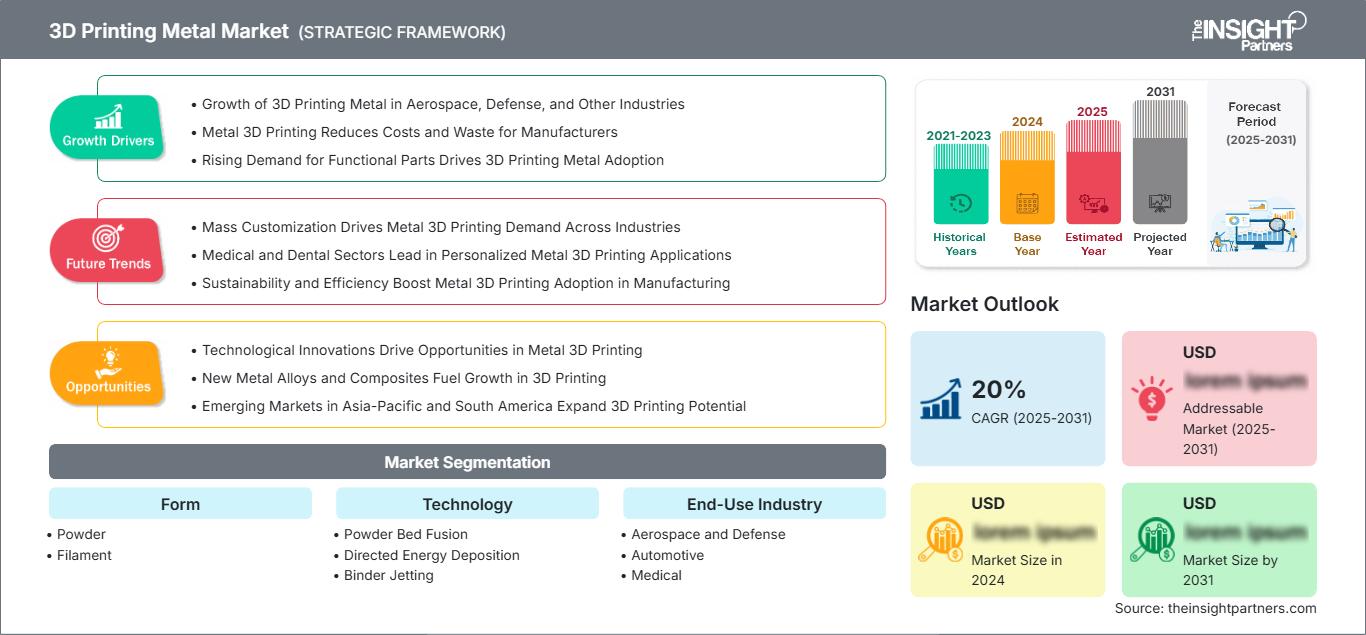
Factories are learning to grow parts instead of cutting them. The 3D Printing Metal Market is expected to reach US$ 3.29 billion by 2031, registering an 18.4% CAGR during 2025 to 2031. Few industrial technologies are expanding at that pace. The released report uses historic data from 2021 to 2023 and treats 2024 as the base year. It examines the 3D printing metal industry by metal type, form, end-use industry and geography, giving manufacturers and suppliers a clear map of where adoption is rising.
What Is Metal 3D Printing?
Metal 3D printing, also called metal additive manufacturing, builds parts layer by layer from metal powder, wire or filament using lasers, electron beams or binders. It can create complex internal channels, lightweight lattices and consolidated assemblies that traditional machining cannot achieve. The result is less material waste and faster design changes.
Request a Sample Copy of the Report: https://www.theinsightpartners.com/sample/TIPTE100000391
What Is Driving Demand for 3D Printing Metal?
Aerospace and defence lead the way. Engineers value lighter parts that cut fuel use, and printing lets them merge many components into one stronger piece. Prototype and low-volume production runs also become faster and cheaper when no tooling is required.
Healthcare is a second engine. Titanium and other biocompatible alloys can be printed into patient-specific implants, surgical guides and dental parts, with shapes matched to individual anatomy. Hospitals and device makers see better fit and shorter lead times.
Automotive firms are joining in. They use metal printing for rapid prototyping, lightweight brackets, tooling and performance parts, and electric vehicle programmes add pressure to reduce weight. As machine costs fall and build speeds rise, printed parts move from labs toward regular production.
What makes this particularly significant is the shift in supply chains. Companies can hold digital files instead of physical stock and print spare parts close to where they are needed. That flexibility reduces inventory and shields operations from shipping delays.
Segmentation Overview: Metals, Forms and End Uses
By Metal Type: The metal type segment covers Titanium, Nickel, Stainless Steel, Aluminum and Others. Titanium offers strength with low weight and biocompatibility, while nickel alloys withstand extreme heat. Stainless steel and aluminium bring affordability and versatility to everyday industrial parts.
By Form: The form segment includes Powder, Filament and Others. Powder is the backbone of laser and electron beam systems because it spreads evenly and fuses precisely. Filament suits more accessible extrusion-based machines that appeal to smaller workshops.
By End-Use Industry: The end-use segment spans Aerospace & Defense, Automotive, Medical, Construction and Others. Aerospace and medical users demand certified, high-performance parts, while automotive and construction users look for speed, customisation and lower weight.
By Geography: The report tracks North America, Europe, Asia Pacific, and South and Central America. Industrial strength, research funding and manufacturing policy differ across these regions, which shapes the pace of adoption.
Key Market Players in the 3D Printing Metal Market
- Stratasys
- CRS Holdings, LLC.
- Materialise
- Sandvik AB
- Höganäs AB
- EOS
- Desktop Metal, Inc.
- SLM Solutions
- Sculpteo
- Markforged
The group spans printer makers, powder suppliers, software firms and service bureaus. EOS, SLM Solutions, Desktop Metal, Inc. and Markforged are tied closely to printing systems, while Sandvik AB and Höganäs AB supply the metal powders that feed them. Materialise and Sculpteo add software and on-demand production services that lower the barrier for new users.
Sustainability and Innovation Trends in Metal Additive Manufacturing
Sustainability is a strong selling point. Printing uses material close to the final shape, which cuts scrap, and lighter parts reduce energy use in aircraft and vehicles. Recycled metal powders and powder reuse practices are gaining attention as buyers look at the full footprint.
Technology keeps advancing. Faster multi-laser systems, better quality monitoring and tighter control of powder properties improve consistency and bring down cost per part. Qualification standards are maturing too, which helps regulated sectors such as aerospace and medicine adopt printed parts with confidence.
Buy Premium Report: https://www.theinsightpartners.com/buy/TIPTE100000391
Regional Outlook for the 3D Printing Metal Market
North America and Europe benefit from strong aerospace, defence and medical device sectors, along with established printer and powder suppliers. Research institutes and industrial partnerships in these regions speed up qualification of new alloys and processes.
Asia Pacific combines large manufacturing bases with growing government support for advanced production, so adoption is expanding across automotive and electronics. South and Central America is at an earlier stage, though rising industrial investment and service providers are widening access.
Related Reports:
Metal Powder Market Size, Growth & Demand by 2034
Titanium Powder Market Demand, Trends & Forecast by 2034
About The Insight Partners
The Insight Partners is among the leading market research and consulting firms in the world. We take pride in delivering exclusive reports along with sophisticated strategic and tactical insights into the industry. Reports are generated through a combination of primary and secondary research, solely aimed at giving our clientele a knowledge-based insight into the market and domain. This is done to assist clients in making wiser business decisions. A holistic perspective in every study undertaken forms an integral part of our research methodology and makes the report unique and reliable.
Contact Us:
If you have any queries about this report or if you would like further information, please contact us:
Phone: +1-646-491-9876
E-mail: sales@theinsightpartners.com
Also Available in: Korean | German | Japanese | French | Chinese | Italian | Spanish
