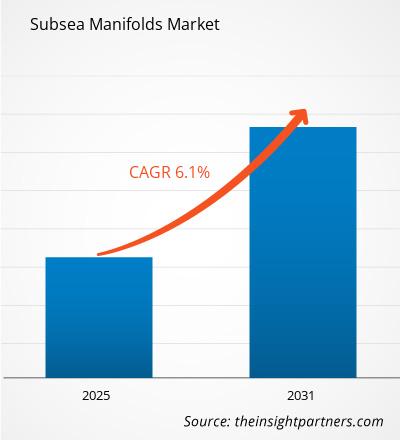
The Subsea Manifolds Market was valued at US$ 7.19 Billion in 2025 and is projected to reach US$ 13.1 Billion by 2034, expanding at a CAGR of 6.89% during 2026–2034. The market covers subsea flow-distribution and gathering equipment used to connect multiple wells, route production and injection fluids, and link subsea production systems with pipelines and host facilities. Demand is shaped by deepwater developments, brownfield tiebacks, field-life extension, and growing standardization of subsea architectures.
Market Scope and Structure
The market is segmented by type into Template Manifold, Cluster Manifold, and Pipeline End Manifold (PLEM). By application, it covers onshore and offshore uses. Template manifolds hold about 42% share in 2025 and are projected to grow at roughly 6% through 2034. Cluster manifolds are expected to grow faster, at around 8%, as operators look for flexible well tiebacks and compact gathering arrangements for deepwater and satellite fields. Offshore applications account for about 76% of the market and are expected to grow at around 7%, while onshore uses are projected to grow at about 4%.
Download Sample Report: https://www.theinsightpartners.com/sample/TIPRE00008418
Regional Performance
North America held about 31% of global share in 2025 and is expected to grow at roughly 6% through 2034. The US accounts for about 82% of regional revenue, supported by Gulf of Mexico deepwater fields and established offshore service capabilities. Europe represented about 29% of the global market, led by Norway, with the UK and other countries contributing through engineering and specialized supply chains. Asia Pacific, at about 25% share, is the fastest-growing major region at roughly 8%, driven by offshore activity in China, Australia, Indonesia, Malaysia, and India. Middle East & Africa is expected to grow at about 7%, supported by West African deepwater resources and emerging offshore provinces.
What Is Powering Demand
Deepwater and tieback development is a core driver. A manifold can consolidate several wells into a common production pathway, which simplifies installation and improves use of existing processing capacity. Standardization and integrated project delivery also matter, since configure-to-order equipment and repeatable designs shorten engineering cycles. Brownfield revitalization adds further demand, because connecting new reservoirs to existing platforms is often more economical than building new host infrastructure.
Shifts Shaping the Industry
Competition is moving beyond hardware features toward standardization, engineering integration, manufacturing capability, installation strength, and lifecycle support. Future projects are expected to place heavier technical demands on manifolds as fields move into deeper waters, longer tiebacks, and higher pressures. Manifolds may increasingly operate alongside subsea boosting, compression, and water injection, which favors suppliers with multidisciplinary engineering strength.
Growth Opportunities
Expanding offshore activity in Asia Pacific, Africa, and other emerging regions opens the door to regional manufacturing, assembly, and service hubs, especially where local-content expectations apply. Lifecycle and brownfield support also offers promise, covering inspection, repair, modification, and integration with additional wells. Digital monitoring and condition-based maintenance can strengthen long-term service relationships.
Recent Industry Moves
In September 2026, Subsea 7 S.A. announced an extension from Turkish Petroleum Offshore Technology Center for the Sakarya Phase 3 development offshore Türkiye. In the same month, TechnipFMC plc announced a significant iEPCI contract from PETRONAS Carigali for the Limbayong deepwater project offshore Malaysia, using its Subsea 2.0 configure-to-order platform. In May 2026, Aker Solutions ASA received a FEED contract from Equinor for the Atlantis subsea tie-in in the northern North Sea.
Key Players
The competitive landscape includes the following companies:
- ABB Limited
- Aker Solutions ASA
- Baker Hughes, a GE Company LLC
- Dril-Quip, Inc.
- Halliburton Company
- McDermott
- Schlumberger Limited
- Subsea 7 S.A.
- TechnipFMC plc
- Trendsetter Engineering
Get Full Copy of This Report @ https://www.theinsightpartners.com/buy/TIPRE00008418
Future Outlook
The market is positioned for healthy growth as operators continue to favor infrastructure reuse, standardized architectures, and integrated delivery models. Rising deepwater investment in Brazil, Guyana, Africa, Australia, and Southeast Asia is expected to create demand for high-specification subsea production systems. Over time, the line between standalone manifold suppliers and integrated subsea-system providers may blur, as operators evaluate complete production architectures rather than individual components. Companies that combine compact, interoperable designs with strong installation and lifecycle capabilities are likely to be best placed to capture growth through 2034.
Related Reports:
Electric commercial vehicle market Trends, Size & Forecast by 2034
Electric heat tracing market Share, Demand & Growth by 2034
About Us
The Insight Partners is a leading global market research and consulting firm specializing in delivering actionable insights across various industries. Our research reports combine extensive primary and secondary research to provide accurate market intelligence, helping businesses make informed strategic decisions. The company provides detailed analysis on emerging technologies, market trends, competitive landscapes, and growth opportunities across sectors including technology, healthcare, manufacturing, and energy.
Contact Us:
Contact Person: Ankit Mathur
Email: ankit.mathur@theinsightpartners.com
Phone: +1-646-491-9876
Also Available in : Korean |German |Japanese |French |Chinese |Italian |Spanish
