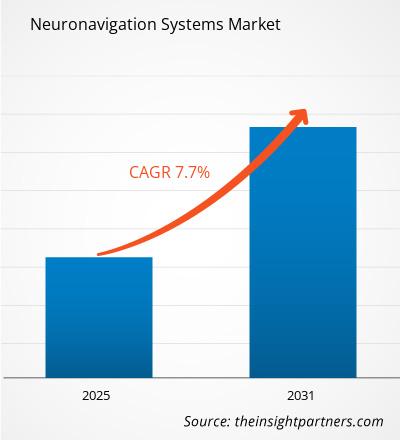
According to the latest market analysis published by The Insight Partners, the Neuronavigation Systems Market was valued at approximately US$ 2.71 Billion in 2024 and is projected to reach US$ 5.24 Billion by 2031, registering a CAGR of 9.9% from 2025 to 2031.
The Neuronavigation Systems Market Research study enhances the decision-making capabilities and helps to create potent counter-strategies to obtain a competitive advantage, says a latest research report at The Insight Partners. The Neuronavigation Systems Market analysis is provided for the international markets, including development trends, competitive landscape analysis, and key regions’ development status.
Receive Sample Copy @ https://www.theinsightpartners.com/sample/TIPHE100001424
Key Players Analysis:
ClaroNav
Parsiss Co.
Stryker
Brainlab AG
Heal Force
Atracsys LLC
Northern Digital Inc.
SURGICAL THEATER, LLC
Micromar Ind. e Com. LTDA
Shenzhen Anke High-tech Co., Ltd.
The market players from Neuronavigation Systems Market are anticipated to have lucrative growth opportunities in the future with the rising demand for Neuronavigation Systems in the global market.
Neuronavigation Systems Market Dynamics, Regional Analysis, and Future Outlook –
Regional Analysis:
North America benefits from advanced neurosurgical facilities, research activity, and access to sophisticated surgical technologies. Europe is supported by specialist hospitals and established image-guided surgery practices. Asia Pacific offers growth opportunities as tertiary hospitals expand their neurosurgical capabilities. Adoption across Latin America and the Middle East and Africa will depend on capital investment, specialist availability, and access to maintenance and technical support.
Market Drivers:
The neuronavigation systems market is propelled by rising demand for precision in brain and spinal surgery, increasing use of image-guided neurosurgical procedures, and continued development of advanced operating rooms. These systems help surgeons relate preoperative imaging to patient anatomy during selected procedures. Growing attention to surgical planning, accuracy, and minimally invasive approaches supports the use of navigation platforms across specialized neurosurgical centers.
Market Opportunities:
Opportunities include integration with robotic surgery, intraoperative imaging, augmented reality, and advanced surgical planning software. Demand may also develop for platforms that support spinal procedures and provide streamlined workflows across multiple surgical specialties. Emerging healthcare markets offer potential as hospitals invest in advanced operating room infrastructure and specialist training programs.
Market Challenges:
High acquisition and maintenance costs can limit adoption, particularly in smaller hospitals. Registration errors, patient movement, equipment calibration, and workflow complexity can affect system performance. Successful implementation requires staff training and compatibility with imaging and surgical equipment. Regulatory requirements, technology upgrades, and the need to demonstrate clinical value also influence purchasing decisions.
Recent Industry Developments:
Technology development increasingly focuses on combining navigation with intraoperative imaging, robotic assistance, and three-dimensional visualization. Manufacturers are refining tracking accuracy, planning software, and operating room integration. Product evolution also emphasizes easier workflows and compatibility with evolving neurosurgical instruments and imaging platforms.
Future Analysis and Forecast:
Future growth is likely to reflect continued investment in precision surgery and the integration of navigation with imaging, robotics, and digital operating room systems. More intuitive interfaces and improved intraoperative visualization may broaden clinical utility. Adoption will depend on measurable surgical benefits, system interoperability, training, and the financial ability of hospitals to maintain advanced equipment.
The research report provides an in-depth analysis of the market, including key growth drivers, opportunities, restraints, challenges, competitive strategies, and recent developments. It offers insights into the factors influencing market growth, evolving consumer behavior, industry dynamics, and potential barriers that may affect market expansion, helping readers gain a comprehensive understanding of the current market landscape and future growth prospects.
Market Segmentation:
- Type (Electromagnetic System and Optical System)
- Application (Neurosurgery, ENT Surgery, Spinal Surgery, Maxillofacial Surgery) Source: https://www.theinsightpartners.com/reports/neuronavigation-systems-market
Get Full Copy of This Report @ https://www.theinsightpartners.com/buy/TIPHE100001424
This report delivers an in-depth evaluation of the global Neuronavigation Systems market, exploring sales performance, revenue generation, pricing patterns, and the competitive positioning of major industry participants. It further examines Neuronavigation Systems industry developments across key geographic markets and assesses industry performance by product type and application.
About Us
The Insight Partners provide comprehensive analysis and insights into market trends that empower businesses to make informed decisions. Our reports are designed to equip stakeholders with the necessary information to navigate the complexities of various industries, including healthcare, technology, and finance. We are dedicated to delivering high-quality research that enables our clients to achieve their strategic objectives.
Contact Us:
Contact Person: Ankit Mathur
E-mail: ankit.mathur@theinsightpartners.com
Phone: +1-646-491-9876
