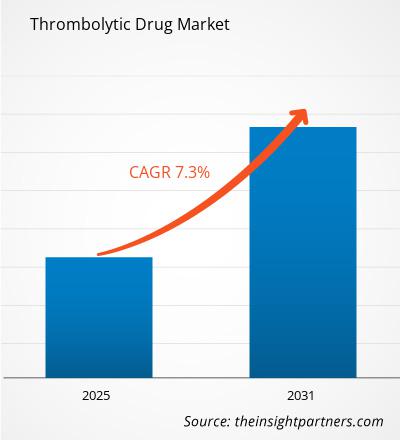
According to the latest market analysis published by The Insight Partners, the Thrombolytic Drug Market was valued at approximately US$ 1.73 Billion in 2025 and is projected to reach US$ 7.31 Billion by 2034, registering a CAGR of 17.38% from 2026 to 2034.
The Thrombolytic Drug Market Research study enhances the decision-making capabilities and helps to create potent counter-strategies to obtain a competitive advantage, says a latest research report at The Insight Partners. The Thrombolytic Drug Market analysis is provided for the international markets, including development trends, competitive landscape analysis, and key regions’ development status.
Receive Sample Copy @ https://www.theinsightpartners.com/sample/TIPRE00018531
Key Players Analysis:
Bristol-Myers Squibb Company
AstraZeneca plc.
Eli Lilly and Company
C.H Boehringer Sohn AG & ko. KG
Aspen Holdings
Eumedica
Genentech
Microbix
Taj Pharmaceuticals Ltd.
Syner-Medica
The market players from Thrombolytic Drug Market are anticipated to have lucrative growth opportunities in the future with the rising demand for Thrombolytic Drug in the global market.
Thrombolytic Drug Market Dynamics, Regional Analysis, and Future Outlook –
Regional Analysis:
North America benefits from advanced emergency care networks and established stroke and cardiovascular treatment centers. Europe is supported by organized acute care pathways and specialist hospitals. Asia Pacific offers opportunities as emergency response and stroke care systems develop, although access varies widely. Latin America and the Middle East and Africa face differences in diagnostic capacity, specialist availability, and timely access to thrombolytic medicines.
Market Drivers:
The thrombolytic drug market is driven by the need for rapid treatment of selected life-threatening conditions involving blood clots, including acute ischemic stroke, certain myocardial infarctions, and pulmonary embolism. Clinical demand is influenced by emergency care capacity, disease recognition, and established treatment protocols. Advances in stroke systems of care and improvements in emergency medical response also affect access to thrombolytic treatment.
Market Opportunities:
Opportunities include agents with improved administration convenience, suitable treatment windows, and optimized safety profiles. Better prehospital recognition of eligible patients and stronger coordination between emergency services and hospitals may support timely treatment. Research into clot-targeting approaches and improved patient selection may also influence future development, subject to evidence and regulatory approval.
Market Challenges:
Major challenges include the risk of serious bleeding, strict eligibility criteria, and the limited time available for treatment in many indications. Accurate diagnosis and exclusion of contraindications are essential. The availability of mechanical thrombectomy and other interventions can affect treatment choices. High clinical responsibility, treatment infrastructure requirements, and differences in emergency care access also influence utilization.
Recent Industry Developments:
Industry and clinical research continue to evaluate thrombolytic agents, treatment protocols, and approaches to shorten delays in emergency care. Health systems emphasize faster stroke recognition and coordinated hospital response. Development priorities include evaluating safety, treatment eligibility, and practical administration within evidence-based protocols.
Future Analysis and Forecast:
Future market development will depend on improved delivery of emergency treatment, ongoing evidence on safety and effectiveness, and advances in patient selection. Formulation and administration improvements may support clinical workflow, while competing interventions will continue to shape use by indication. Market prospects will be influenced by clinical guidelines, hospital capabilities, drug availability, and the balance between rapid clot dissolution and bleeding risk.
The research report provides an in-depth analysis of the market, including key growth drivers, opportunities, restraints, challenges, competitive strategies, and recent developments. It offers insights into the factors influencing market growth, evolving consumer behavior, industry dynamics, and potential barriers that may affect market expansion, helping readers gain a comprehensive understanding of the current market landscape and future growth prospects.
Market Segmentation:
- Drug Type (Fibrin Specific Drugs, Non- Fibrin Specific)
- Application (Myocardial Infarction, Pulmonary Embolism, Deep vein thrombosis, Acute ischemic stroke)
Get Full Copy of This Report @ https://www.theinsightpartners.com/buy/TIPRE00018531
This report delivers an in-depth evaluation of the global Thrombolytic Drug market, exploring sales performance, revenue generation, pricing patterns, and the competitive positioning of major industry participants. It further examines Thrombolytic Drug industry developments across key geographic markets and assesses industry performance by product type and application.
About Us
The Insight Partners provide comprehensive analysis and insights into market trends that empower businesses to make informed decisions. Our reports are designed to equip stakeholders with the necessary information to navigate the complexities of various industries, including healthcare, technology, and finance. We are dedicated to delivering high-quality research that enables our clients to achieve their strategic objectives.
Contact Us:
Contact Person: Ankit Mathur
E-mail: ankit.mathur@theinsightpartners.com
Phone: +1-646-491-9876
