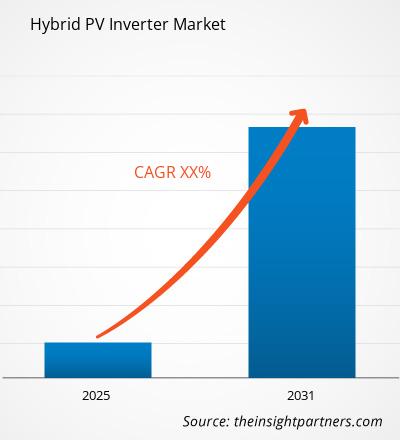
According to The Insight Partners, The Hybrid PV Inverter Market size is expected to reach US$ 24.13 Billion by 2034 from US$ 11.72 Billion in 2025. The market is estimated to record a CAGR of 8.36% from 2026 to 2034. This projected growth reflects the increasing integration of solar photovoltaic systems with battery storage, the need for more flexible electricity management, and the expansion of distributed renewable energy installations. Hybrid inverters are becoming an important component of modern solar systems because they help coordinate energy generation, storage, and consumption through a single integrated solution.
The global Hybrid PV Inverter Market is gaining momentum as the adoption of solar energy and energy storage technologies continues to expand. Hybrid photovoltaic (PV) inverters are designed to convert direct current (DC) electricity generated by solar panels into alternating current (AC) electricity while managing energy flows between solar installations, battery storage systems, and the electricity grid.
Download Sample PDF – https://www.theinsightpartners.com/sample/TIPRE00029460
These inverters enable users to store excess solar power for later use, improve energy self-consumption, and maintain electricity availability during grid disruptions when supported by suitable system configurations. Increasing investments in renewable energy, rising electricity costs, and growing demand for energy independence are creating favorable conditions for market expansion.
Hybrid PV Inverter Market Overview
Hybrid PV inverters play a significant role in improving the functionality of solar power installations. Unlike conventional grid-tied inverters, which primarily convert solar electricity for immediate use or export to the grid, hybrid inverters can also manage compatible battery storage systems. This capability allows households and businesses to store surplus solar energy and use it when solar generation is low or electricity demand increases.
The technology supports several operating modes, including self-consumption, battery charging, grid interaction, and backup power, depending on the inverter design and system configuration. These capabilities make hybrid PV inverters suitable for locations where electricity prices fluctuate, grid reliability is a concern, or users want to maximize the value of their solar installations.
Residential applications are an important area of demand as homeowners increasingly explore ways to reduce electricity bills and improve energy security. Commercial and industrial users are also evaluating hybrid systems to manage electricity costs, optimize on-site renewable generation, and improve operational resilience. As battery storage technologies become more widely available, the integration of solar generation and storage is expected to create additional opportunities for hybrid inverter manufacturers.
Key Market Drivers and Trends
Several factors are supporting the growth of the Hybrid PV Inverter Market. The increasing deployment of solar photovoltaic systems is creating demand for advanced inverter technologies that can support efficient electricity conversion and flexible energy management. Hybrid inverters help users optimize the utilization of generated solar power by coordinating electricity production, battery charging, and consumption.
Growing adoption of battery energy storage: The expansion of residential and commercial battery storage is a significant market trend. Hybrid inverters enable solar installations to work with compatible batteries, allowing users to store surplus electricity and use it during periods of low solar generation. This capability can improve energy self-consumption and reduce reliance on grid electricity.
Increasing focus on energy independence: Electricity price fluctuations and concerns about grid reliability are encouraging consumers and businesses to consider integrated solar and storage systems. Hybrid PV inverters support these installations by enabling coordinated energy management and, in compatible systems, backup power during outages.
Technological advancements: Manufacturers are developing inverters with improved conversion efficiency, smart monitoring, flexible operating modes, and enhanced connectivity. Integration with energy management platforms allows users to monitor system performance and make informed decisions about electricity consumption and storage.
Government initiatives and renewable energy targets: Policies supporting solar deployment, distributed generation, and energy storage can encourage investment in hybrid systems. However, the impact of incentives varies by country and depends on local regulations, installation costs, and program eligibility.
Key Players in the Hybrid PV Inverter Market
The following companies are identified as key players in the Hybrid PV Inverter Market:
- Flin Technologies Private Limited
- Luminous India
- MICROTEK
- Fujiyama Power Systems Pvt Ltd
- Havells India Ltd.
- SolaX Power
- Schneider Electric
- Delta Energy Systems
- Redback Technologies
- KACO New Energy
These companies compete through product innovation, inverter efficiency, system compatibility, product reliability, and distribution capabilities. Manufacturers are also focusing on monitoring features, integration with battery storage, and solutions suited to different installation sizes. Partnerships with solar installers and distributors can further support market reach. Competitive success depends on meeting local technical standards, providing dependable after-sales service, and adapting products to changing customer requirements.
Hybrid PV Inverter Market Size, Share, Trends, Analysis, and Forecast by 2034
- Market Size: The market is projected to increase from US$ 11.72 billion in 2025 to US$ 24.13 billion by 2034, reflecting growing demand for integrated solar and storage systems.
- Market Share: Market share is influenced by inverter performance, product reliability, pricing, battery compatibility, distribution networks, and brand reputation.
- Market Trends: Solar-plus-storage installations, smart energy monitoring, backup power capabilities, and advanced energy management are shaping market development.
- Market Analysis: Solar adoption, electricity costs, energy security requirements, and battery storage deployment are important factors influencing demand for hybrid PV inverters.
- Market Forecast: The market is estimated to record a CAGR of 8.36% from 2026 to 2034, supported by renewable energy investments and the expansion of distributed energy systems.
Regional Analysis
North America: North America is supported by residential solar installations, commercial renewable energy projects, and growing interest in battery storage. Demand for energy resilience and improved management of electricity consumption is creating opportunities for hybrid PV inverter manufacturers.
Europe: Europe offers growth opportunities through renewable energy targets, rooftop solar adoption, and increased integration of battery storage. Hybrid inverters can help households and businesses maximize solar self-consumption and manage electricity use more efficiently.
Asia Pacific: Asia Pacific is an important region for the hybrid PV inverter industry because of expanding solar installations, growing electricity demand, and the development of residential and commercial energy storage. Countries such as China, India, Japan, and Australia offer opportunities for manufacturers as solar power adoption and distributed energy systems expand.
South and Central America: Solar energy deployment and demand for reliable electricity are creating opportunities for hybrid PV inverter adoption. These systems can support households and businesses seeking to combine solar generation with battery storage, particularly where grid reliability or electricity costs influence purchasing decisions.
Middle East and Africa: High solar energy potential and increasing investment in renewable power provide opportunities for hybrid inverter installations. These technologies can support off-grid electrification, remote facilities, and locations where combining solar generation with energy storage improves electricity availability.
Challenges and Opportunities
Despite favorable growth prospects, the market faces challenges related to initial installation costs, battery system expenses, technical compatibility, and the availability of qualified installers. Hybrid PV systems may require careful configuration to ensure that inverters, batteries, solar panels, and electrical infrastructure operate together effectively. Differences in grid standards and local regulations can also affect product deployment.
At the same time, continued improvements in battery technology, inverter efficiency, and smart energy management present opportunities for manufacturers. Developing scalable solutions for residential, commercial, and industrial customers can help companies reach a broader customer base. Improved monitoring, simplified installation, and compatibility with different storage technologies may further strengthen product competitiveness.
Get Premium Market Research Report Here: https://www.theinsightpartners.com/buy/TIPRE00029460
Future Outlook
The Hybrid PV Inverter Market is expected to expand through 2034 as solar energy and battery storage become increasingly integrated into modern electricity systems. Demand for energy independence, lower electricity costs, and improved power resilience is likely to support the adoption of hybrid inverter technologies. Manufacturers that prioritize efficiency, reliability, battery compatibility, and intelligent energy management may be well positioned to benefit from future opportunities. Market performance will depend on solar deployment rates, storage costs, policy developments, and the pace of technological innovation.
About Us
The Insight Partners is a one-stop industry research provider of actionable intelligence. We help our clients address their research requirements through our syndicated and consulting research services. We specialize in industries such as Semiconductor and Electronics, Aerospace and Defense, Automotive and Transportation, Biotechnology, Healthcare IT, Manufacturing and Construction, Medical Device, Technology, Media and Telecommunications, and Chemicals and Materials.
Contact Us
Ankit Mathur | The Insight Partners
Email: ankit.mathur@theinsightpartners.com
Phone: +1-646-491-9876
Also Available in : Korean | German | Japanese | French | Chinese | Italian | Spanish
