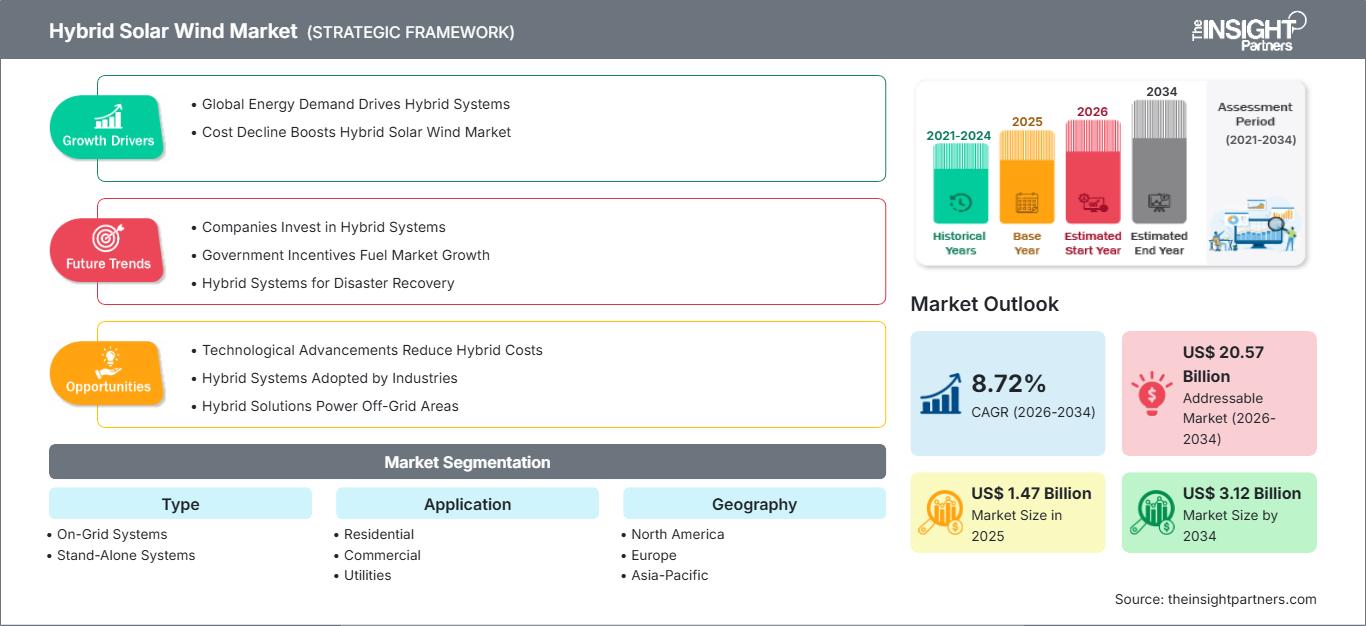
According to The Insight Partners, the Hybrid Solar Wind Market size is expected to reach US$ 3.12 Billion by 2034 from US$ 1.47 Billion in 2025. The market is anticipated to register a CAGR of 8.72% during the forecast period 2026-2034. This growth reflects increasing interest in renewable energy integration, improved energy management, and hybrid generation systems capable of delivering electricity under varying weather conditions.
Hybrid Solar Wind Market Size, Share, Trends, Analysis, and Forecast by 2034
- Market Size: The market is projected to grow from US$ 1.47 billion in 2025 to US$ 3.12 billion by 2034, driven by investments in integrated renewable energy infrastructure.
- Market Share: Market share is influenced by technology capabilities, project costs, regional renewable energy policies, and the presence of established equipment manufacturers and system integrators.
Download Sample PDF – https://www.theinsightpartners.com/sample/TIPRE00027566
- Market Trends: Key trends include battery energy storage integration, smart energy management, hybrid microgrids, and the deployment of renewable systems in remote and off-grid locations.
- Market Analysis: Market development depends on solar and wind resource availability, installation and maintenance costs, grid connectivity, financing conditions, and advances in power conversion technologies.
- Market Forecast: The market is expected to register a CAGR of 8.72% between 2026 and 2034, supported by the transition toward cleaner and more resilient electricity systems.
Overview of the Hybrid Solar Wind Market
Hybrid solar wind systems combine solar panels and wind turbines to generate electricity from two renewable sources within a coordinated power generation arrangement. Depending on project requirements, these systems may include batteries, inverters, charge controllers, monitoring equipment, and energy management software. Their configuration can be tailored to utility-scale installations, commercial facilities, rural electrification projects, telecommunications infrastructure, and isolated communities.
The primary advantage of combining solar and wind technologies is their complementary generation potential. Solar panels generally produce electricity during daylight hours, while wind turbines can generate power whenever wind conditions are suitable, including at night. Although actual output depends on local weather patterns and seasonal conditions, combining these resources can help balance electricity production and reduce reliance on a single energy source.
The integration of battery storage further enhances system flexibility by allowing surplus electricity to be stored for later use. This capability is particularly valuable in off-grid installations and locations where grid access is limited or electricity supply is inconsistent. As energy storage technologies and control systems improve, hybrid installations are becoming more adaptable to diverse energy requirements.
Key Market Growth Drivers
The growing emphasis on decarbonization is an important factor supporting the Hybrid Solar Wind Market. Governments, businesses, and utilities are seeking alternatives to fossil fuel-based generation to reduce greenhouse gas emissions and diversify their energy portfolios. Hybrid renewable systems offer an approach to increasing clean electricity generation while potentially improving the utilization of available renewable resources.
Rising electricity demand is another significant growth driver. Industrial expansion, urbanization, electrification, and the development of digital infrastructure are increasing the need for reliable power. Hybrid systems can support facilities that require dependable electricity, particularly when combined with appropriate battery storage and backup arrangements.
Technological advancements are also contributing to market development. Improvements in photovoltaic module efficiency, wind turbine design, power electronics, battery performance, and digital monitoring systems can improve project economics and operational performance. Intelligent controllers help coordinate electricity generation from both sources, manage storage, and match supply with changing demand.
Key Players in the Hybrid Solar Wind Market
Companies involved in the market contribute through renewable energy equipment, system integration, project development, and related technologies. Competitive positioning can depend on product reliability, engineering capabilities, installation services, cost efficiency, and the ability to deliver solutions suited to different geographic and operating conditions.
Key players identified for the Hybrid Solar Wind Market include:
- Alpha Windmills
- ReGen Powertech
- Supernova Technologies Private Limited
- Grupo Dragon
- Zenith Solar System
- Polar Power, Inc.
- Alternate Energy Company
- Gamesa Renewable Energy
- UNITRON Energy Systems
- General Windmills
These companies operate across different areas of renewable energy technology and system development. Their market participation and individual competitive positions may vary by product portfolio, geography, and project type.
Regional Analysis
North America: North America represents an important region for hybrid renewable energy deployment because of its renewable energy investment activity, established power infrastructure, and increasing focus on electricity resilience. The integration of solar and wind generation with energy storage can support utilities, commercial operations, rural communities, and remote industrial facilities. Policy incentives, grid modernization initiatives, and corporate sustainability objectives can further influence regional demand.
United States: The United States offers opportunities for hybrid solar wind projects because of its diverse solar and wind resources, expanding renewable energy capacity, and demand for distributed power solutions. Hybrid installations can serve remote locations, agricultural operations, telecommunications facilities, commercial buildings, and microgrids. Project development, however, depends on local permitting requirements, interconnection capacity, financing availability, and the suitability of solar and wind resources.
Europe: European countries are advancing renewable energy integration through decarbonization targets, investments in clean power infrastructure, and efforts to improve energy security. Hybrid systems may help diversify renewable generation, particularly in locations where wind and solar resources complement one another. Grid constraints, permitting procedures, and project economics remain important considerations.
Asia Pacific: Asia Pacific offers growth opportunities because of rising electricity consumption, industrial development, and continuing investment in renewable energy. Hybrid systems can contribute to rural electrification, island power supply, remote industrial operations, and distributed generation. Government initiatives and improvements in energy storage availability may support adoption across selected markets.
Rest of the World: Latin America, the Middle East, and Africa also present opportunities for hybrid renewable energy installations. Strong solar resources in several locations, favorable wind conditions in selected areas, and the need to expand electricity access can encourage project development. Financing, infrastructure limitations, maintenance requirements, and regulatory uncertainty may influence adoption rates.
Market Challenges and Opportunities
Despite its growth potential, the Hybrid Solar Wind Market faces challenges related to upfront capital expenditure, project complexity, and the variable nature of renewable energy resources. Combining two generation technologies requires careful system design, resource assessment, equipment compatibility, and operational planning. Battery storage can improve reliability but may increase installation costs and replacement requirements.
Grid connection procedures, land availability, permitting requirements, and access to financing can also affect project timelines. In addition, the economic viability of each installation depends on local electricity prices, renewable resource conditions, and the cost of competing power sources.
Nevertheless, the expansion of microgrids, demand for off-grid electricity, and improvements in energy storage present substantial opportunities. Hybrid systems can support remote communities, critical infrastructure, agricultural operations, and industrial sites that require greater energy independence. Digital controls and predictive maintenance can further improve system management and reduce avoidable downtime.
Future Outlook
The Hybrid Solar Wind Market is positioned for continued expansion through 2034 as energy producers seek cleaner, more flexible, and diversified electricity generation solutions. Progress in battery storage, power electronics, and intelligent energy management is expected to improve the practical application of hybrid systems across multiple sectors.
Get Premium Market Research Report Here: https://www.theinsightpartners.com/buy/TIPRE00027566
The pace of adoption will depend on project costs, government policies, financing conditions, resource availability, and grid infrastructure. With the market projected to reach US$ 3.12 billion by 2034, hybrid solar and wind technologies are expected to remain an important option for renewable energy development, particularly where complementary generation sources can improve electricity availability and support long-term sustainability goals.
About Us
The Insight Partners is a one stop industry research provider of actionable intelligence. We help our clients in getting solutions to their research requirements through our syndicated and consulting research services. We specialize in industries such as Semiconductor and Electronics, Aerospace and Defense, Automotive and Transportation, Biotechnology, Healthcare IT, Manufacturing and Construction, Medical Device, Technology, Media and Telecommunications, Chemicals and Materials.
Contact Us
Ankit Mathur | The Insight Partners
Email: ankit.mathur@theinsightpartners.com
Phone: +1-646-491-9876
Also Available in : Korean | German | Japanese | French | Chinese | Italian | Spanish
