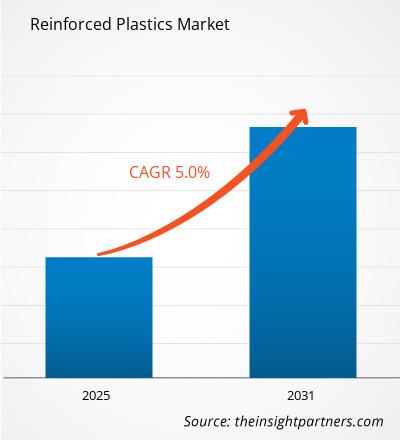
A wind turbine blade, a car body panel and a ship hull look nothing alike, yet all three rely on the same idea: plastic made stronger by fibre. The Reinforced Plastics Market was valued at US$ 274.93 billion in 2025 and is expected to reach US$ 360.53 billion by 2034, recording a 3.06% CAGR during 2026 to 2034. Growth of that size, on a base this large, adds tens of billions of dollars in new demand.
The report from The Insight Partners, released with historic data for 2021 to 2024 and a 2025 base year, segments the reinforced plastics market by fibre type and application. Fibre types include glass fibre, carbon fibre, aramid fibre and others, while applications span aerospace, automotive, building and construction, marine, wind energy and others. Geographic coverage includes North America, Europe, Asia Pacific, and South and Central America.
What Are Reinforced Plastics?
Reinforced plastics are composite materials in which a polymer matrix is strengthened with fibres. The fibres carry the load while the plastic holds them in place and protects them. The result is a material that is light, strong and resistant to corrosion.
Request a Sample Copy of the Report: https://www.theinsightpartners.com/sample/TIPRE00023804
What Is Driving Demand for Reinforced Plastics?
Weight is the currency of modern transport, and reinforced plastics spend it well. Carmakers chasing better fuel efficiency and longer electric vehicle range are replacing metal with fibre-reinforced parts in body panels, chassis components and interiors. Aircraft makers follow the same logic for wings, fuselages and cabin structures, where every kilogram saved lowers fuel burn.
Construction offers a second, steadier source of demand. Reinforced plastics are used in pipes, roofing, panels and insulation because they resist corrosion and last for decades without heavy maintenance. As urbanisation and infrastructure spending continue in emerging economies, builders increasingly treat these materials as practical alternatives to metals and concrete.
Technology keeps widening the field. Continuous improvements in glass fibre and carbon fibre composites are raising strength-to-weight ratios, impact resistance and thermal stability. Those gains have pushed adoption into marine, electronics and renewable energy, most visibly in wind turbine blades that grow longer with each generation. Moreover, advanced manufacturing methods such as 3D printing and injection moulding now allow complex, high-performance parts to be produced at lower cost.
Segmentation Overview
By Fiber Type
Glass Fiber: Glass fibre is the workhorse of the reinforced plastics market, valued for low cost, good strength and wide availability. It anchors volume demand in construction, marine and general industrial parts.
Carbon Fiber: Carbon fibre delivers the highest stiffness for its weight, which makes it the preferred choice in aerospace, performance automotive and wind energy. Its premium price is accepted where weight savings carry real financial value.
Aramid Fiber: Aramid fibre brings toughness and impact resistance. It suits applications that must absorb shocks or resist abrasion without adding bulk.
Others: Natural, basalt and hybrid reinforcements sit in this group. Interest here is rising as manufacturers combine different fibres to balance cost, performance and sustainability.
By Application
Aerospace: Aerospace buyers demand certified, lightweight structures, and reinforced plastics answer both needs. Fuel-efficiency goals keep this application strategically important.
Automotive: Lighter vehicles use less energy, so automakers keep expanding composite content, especially in electric platforms.
Building and Construction: Pipes, panels, roofing and structural profiles benefit from corrosion resistance and long service life.
Marine: Boat hulls and decks rely on fibre-reinforced plastics for their resistance to water and salt.
Wind Energy: Turbine blades are among the most demanding composite structures, and larger rotors raise the performance bar.
Others: Electrical, industrial and consumer uses complete the picture.
Key Market Players
- BASF SE
- Owens Corning
- Toray Industries Inc
- SGL Carbon SE
- Teijin Limited
- Mitsubishi Chemical Holdings Corporation
- Hexcel Corporation
- Solvay SA
- Huntsman Corporation
- SABIC
The group mixes diversified chemical producers with specialists in fibres and composites. Owens Corning and Hexcel Corporation are closely tied to glass fibre and advanced composites respectively, while Toray Industries Inc, Teijin Limited and SGL Carbon SE are known for carbon fibre. Competition in the reinforced plastics market turns on material performance, processing efficiency and long-term supply agreements with aerospace, automotive and wind customers.
Sustainability and Innovation Trends
Sustainability is becoming a design requirement rather than a marketing line. Buyers in automotive, construction and packaging want reinforced plastics that can be recycled or made from bio-based feedstocks, and manufacturers are working on composites that fit circular economy goals. Recycling technologies for fibre-reinforced plastics, long seen as a weak point, are now a focus of research.
Material science is moving just as fast. Hybrid composites that combine different fibres or matrix systems are widening the range of properties available to engineers. Growing use of carbon fibre reinforced plastics is expected to be a defining trend, backed by the push for lighter electric vehicles and more efficient aircraft.
Buy Premium Report: https://www.theinsightpartners.com/buy/TIPRE00023804
Regional Outlook
North America, with the United States as a key market, draws demand from automotive, aerospace and construction. Lightweighting targets and infrastructure renewal keep reinforced plastics firmly on procurement lists.
Europe combines a strong automotive base with demanding efficiency and emissions rules. These pressures favour composites and encourage work on recyclable and bio-based systems.
Asia Pacific held the largest share of the reinforced plastics market, supported by strong automotive and medical industries. China, India, Japan and Australia add large manufacturing bases and sustained infrastructure investment.
South and Central America, including Brazil and Argentina, offers steady opportunity through construction, marine and industrial use. Infrastructure programmes and expanding manufacturing support gradual growth in the reinforced plastics market.
Related Reports:
Plastic Pipes Market Overview and Growth by 2031
Bioplastics and Biopolymers Market Size and Competitive Analysis by 2030
About The Insight Partners
The Insight Partners is among the leading market research and consulting firms in the world. We take pride in delivering exclusive reports along with sophisticated strategic and tactical insights into the industry. Reports are generated through a combination of primary and secondary research, solely aimed at giving our clientele a knowledge-based insight into the market and domain. This is done to assist clients in making wiser business decisions. A holistic perspective in every study undertaken forms an integral part of our research methodology and makes the report unique and reliable.
Contact Us:
If you have any queries about this report or if you would like further information, please contact us:
Phone: +1-646-491-9876
E-mail: sales@theinsightpartners.com
Also Available in: Korean | German | Japanese | French | Chinese | Italian | Spanish
