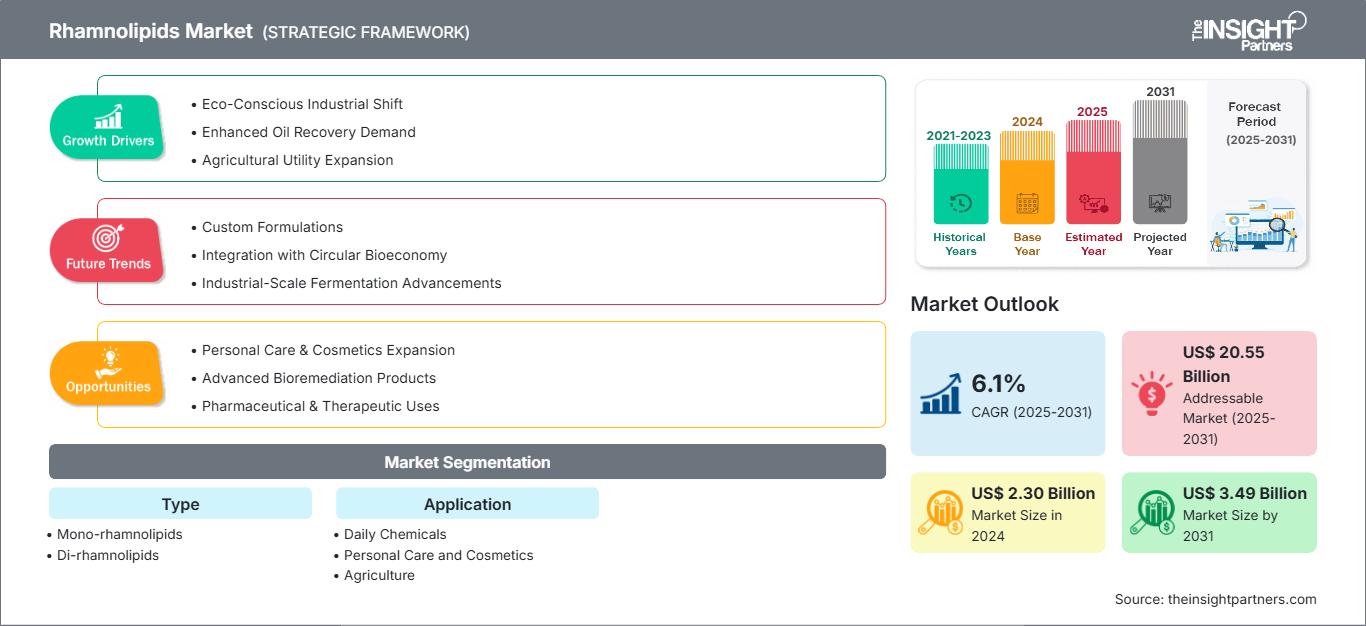
Cleaning products have long relied on petrochemical surfactants, but a sugar-based molecule grown by microbes is starting to change that habit. The Rhamnolipids Market is projected to reach US$ 3.49 billion by 2031, up from US$ 2.30 billion in 2024, at a 6.1% CAGR during 2025 to 2031. Growth at that pace shows how quickly sustainability goals are turning into purchasing decisions.
The report from The Insight Partners, published in January 2026 with historic data for 2021 to 2023 and a 2024 base year, analyses the rhamnolipids market by type and application. Type covers mono-rhamnolipids and di-rhamnolipids, while application spans daily chemicals, personal care and cosmetics, agriculture, food, pharmaceuticals, oilfield and petroleum, environmental protection and others. Geographic coverage includes North America, Europe, Asia Pacific, Middle East and Africa, and South and Central America.
What Are Rhamnolipids?
Rhamnolipids are natural biosurfactants from the glycolipid family, made through microbial fermentation using renewable materials. They carry one or two rhamnose sugar units attached to fatty acid chains, which gives them strong surface-active properties. They are biodegradable, low in toxicity and effective across wide ranges of temperature, salinity and pH.
Request a Sample Copy of the Report: https://www.theinsightpartners.com/sample/TIPRE00042219
What Is Driving Demand for Rhamnolipids?
Consumers are asking harder questions about what goes into the products they use. Preference for biodegradable, low-toxicity ingredients in personal care, household and industrial products is pushing brands to reformulate with renewable inputs such as rhamnolipids. That shift is gathering pace in home care and beauty, where natural positioning sells.
Regulation reinforces the trend. Policies in Europe, North America and Asia aim to cut chemical pollution, and frameworks such as REACH and the European Green Deal encourage bio-based chemistry. Compliance with chemical safety and wastewater rules has sped up the move from petrochemical surfactants to biosurfactants.
Versatility widens the commercial case. Rhamnolipids emulsify, disperse, wet and fight microbes, so a single ingredient family can serve detergents, farm sprays, oil recovery and wastewater treatment. Better fermentation and purification methods are also lifting production efficiency and lowering costs, which helps the products compete on price as well as principle.
Sustainable agriculture adds another channel. Used as bio-based adjuvants and soil conditioners, rhamnolipids support farming practices that can improve crop performance while reducing environmental impact. Growers in South and Central America are showing particular interest.
Segmentation Overview
By Type
Mono-rhamnolipids: Mono-rhamnolipids held the larger share of the rhamnolipids market in 2024. They offer strong emulsifying and cleaning ability, which suits personal care and environmental uses.
Di-rhamnolipids: Di-rhamnolipids bring better stability and foaming. Producers choose them for cosmetics and industrial cleaning products that need longer-lasting performance.
By Application
Daily Chemicals: This group covers laundry detergents, dishwashers, surface cleaners and other household products. Rhamnolipids deliver effective cleaning with a lighter environmental burden.
Personal Care and Cosmetics: This is the fastest-growing application. Mild, skin-compatible and biodegradable, rhamnolipids suit shampoos, soaps and lotions.
Agriculture: Bio-based adjuvants and soil conditioners improve nutrient uptake and support sustainable farming.
Food: Natural emulsifier and antimicrobial properties help stability and safety in processing and packaging.
Pharmaceuticals: Biocompatibility and antimicrobial action open doors in drug delivery and wound care.
Oilfield and Petroleum: Rhamnolipids aid enhanced oil recovery, emulsification and hydrocarbon clean-up.
Environmental Protection: Bioremediation and wastewater treatment use rhamnolipids to mobilise pollutants and help microbes break them down.
Others: Specialty chemicals and emerging industries seeking sustainable surfactants complete the list.
Key Market Players
- Zhejiang Seedling Bio Co., Ltd
- Seebio Biotech (Shanghai) Co Ltd
- GlycoSurf
- Biotensidon GmbH
- Zhejiang Silver-Elephant Bio-engineering Co., Ltd.
- Hangzhou Leap Chem Co., Ltd.
- Shaanxi Deguan Biotechnology Co., Ltd
- Biosynth AG
- Evonik Industries AG
- Starchem Enterprises Limited
- Sihauli Chemicals Private Limited
- AGAE Technologies LLC
- Merck KGaA
- Alfa Chemistry
- Jeneil Biotech Inc
Competition in the rhamnolipids market is intense, with specialist biotech producers sharing the field with global chemical companies. Evonik Industries AG opened the first industrial-scale rhamnolipid production facility in 2024 and signed a distribution agreement with Sea-Land Chemical Company to widen its reach across the United States. Others compete through diverse portfolios, sustainable sourcing, competitive pricing and strong customer support.
Sustainability and Innovation Trends
Growing investment in biotechnology infrastructure is the defining trend. Companies are scaling fermentation capacity, refining purification and exploring acquisitions of biosurfactant businesses to widen their footprint. Industrial-scale production is moving rhamnolipids from specialist niche to mainstream ingredient.
New uses keep appearing. Opportunities are emerging in natural food preservation, wound care, soil clean-up and oil spill response, all of which draw on the molecule’s antimicrobial and biocompatible properties. Product launches built around sustainable cleaning are likely to follow.
Buy Premium Report: https://www.theinsightpartners.com/buy/TIPRE00042219
Regional Outlook
Europe dominated the rhamnolipids market in 2024, helped by strict environmental policy and rapid industrial-scale commercialisation. North America follows closely, with strong regulatory enforcement and rising demand for natural cleaning and personal care products.
Asia Pacific holds a significant share and offers the strongest growth outlook, supported by industrialisation, environmental awareness and investment in biotechnology. China, India, Japan, Australia and South Korea are all in scope.
South and Central America is a fast-growing market, driven by agricultural demand and government incentives for sustainable farming. Brazil and Argentina lead the opportunity.
Middle East and Africa is small but expanding quickly. Demand from the oil and gas sector, combined with tighter environmental rules, is driving interest in biosurfactants for enhanced oil recovery and remediation.
Related Reports:
Surfactants Materials Market Outlook, Geography, and Strategic Insights by 2031
Polysorbate Market Size, Growth & Trends by 2034
About The Insight Partners
The Insight Partners is among the leading market research and consulting firms in the world. We take pride in delivering exclusive reports along with sophisticated strategic and tactical insights into the industry. Reports are generated through a combination of primary and secondary research, solely aimed at giving our clientele a knowledge-based insight into the market and domain. This is done to assist clients in making wiser business decisions. A holistic perspective in every study undertaken forms an integral part of our research methodology and makes the report unique and reliable.
Contact Us:
If you have any queries about this report or if you would like further information, please contact us:
Phone: +1-646-491-9876
E-mail: sales@theinsightpartners.com
Also Available in: Korean | German | Japanese | French | Chinese | Italian | Spanish
