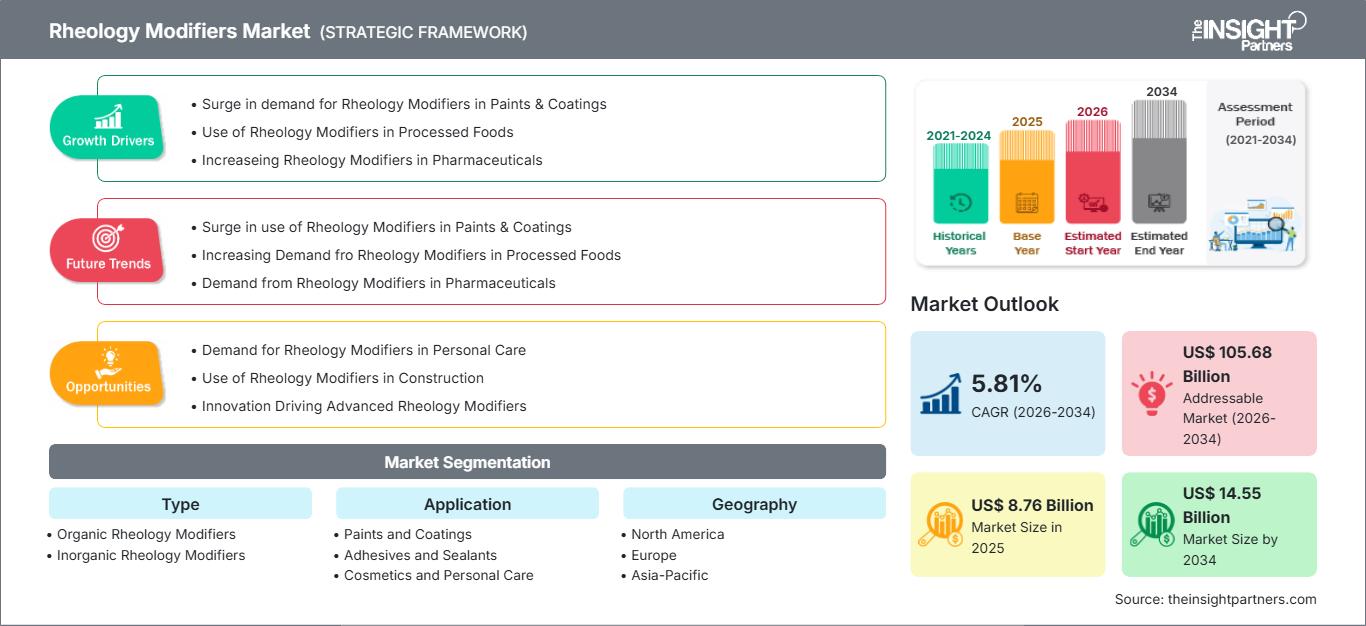
Every paint that rolls on without dripping, every moisturiser that glides on smoothly and every liquid detergent that keeps its particles in suspension owes something to rheology. Demand for the additives behind that performance is climbing steadily, and the Rheology Modifiers Market is projected to grow from US$ 8.76 billion in 2025 to US$ 14.55 billion by 2034, registering a 5.81% CAGR during 2026-2034. Formulators in coatings, personal care, pharmaceuticals and home care now treat flow control as a core performance specification, and that shift underpins the rheology modifiers market outlook for the coming decade.
What Are Rheology Modifiers?
Rheology modifiers are additives that control the viscosity, flow and stability of liquid and semi-solid formulations. They thicken, suspend and structure products so that they behave properly during manufacture, storage and application. Chemists choose between organic options such as cellulosics and acrylics, and inorganic options such as clays and fumed silica.
Request a Sample Copy of the Report: https://www.theinsightpartners.com/sample/TIPRE00022847
Market Drivers Behind Rheology Modifiers Market Growth
Start with paints and coatings, the largest battleground for viscosity control. Tightening limits on volatile organic compounds have pushed manufacturers from solvent-based to waterborne systems, and water offers none of the natural body that solvents provide. Associative thickeners and cellulose derivatives fill that gap, delivering sag resistance, spatter control and open time. Steady construction and renovation activity, particularly across Asia Pacific, keeps demand for rheology modifiers firmly in motion. Adhesives and sealants provide a second engine, since lightweight vehicles, modular building and e-commerce packaging all call for formulations that stay put during application and cure without slumping.
Personal care adds a different kind of pull. Consumers judge a serum, cream or sulphate-free cleanser by feel before they judge it by result, so texture has become a selling point in its own right. Brands are therefore investing in thickeners that deliver a premium sensory profile while meeting clean-label and natural-origin expectations. Home care follows the same logic. Concentrated liquid detergents and fabric conditioners depend on structured formulations that suspend actives and remain stable on the shelf.
Pharmaceuticals contribute a smaller volume but a richer margin. Topical gels, oral suspensions and ointments need consistent viscosity to guarantee uniform dosing and patient compliance, which makes high-purity, tightly specified grades essential. What makes this particularly significant is the regulatory discipline attached to these applications: once a grade is qualified, suppliers tend to keep the business.
So why does the rheology modifiers market grow at 5.81% rather than faster? Raw material volatility is part of the answer. Prices for acrylic monomers, cellulose pulp and specialty minerals swing with energy costs and supply disruptions, which squeezes margins and limits pricing power. Yet multifunctional additives that replace two or three ingredients with one are helping producers defend profitability and win share.
Segmentation Overview
By Type: Organic rheology modifiers include cellulosics, acrylics, polyurethane associative thickeners and natural gums, and they are widely chosen where formulators need precise, tunable flow behaviour in waterborne systems. Inorganic rheology modifiers, built on clays, fumed silica and similar minerals, offer thermal stability and strong anti-settling performance, which suits solvent-borne coatings, adhesives and sealants.
By Application: Paints and coatings anchor demand, with adhesives and sealants close behind as construction and packaging activity expands. Cosmetics and personal care, pharmaceuticals and home care each ask for thickeners that balance texture, stability and safety. The others category captures inks, oilfield fluids and industrial formulations.
By Geography: North America, Europe, Asia Pacific, and South and Central America each follow distinct demand patterns shaped by regulation, construction cycles and consumer spending. Producers that tailor their grades to these local conditions tend to hold the strongest positions.
Key Market Players
- Dow
- BASF SE
- Lubrizol Corporation
- Arkema
- Clariant
- Croda International Plc.
- Ashland
- Akzo Nobel N.V.
- Elementis Plc.
- BYK Additives and Instruments
Dow, BASF SE and Lubrizol Corporation bring broad acrylic and polyurethane thickener portfolios backed by global manufacturing scale. Arkema, Clariant and Akzo Nobel N.V. draw on deep specialty chemistry and coatings expertise. Croda International Plc. and Ashland lean on personal care and pharmaceutical know-how, while Elementis Plc. and BYK Additives and Instruments add mineral-based and additive-focused solutions.
Sustainability and Innovation Trends in the Rheology Modifiers Market
Bio-based and biodegradable thickeners are moving from niche to mainstream. Suppliers are developing modified starch, xanthan and cellulose grades that cut reliance on petrochemical feedstocks, and several are pursuing renewable-carbon credentials to support customers’ own climate targets. In parallel, low-dosage, high-efficiency polymers reduce the amount of additive needed per batch, trimming cost and waste. Smart, stimuli-responsive systems that adjust viscosity to temperature or shear are also gaining attention, particularly in advanced coatings and drug delivery. Regulatory frameworks such as REACH in Europe keep pressing suppliers to document safety and biodegradability, so compliance expertise is itself becoming a competitive asset.
Buy Premium Report: https://www.theinsightpartners.com/buy/TIPRE00022847
Regional Outlook
Asia Pacific carries the greatest momentum, supported by large-scale construction, expanding manufacturing bases and a growing middle class that spends more on personal care and home care products. North America combines mature coatings demand with strong pharmaceutical and specialty formulation activity, and innovation in high-performance grades is a clear priority there. Europe leans on strict environmental rules that accelerate the move to waterborne and bio-based thickeners. South and Central America offers steady, if more cyclical, opportunity as housing and consumer markets recover.
Related Reports:
Surfactants Materials Market Outlook, Geography, and Strategic Insights by 2031
Green Coating Market Size, Share & Demand by 2034
Construction Additives Market Growth and Forecast by 2030
Smart Coatings Market Size, Share, and Growth by 2031
About The Insight Partners
The Insight Partners is among the leading market research and consulting firms in the world. We take pride in delivering exclusive reports along with sophisticated strategic and tactical insights into the industry. Reports are generated through a combination of primary and secondary research, solely aimed at giving our clientele a knowledge-based insight into the market and domain. This is done to assist clients in making wiser business decisions. A holistic perspective in every study undertaken forms an integral part of our research methodology and makes the report unique and reliable.
Contact Us:
If you have any queries about this report or if you would like further information, please contact us:
Phone: +1-646-491-9876
E-mail: sales@theinsightpartners.com
Also Available in: Korean | German | Japanese | French | Chinese | Italian | Spanish
