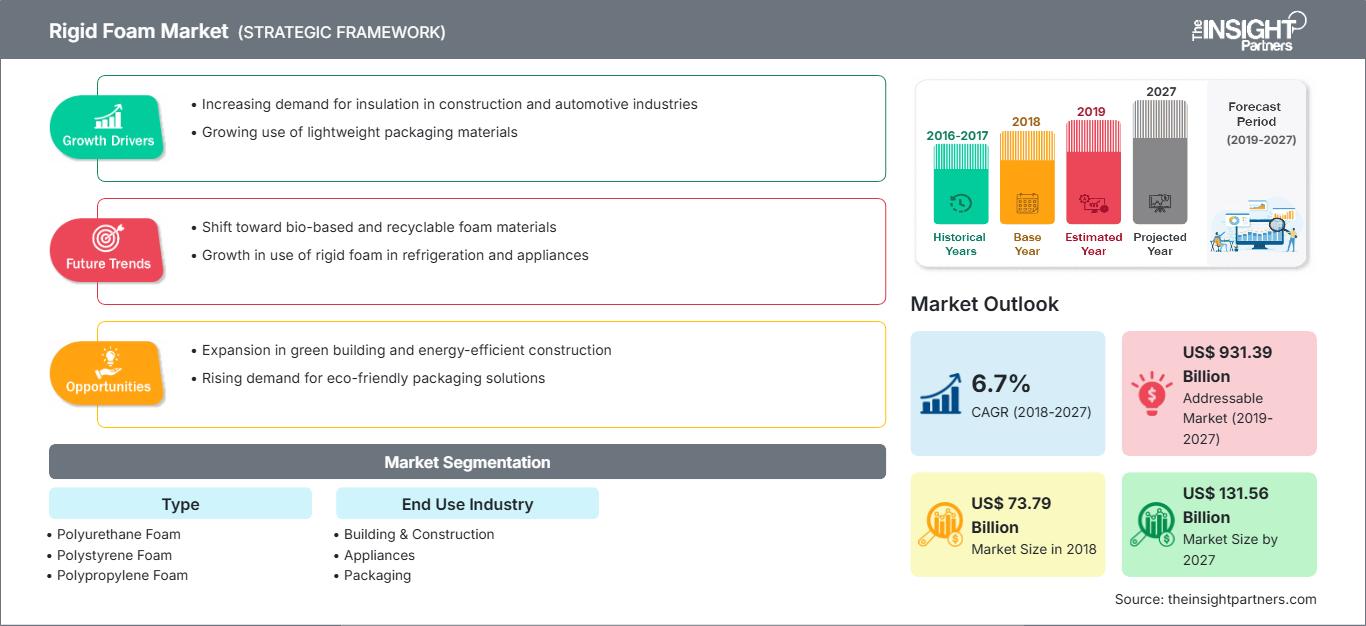
Insulation rarely makes headlines, yet it quietly decides how much energy a building, a refrigerator or a vehicle consumes. That influence explains why the Rigid Foam Market accounted for US$ 73,786.7 Mn in 2018 and is expected to reach US$ 131,558.9 Mn by 2027, growing at a 6.7% CAGR during 2019-2027. Lightweight, thermally efficient and structurally sound, rigid foams have moved from specialist material to default choice across construction, appliances, packaging and automotive design.
What Is Rigid Foam?
Rigid foam is a closed or semi-closed cell polymer material that keeps its shape under load instead of flexing like cushioning foam. It combines low weight with strong thermal insulation, impact absorption and moisture resistance. Manufacturers produce it from several polymers, each tuned for a different balance of cost, strength and heat performance.
Request a Sample Copy of the Report: https://www.theinsightpartners.com/sample/TIPRE00005351
Market Drivers Behind Rigid Foam Market Growth
Energy efficiency sits at the centre of the story. Governments in North America, Europe and Asia have tightened building codes, and architects now specify thicker, better-performing insulation for walls, roofs and floors. Rigid foam boards and panels deliver high thermal resistance in a slim profile, which matters when floor space is expensive. As new housing and commercial projects multiply, the rigid foam market benefits directly.
Appliances add a second layer of demand. Refrigerators, freezers and water heaters rely on rigid foam cores to hold temperatures steady while using less electricity, and efficiency labels have made that performance visible to consumers. Cold chain logistics follows the same logic. Rigid foam insulated containers and panels protect food and pharmaceuticals in transit, a role that grows with every expansion in online grocery and temperature-controlled distribution.
Then there is transport. Automakers face emissions targets that reward every kilogram saved, so they are replacing heavier materials with rigid foam in bumpers, door panels, headliners and structural cores. What makes this particularly significant is the dual payoff: lighter vehicles burn less fuel or extend electric range, while foam also improves crash energy absorption and cabin acoustics. Packaging completes the picture, with protective foam inserts safeguarding electronics, medical devices and fragile goods.
Growth is not frictionless, of course. Petrochemical feedstock prices swing with crude oil, and environmental scrutiny of blowing agents and end-of-life disposal continues to rise. So how does the rigid foam market sustain a 6.7% CAGR despite these pressures? Producers have answered with new formulations, recycled content and tighter process control, and customers have generally rewarded them.
Segmentation Overview
By Type: Polyurethane foam leads on insulation performance and is widely used in construction panels and appliances. Polystyrene foam offers a cost-effective route for board insulation and protective packaging. Polypropylene foam and polyethylene foam bring toughness, chemical resistance and recyclability, which suits automotive and packaging uses. Polyvinyl chloride foam provides rigidity and fire-retardant properties for marine, transport and signage applications, while the others category covers specialty and engineered foams.
By End Use Industry: Building and construction remains the anchor segment, driven by insulation mandates and steady renovation activity. Appliances follow, supported by efficiency standards and rising ownership in emerging economies. Packaging draws on rigid foam for shock protection and thermal control, and automotive relies on it for lightweighting and noise reduction. The others segment spans marine, aerospace, wind energy and industrial uses.
Key Market Players
- ARMACELL INTERNATIONAL HOLDING GMBH
- BOREALIS AG
- COMPAGNIE DE SAINT-GOBAIN S.A.
- Covestro AG
- Dow Chemical Corporation
- Huntsman International LLC
- JSP
- BASF SE
- SEKISUI CHEMICAL CO., LTD.
- ZoteFoams Plc
Covestro AG, Huntsman International LLC, Dow Chemical Corporation and BASF SE bring deep polyurethane and polymer chemistry to the rigid foam market. COMPAGNIE DE SAINT-GOBAIN S.A. connects foam products with its broad building materials reach. JSP, SEKISUI CHEMICAL CO., LTD. and ZoteFoams Plc concentrate on polyolefin and expanded bead foams, while BOREALIS AG supplies the polyolefin base materials and ARMACELL INTERNATIONAL HOLDING GMBH serves technical insulation and engineered foam applications.
Sustainability and Innovation Trends in the Rigid Foam Market
Sustainability now shapes product roadmaps as much as price does. Manufacturers are moving to blowing agents with lower global warming potential, partly in response to regulation and partly because major customers demand it. Bio-based polyols, recycled polymer content and mechanical recycling of foam offcuts are gaining ground, and several producers are designing foams that are easier to separate and reuse at end of life. Innovation also targets performance. Thinner high-efficiency insulation boards, fire-retardant grades and foams engineered for composite sandwich structures all expand the range of jobs that rigid foam can handle. Companies that pair environmental credentials with measurable thermal performance are likely to win the larger share of specifications.
Buy Premium Report: https://www.theinsightpartners.com/buy/TIPRE00005351
Regional Outlook
Asia Pacific offers the strongest momentum, with rapid urbanisation, large-scale housing programmes and growing appliance and vehicle production creating sustained demand for rigid foam. North America combines a mature construction sector with strict energy codes and a strong retrofit market, which keeps insulation demand firm. Europe leads on regulatory pressure, as efficiency directives and low-carbon building targets push adoption of high-performance and more sustainable foam solutions. Other regions, including South and Central America and the Middle East and Africa, show growing interest as infrastructure investment rises and cooling needs increase.
Related Reports:
Polyurethane Foams Market Growth and Analysis by 2030
Spray Foam Insulation Market Trends, Size & Growth by 2034
PET Foam Market Size, Growth & Trends by 2034
About The Insight Partners
The Insight Partners is among the leading market research and consulting firms in the world. We take pride in delivering exclusive reports along with sophisticated strategic and tactical insights into the industry. Reports are generated through a combination of primary and secondary research, solely aimed at giving our clientele a knowledge-based insight into the market and domain. This is done to assist clients in making wiser business decisions. A holistic perspective in every study undertaken forms an integral part of our research methodology and makes the report unique and reliable.
Contact Us:
If you have any queries about this report or if you would like further information, please contact us:
Phone: +1-646-491-9876
E-mail: sales@theinsightpartners.com
Also Available in: Korean | German | Japanese | French | Chinese | Italian | Spanish
