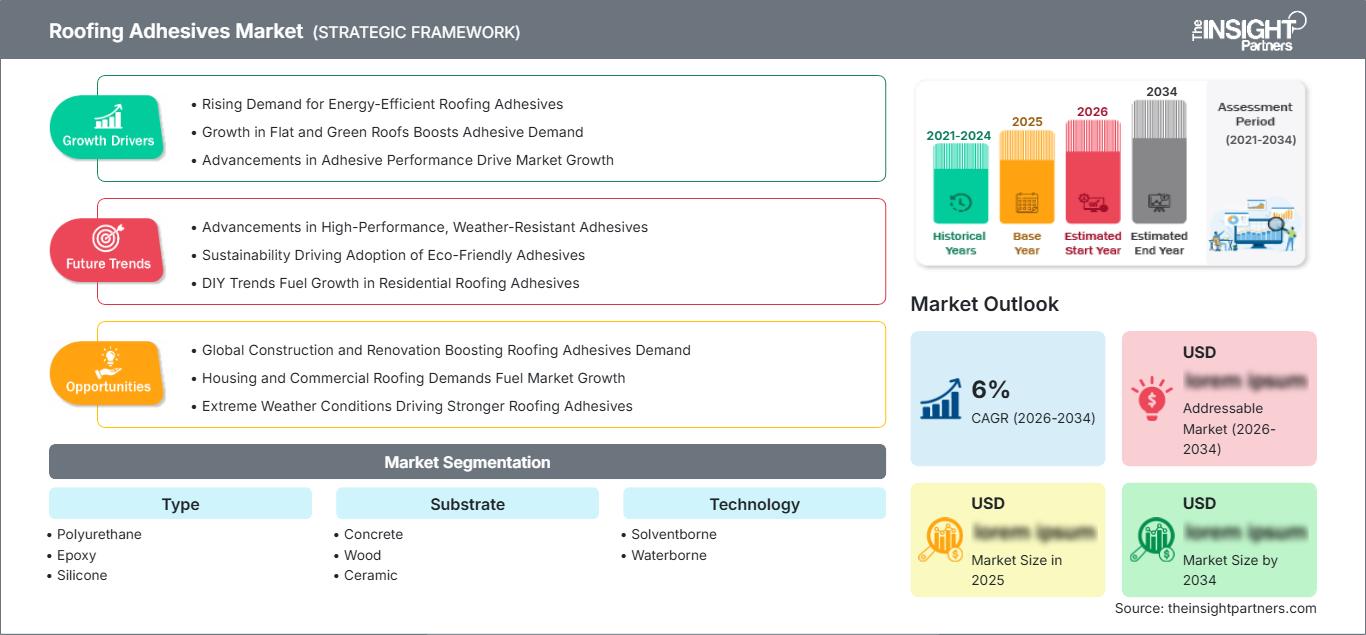
Few building components work as hard as a roof, and few failures cost as much as a leaking one. Behind every sound roof sits a bond between membrane, insulation and deck, which is why the Roofing Adhesives Market is projected to rise from US$ 6.36 billion in 2025 to US$ 11.23 billion by 2034, registering a 6.52% CAGR during 2026-2034. Roofers are replacing nails, screws and torch-applied methods with adhesive systems that install faster, run cleaner and perform more consistently, and that preference is lifting demand for roofing adhesives in both residential and non-residential construction.
What Is Roofing Adhesives?
Roofing adhesives are engineered bonding products that secure membranes, insulation boards, tiles, shingles and flashings to a roof substrate. They have to withstand ultraviolet exposure, thermal cycling, moisture and wind uplift for many years. Manufacturers formulate them from polyurethane, epoxy, silicone and acrylic chemistries to match different roof designs and climates.
Request a Sample Copy of the Report: https://www.theinsightpartners.com/sample/TIPRE00018878
What Is Driving Demand for Roofing Adhesives?
Construction volume provides the foundation. New housing, commercial property and industrial facilities all need roofs, while ageing buildings in North America and Europe feed a dependable replacement and retrofit cycle. Each project creates a bonding requirement, so the roofing adhesives market moves in step with the wider roofing sector.
Energy performance gives the market an extra push. Cool roofs, green roofs and high-performance insulation systems have become standard features of building codes and sustainability ratings, and they rely on adhesives to attach reflective membranes, insulation and planting layers without piercing the waterproofing underneath. Adhesive-applied assemblies avoid the thermal bridges and leak paths that mechanical fixings can introduce. Beyond that, owners now judge roofs on lifetime cost rather than installation price alone, and long-lasting bonds fit that mindset.
Severe weather is another factor. Stronger storms and more frequent high-wind events have raised expectations for wind uplift resistance, and insurers and building owners pay closer attention to how roofs are fastened. Adhesives spread stress across the entire surface instead of concentrating it at a handful of fixing points, giving contractors a credible response to tougher performance standards.
So what could hold the roofing adhesives market back? Raw material prices linked to petrochemical feedstocks are one risk, and skilled installer shortages are another. Tighter limits on volatile organic compounds also force reformulation. Still, a 6.52% CAGR shows that the benefits of adhesive-based roofing outweigh these obstacles for most buyers.
Segmentation Overview
By Type: Polyurethane adhesives combine strong adhesion with flexibility and are widely used for membrane and insulation bonding. Epoxy adhesives provide high strength and chemical resistance on demanding surfaces. Silicone adhesives excel in weathering and UV stability, acrylic adhesives balance cost, durability and ease of application, and the others category covers specialty and hybrid formulations.
By Substrate: Concrete decks dominate commercial and industrial roofs, where adhesives must cope with porosity and moisture. Wood substrates are central to residential roofing and need flexible products that tolerate seasonal movement. Ceramic surfaces, such as roof tiles, demand excellent grip and thermal stability, while others include metal and composite decks.
By Technology: Solventborne adhesives offer fast tack and dependable bonding in cool or damp conditions. Waterborne adhesives are gaining ground because they release fewer volatile compounds and comply more easily with tightening regulations. The others segment includes reactive and hot-melt systems.
By Application: Residential roofing uses adhesives for shingles, tiles and underlayments, supported by steady reroofing activity. Non-residential roofing, spanning commercial, industrial and institutional buildings, relies on large-area membrane and insulation bonding.
By Geography: North America, Europe, Asia Pacific, and South and Central America each reflect distinct climate, regulatory and construction conditions.
Key Market Players
- The 3M Company
- Arkema S.A
- Dove Technology
- GAF Materials Corporation
- H.B. Fuller Company
- Henkel AG and Co. KGaA
- Henry Company LLC
- Johns Manville
- Sika AG
- The Dow Chemical Company
H.B. Fuller Company, Henkel AG and Co. KGaA, Sika AG and The 3M Company bring broad adhesive and sealant expertise to roofing projects. GAF Materials Corporation, Johns Manville and Henry Company LLC are rooted in roofing systems, giving them direct access to contractors and specifiers. Arkema S.A and The Dow Chemical Company supply advanced polymer chemistry, and Dove Technology contributes focused product know-how.
Sustainability and Innovation Trends in the Roofing Adhesives Market
Low-VOC and solvent-free formulations are shifting from preference to expectation, pushed by regulation and by green building programmes that reward cleaner materials. Suppliers are also developing adhesives compatible with recyclable and reflective membranes, which helps roofs meet energy targets and reduces waste at end of life. Performance innovation is just as active. Fast-curing, cold-applied systems shorten installation time and widen the weather window for work, and digital aids such as moisture checks and application guidance support consistent results. Companies that pair low emissions with proven durability stand the best chance of winning specifications.
Buy Premium Report: https://www.theinsightpartners.com/buy/TIPRE00018878
Regional Outlook
North America pairs a large reroofing market with strict wind and energy standards, which sustains demand for high-performance adhesives. Europe leads on environmental regulation, steering builders toward waterborne, low-emission products and adhesive-applied insulation systems. Asia Pacific offers the strongest growth momentum, fuelled by rapid urbanisation, industrial construction and rising housing demand. South and Central America presents expanding opportunity as commercial building and infrastructure investment gather pace.
Related Reports:
Cool Roof Coating Market Growth, Trends & Forecast by 2034
Synthetic Roofing Underlayment Market Share, Growth & Forecast by 2034
Construction Additives Market Growth and Forecast by 2030
Spray Foam Insulation Market Trends, Size & Growth by 2034
About The Insight Partners
The Insight Partners is among the leading market research and consulting firms in the world. We take pride in delivering exclusive reports along with sophisticated strategic and tactical insights into the industry. Reports are generated through a combination of primary and secondary research, solely aimed at giving our clientele a knowledge-based insight into the market and domain. This is done to assist clients in making wiser business decisions. A holistic perspective in every study undertaken forms an integral part of our research methodology and makes the report unique and reliable.
Contact Us:
If you have any queries about this report or if you would like further information, please contact us:
Phone: +1-646-491-9876
E-mail: sales@theinsightpartners.com
Also Available in: Korean | German | Japanese | French | Chinese | Italian | Spanish
