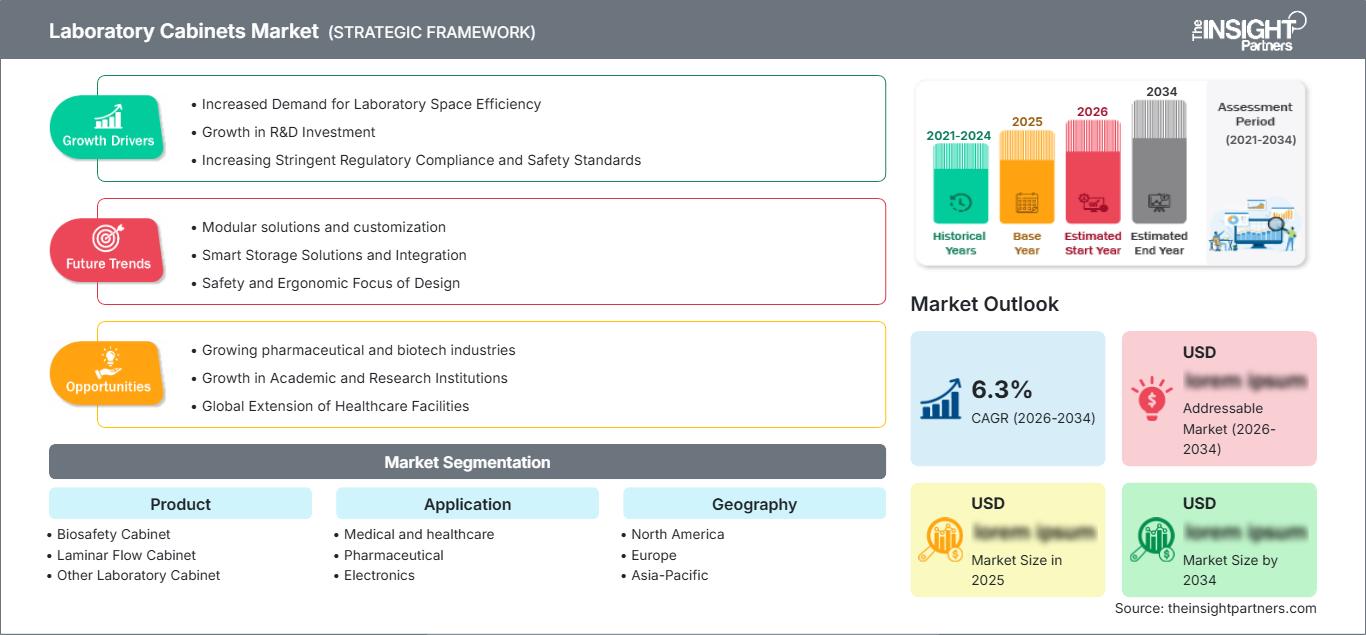
According to The Insight Partners, the global Laboratory Cabinets Market size is projected to reach US$ 6.97 billion by 2034 from US$ 3.68 billion in 2025. The market is anticipated to register a CAGR of 7.34% during the forecast period 2026–2034. Increasing investments in research infrastructure, growing laboratory construction, and rising demand for specialized storage and work surfaces are expected to support market expansion.
Laboratory Cabinets Market Overview
Laboratory cabinets are specialized furniture systems designed to support laboratory operations by providing organized storage, durable work surfaces, and designated spaces for equipment, chemicals, instruments, and supplies. These cabinets are widely used in pharmaceutical laboratories, biotechnology research centers, hospitals, diagnostic facilities, academic institutions, and industrial testing environments. Depending on their applications, laboratory cabinets may be constructed from stainless steel, metal, chemical-resistant materials, wood-based composites, or other materials suitable for specific laboratory conditions.
Download Sample PDF – https://www.theinsightpartners.com/sample/TIPRE00017434
The Laboratory Cabinets Market is gaining momentum as laboratories increasingly prioritize workplace safety, operational efficiency, and compliance with applicable standards. Modern laboratory environments require furniture that can withstand frequent use, resist chemical exposure where necessary, and support effective organization. As research activities become more specialized, laboratories are seeking cabinet solutions tailored to their operational requirements.
The expansion of pharmaceutical research, biotechnology development, clinical diagnostics, and academic research is contributing to market demand. Laboratories involved in drug discovery, chemical analysis, microbiological testing, and materials research require appropriate storage systems to protect supplies and maintain organized workspaces. In addition, renovations and upgrades to existing laboratories are creating opportunities for manufacturers offering modular, customizable, and space-efficient cabinet designs.
Laboratory Cabinets Market Size, Share, Trends, Analysis, and Forecast by 2034
- Market Size: The global Laboratory Cabinets Market is projected to grow from US$ 3.68 billion in 2025 to US$ 6.97 billion by 2034, reflecting rising investments in laboratory infrastructure.
- Market Share: Market share is influenced by product quality, material durability, customization capabilities, pricing, distribution networks, and relationships with research and healthcare institutions.
- Market Trends: Increasing adoption of modular laboratory furniture, chemical-resistant cabinets, ergonomic designs, and space-saving storage systems is shaping market development.
- Market Analysis: Growing pharmaceutical research, biotechnology development, diagnostic testing, and academic research are increasing demand for specialized laboratory storage and furniture solutions.
- Market Forecast: The market is anticipated to register a CAGR of 7.34% during 2026–2034, supported by laboratory modernization and expanding scientific research activities.
Key Players in the Laboratory Cabinets Market
The competitive landscape comprises manufacturers and suppliers offering laboratory furniture, storage cabinets, workstations, and specialized laboratory infrastructure. Companies compete through product innovation, material quality, customization, safety features, and distribution capabilities.
Key players in the Laboratory Cabinets Market include:
- Thermo Fisher Scientific
- WALDNER Laboreinrichtungen GmbH & Co. KG
- Scala-Waldner Inc.
- Thomas Scientific
- ESCO
- The Baker Company, Inc.
- deltalab
- Bassaire
- Durcon
- Erlab
These companies serve different laboratory environments, including pharmaceutical research, healthcare diagnostics, educational institutions, and industrial testing facilities. Product development, manufacturing efficiency, customer support, and the ability to meet laboratory-specific requirements are important competitive factors. Manufacturers that provide flexible configurations and durable materials can address the changing needs of modern research facilities.
Laboratory Cabinets Market Growth Drivers and Trends
Increasing Investments in Research and Development
Growing investments in pharmaceutical development, biotechnology, life sciences, and chemical research are creating demand for laboratory infrastructure. Research organizations require well-designed workspaces and storage systems to support routine testing, complex experiments, and equipment management. The establishment of new research facilities and the expansion of existing laboratories are expected to support demand for laboratory cabinets.
Expansion of Pharmaceutical and Biotechnology Industries
The pharmaceutical and biotechnology sectors rely on specialized laboratories for drug discovery, formulation development, quality control, and analytical testing. As these industries expand their research capabilities, the need for durable and organized laboratory furniture increases. Cabinets that support efficient storage and help maintain organized work environments are becoming important components of laboratory planning.
Growing Focus on Laboratory Safety
Laboratory safety is a significant consideration when selecting cabinets and storage systems. Facilities handling chemicals, biological materials, and sensitive instruments require products suited to their specific operational and safety requirements. Manufacturers are responding by offering specialized cabinet configurations, chemical-resistant materials, and solutions designed to support safer laboratory workflows.
Increasing Adoption of Modular and Customized Cabinets
Modern laboratories often require flexible layouts that accommodate changing research activities and equipment requirements. Modular cabinet systems allow facilities to optimize available space and modify configurations when operational needs change. Customizable dimensions, integrated storage, and ergonomic designs are also gaining attention as laboratories seek to improve workflow efficiency.
Regional Analysis
North America: North America represents an important market due to its established pharmaceutical and biotechnology industries, advanced research infrastructure, and continued investment in laboratory facilities. Demand from universities, healthcare institutions, and private research organizations supports the adoption of modern laboratory furniture.
Europe: Europe benefits from a strong scientific research ecosystem, established pharmaceutical manufacturing, and investments in laboratory modernization. Demand for durable, customizable, and safety-oriented laboratory cabinets is supported by research institutions, universities, and industrial testing facilities.
Asia Pacific: Asia Pacific offers substantial growth opportunities as pharmaceutical manufacturing, biotechnology research, academic laboratories, and healthcare infrastructure continue to expand. Increasing investments in scientific research and the establishment of new laboratory facilities are expected to contribute to regional market development.
South and Central America: Market growth is influenced by investments in healthcare laboratories, pharmaceutical manufacturing, academic research, and diagnostic testing. Improvements in laboratory infrastructure and increasing demand for organized workspaces may create additional opportunities for suppliers.
Middle East and Africa: Laboratory infrastructure development, healthcare investments, and growing interest in scientific research are supporting demand for laboratory furniture. The pace of adoption varies according to regional investment levels, research capabilities, and access to specialized laboratory equipment.
Future Outlook of the Laboratory Cabinets Market
The Laboratory Cabinets Market is expected to experience sustained growth through 2034 as research institutions, pharmaceutical companies, healthcare providers, and educational organizations continue investing in laboratory infrastructure. The increasing need for efficient storage, durable work surfaces, and adaptable laboratory layouts is likely to support demand for specialized cabinet systems.
Technological developments in materials, modular designs, and customizable furniture configurations may create additional opportunities for manufacturers. Companies that emphasize product durability, efficient space utilization, safety-oriented designs, and customer-specific solutions are well positioned to address evolving laboratory requirements.
Get Premium Market Research Report Here: https://www.theinsightpartners.com/buy/TIPRE00017434
However, manufacturers may face challenges related to raw material costs, competitive pricing, installation requirements, and compliance with applicable laboratory standards. Addressing these challenges while maintaining product quality and operational efficiency will remain important for long-term competitiveness.
Overall, rising research and development expenditure, pharmaceutical industry expansion, and laboratory modernization are expected to remain important factors supporting the Laboratory Cabinets Market through 2034.
About Us
The Insight Partners is a one-stop industry research provider of actionable intelligence. We help our clients meet their research requirements through syndicated and consulting research services. We specialize in industries such as Semiconductor and Electronics, Aerospace and Defense, Automotive and Transportation, Biotechnology, Healthcare IT, Manufacturing and Construction, Medical Device, Technology, Media and Telecommunications, and Chemicals and Materials.
Contact Us
Ankit Mathur | The Insight Partners
E-mail: ankit.mathur@theinsightpartners.com
Phone: +1-646-491-9876
Also Available in : Korean | German | Japanese | French | Chinese | Italian | Spanish
