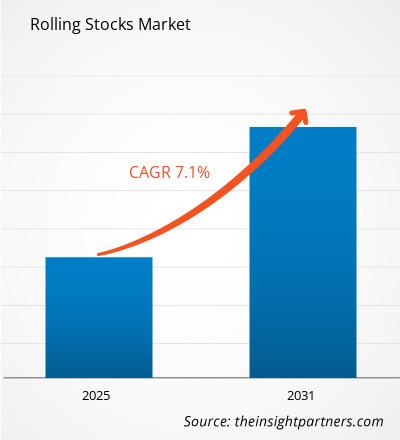
The Rolling Stocks Market size is expected to reach US$ 55.11 billion by 2031. The market is anticipated to register a CAGR of 6.1% during 2025-2031. It was valued at US$ 36.41 billion in 2024. The total addressable market during the forecast period is projected at approximately US$ 325.25 billion. Rolling stock covers the locomotives, coaches, wagons, and rapid transit vehicles that keep passengers and cargo moving across rail networks worldwide.
How the Market Is Segmented
The analysis divides the industry by technology, product type, and application. Technology covers conventional locomotives, turbocharged locomotives, and maglev. Product types include locomotives, rapid transit, coaches, wagons, and others. Applications are split between passenger transportation and freight. Geographically, the study spans North America, Europe, Asia-Pacific, South and Central America, and the Middle East and Africa, with country-level breakdowns for major economies.
Download Sample Report: https://www.theinsightpartners.com/sample/TIPAT00002316
Demand for Efficient Transportation
Rising urbanization and expanding global trade are increasing the need for modern rail systems that can handle larger passenger and cargo volumes. This pushes operators to invest in new locomotives, passenger coaches, and freight cars to improve efficiency and shorten travel times.
Government Investment in Rail Infrastructure
Many countries are prioritizing the expansion and modernization of their rail networks to promote sustainable transport, reduce congestion, and improve connectivity. Public-private partnerships are also becoming more common. They allow advanced rolling stock to be procured while spreading financial risk, which creates openings for manufacturers and suppliers.
Technological Advancements Shaping Trains
Lightweight materials, energy-efficient propulsion, and advanced control systems are improving train performance and sustainability. Digital tools such as Internet of Things sensors for predictive maintenance and real-time monitoring are also raising operational efficiency and safety, paving the way for next-generation rolling stock.
Sustainability and Urban Mobility Trends
A strong shift toward green technologies is under way. Rail operators are investing in electric and hybrid locomotives to cut carbon emissions and energy use, driven by regulatory pressure and public awareness of climate change. At the same time, cities are turning to light rail, trams, commuter trains, and metro systems to ease traffic congestion. Manufacturers are responding with versatile vehicles that adapt to different urban environments and passenger needs.
Emerging Opportunities for Manufacturers
Autonomous rail technology is a promising area. Advances in automation and artificial intelligence are making driverless trains and automated operations more feasible, with potential gains in safety, operating costs, and service reliability. Collaborative models and public-private partnerships also offer manufacturers a way to share risks, access funding, and deliver innovative solutions for new rail systems and fleet upgrades.
Key Players
The competitive landscape features leading global manufacturers focused on innovation and strategic development:
- Alstom SA
- Bombardier Inc.
- Wabtec Corporation
- CRRC Corporation Limited
- Construcciones y Auxiliar de Ferrocarriles
- Hyundai Rotem
- Kawasaki Heavy Industries
- Hitachi Rail Systems
- Stadler Rail
- Mitsubishi Heavy Industries
Regional Insight
The United States is a key market, supported by growing demand for efficient transportation, government investment in infrastructure, and technological progress. Asia-Pacific, Europe, and other regions are evaluated across the forecast period to show how local priorities shape demand.
Get Full Copy of This Report @ https://www.theinsightpartners.com/buy/TIPAT00002316
Future Outlook
The rolling stocks industry is positioned for steady expansion through 2031, with the market moving from US$ 36.41 billion in 2024 toward US$ 55.11 billion at a CAGR of 6.1%. Adoption of new technologies is identified as the key future trend. Urbanization, population growth, and continued government spending on railway infrastructure will keep fleet renewal and expansion on the agenda. Manufacturers that invest in sustainable propulsion, digital monitoring, and autonomous capabilities, while forming strong partnerships with public bodies, will be best placed to capture the opportunities ahead.
Related Reports:
Automotive interior market Trends, Size & Forecast by 2034
Automotive leaf spring market Growth, Trends & Demand by 2034
Automotive mass air flow sensors market Share, Demand & Growth by 2034
About Us
The Insight Partners is a leading global market research and consulting firm specializing in delivering actionable insights across various industries. Our research reports combine extensive primary and secondary research to provide accurate market intelligence, helping businesses make informed strategic decisions. The company provides detailed analysis on emerging technologies, market trends, competitive landscapes, and growth opportunities across sectors including technology, healthcare, manufacturing, and energy.
Contact Us:
Contact Person: Ankit Mathur
Email: ankit.mathur@theinsightpartners.com
Phone: +1-646-491-9876
Also Available in : Korean |German |Japanese |French |Chinese |Italian |Spanish
