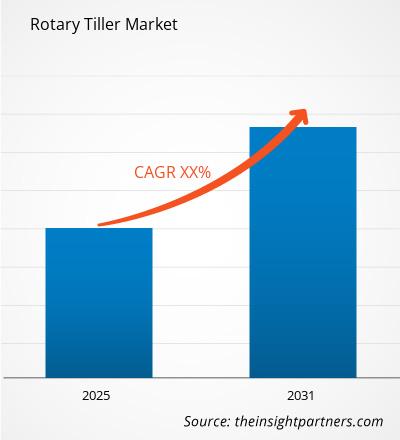
The Rotary tiller market was valued at US$ 2.68 Billion in 2025 and is projected to reach US$ 3.97 Billion by 2034, expanding at a CAGR of 4.10% during 2026–2034. Growth is supported by mechanized soil preparation, the replacement of manual cultivation, and wider use of tractor-mounted implements across agriculture, gardening, and commercial land maintenance. Manufacturers are putting more emphasis on operating efficiency, adaptable working widths, durable blades, and compatibility with compact and utility tractors.
Regional Demand Patterns
Asia Pacific leads with an estimated 42% to 47% share in 2025 and is expected to grow at a 4.6% to 5.5% CAGR through 2034. China, India, Japan, South Korea, and Australia are the main demand centers, helped by mechanization policies and rising labor costs.
Download Sample Report: https://www.theinsightpartners.com/sample/TIPRE00021345
North America is estimated at a 20% to 24% share, growing at 3.2% to 4.0%. The US makes up roughly 76% to 81% of regional demand, driven by commercial agriculture, landscaping, and specialty farming. Europe holds an estimated 18% to 22% share and is projected to grow at 3.5% to 4.3%, led by Germany, Italy, France, the UK, and Spain. The Middle East and Africa is expected to expand at 3.8% to 4.7%, with Saudi Arabia, the UAE, and South Africa as important markets.
Segment Highlights
Blade shape shapes buying decisions. L-shape, C-shape, J-shape, and straight knife designs each suit different soil conditions, power levels, and residue needs. C-shaped blades are valued for lower power requirements, which makes them a good fit for compact tractors.
By end use, agriculture is the largest segment, with an expected 58% to 63% share in 2025 and growth of 3.8% to 4.5%. Commercial applications are the faster-growing segment, estimated at a 13% to 18% share with a 4.8% to 5.7% CAGR, supported by landscaping and land management. Gardening adds steady demand for compact tillers used around beds and small plots.
What Is Driving Demand
Tillage is repetitive, time-sensitive, and physically demanding, so labor shortages raise the value of mechanized implements. Compact tractors paired with tillers let smaller farms and specialty growers cut their reliance on manual work. Mechanization programs in developing economies add further momentum.
Horticulture, nurseries, and commercial grounds management are also widening the customer base beyond conventional farms. These users value maneuverability, soil finish, and attachment flexibility, and they give manufacturers a useful hedge against swings in the agricultural equipment cycle.
Compatibility with precision and autonomous tractors is a longer-term driver. Deere & Company is extending autonomy into tillage, which signals that implements may need to work smoothly with connected machinery ecosystems.
Competitive Landscape
Supply is relatively fragmented because regional buyers need different working widths, hitch categories, and blade configurations. Competition depends on durability, tractor compatibility, operating depth, maintenance needs, and dealer support. Larger equipment brands draw on existing dealer ecosystems, while specialized producers compete through focused implements.
Key Players
- Bobcat Company
- Caroni S.p.A.
- Deere & Company
- Del Morino S.r.l.
- HOWSE Implement
- Kubota Agricultural Machinery India Pvt. Ltd.
- Land Pride
- Tarter Farm and Ranch Equipment
- Wessex International
- Woods Equipment Company
Get Full Copy of This Report @ https://www.theinsightpartners.com/buy/TIPRE00021345
Future Outlook
The coming years are likely to favor modular, multi-application implements with interchangeable blades, variable working widths, and quick hitch systems. Data-enabled tillage is also expected to emerge, with sensors and electronic interfaces reporting machine status and maintenance needs. Adoption will probably start with technology-oriented commercial farms before spreading as tractor connectivity becomes standardized. Localized manufacturing and dealer expansion in emerging markets such as India, China, Southeast Asia, and parts of Africa offer major opportunities. Premium attachments for professional landscaping and rental operations offer another. Companies that combine reliable products, strong service networks, and digital readiness are best placed to benefit through 2034.
Related Reports:
Automotive retarder market Trends, Size & Forecast by 2034
Automotive smart antenna market Growth, Trends & Demand by 2034
Automotive smart key market Share, Demand & Growth by 2034
About Us
The Insight Partners is a leading global market research and consulting firm specializing in delivering actionable insights across various industries. Our research reports combine extensive primary and secondary research to provide accurate market intelligence, helping businesses make informed strategic decisions. The company provides detailed analysis on emerging technologies, market trends, competitive landscapes, and growth opportunities across sectors including technology, healthcare, manufacturing, and energy.
Contact Us:
Contact Person: Ankit Mathur
Email: ankit.mathur@theinsightpartners.com
Phone: +1-646-491-9876
Also Available in : Korean |German |Japanese |French |Chinese |Italian |Spanish
