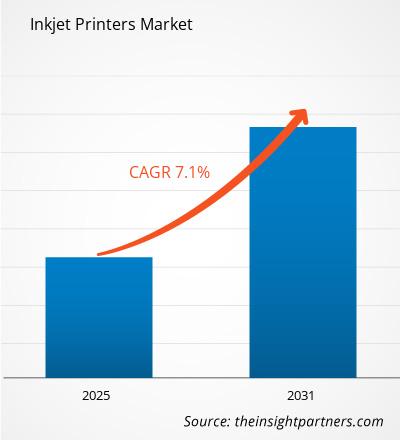
The global Inkjet Printers Market was valued at US$ 50.43 billion in 2025 and is expected to reach US$ 64.78 billion by 2034. The market is estimated to register a compound annual growth rate (CAGR) of 2.82% during the forecast period from 2026 to 2034. Demand for versatile printing solutions, advances in printhead technology, and the growing use of digital printing across commercial and industrial applications are contributing to market development.
Inkjet printers produce text, images, and graphics by depositing small droplets of ink onto paper and other compatible materials. Their ability to deliver detailed output, support color printing, and accommodate different printing requirements makes them useful across homes, offices, educational institutions, commercial printing facilities, and manufacturing operations.
Demand for Flexible Digital Printing Solutions
The continued need for convenient and high-quality printing supports the inkjet printers market. Businesses use inkjet technology to produce documents, promotional materials, photographs, labels, packaging information, and other printed content. Its flexibility allows users to handle different print jobs without relying on traditional printing processes for every application.
In offices and educational environments, inkjet printers support routine document production and color printing. Commercial users may require more specialized equipment capable of producing detailed graphics, marketing materials, or customized print jobs. Industrial users also employ inkjet technology for product coding, marking, and identification.
Digital printing capabilities are particularly useful when customers need variable information or customized output. Inkjet systems can print changing text, images, and codes, supporting applications in which information differs from one item to another. These capabilities help businesses respond to diverse printing requirements.
Get a PDF Sample- https://www.theinsightpartners.com/sample/TIPRE00011987
Technological Advancements and Print Quality
Developments in printhead design, ink formulations, and printer control systems are shaping the market. Manufacturers continue to focus on improving print resolution, output consistency, printing speed, and equipment reliability. These improvements can help inkjet printers address a wider range of professional and industrial requirements.
Ink technology is another important area of development. Different formulations are designed to work with particular materials and applications. The choice of ink can influence color quality, drying time, durability, adhesion, and resistance to environmental conditions.
Connectivity and software integration also affect purchasing decisions. Wireless printing, network access, mobile device compatibility, and workflow management features can make equipment easier to use in modern workplaces. For commercial and industrial customers, integration with existing production systems can be an important factor when selecting a printing solution.
Expanding Commercial and Industrial Applications
Inkjet printing has applications beyond conventional document and photo printing. In manufacturing, specialized systems can print product identifiers, batch information, dates, barcodes, and other details directly onto products or packaging. These applications support product traceability and help businesses communicate essential information throughout supply chains.
Packaging and labeling operations can benefit from digital printing’s flexibility, particularly when production requires changing designs, customized content, or short print runs. Commercial printing providers can also use inkjet equipment to produce marketing materials and graphics tailored to customer requirements.
However, the suitability of inkjet technology depends on the application. Print speed, material compatibility, ink performance, production volume, and required durability can influence equipment selection. Businesses must evaluate these factors to determine whether a particular printer meets their operational needs.
Market Challenges and Competitive Factors
Despite its versatility, the inkjet printers market faces challenges related to operating costs, maintenance, and competition from other printing technologies. Ink and other consumables can contribute significantly to the total cost of ownership, especially for users with high printing volumes. Customers therefore assess ongoing expenses alongside initial equipment prices.
Printhead maintenance, ink compatibility, and equipment downtime can also affect productivity. Industrial users may require specialized support to maintain consistent print quality and ensure reliable operation in demanding production environments.
Suppliers can address these concerns through improved product reliability, efficient ink usage, technical support, and solutions tailored to specific applications. Clear information about operating costs and maintenance requirements can also help customers make informed purchasing decisions.
Key Players in the Inkjet Printers Market
Key companies operating in the inkjet printers market include:
- Brother Industries, Ltd.
- Canon Singapore Pte. Ltd.
- HP Development Company, L.P.
- Jet Inks Private Limited
- KEYENCE CORPORATION
- Konica Minolta, Inc.
- Pannier Corporation
- Seiko Epson Corporation
- Videojet Technologies, Inc.
- Xerox Corporation
These companies participate in the broader printing technology industry through printing equipment, industrial marking systems, imaging technologies, and related solutions. Competition is influenced by print quality, equipment performance, reliability, operating costs, product availability, and after-sales support. Continued product development and the ability to serve different customer requirements remain important considerations for market participants.
Get Full Copy of This Report- https://www.theinsightpartners.com/buy/TIPRE00011987
Future Outlook
The global inkjet printers market is projected to grow from US$ 50.43 billion in 2025 to US$ 64.78 billion by 2034, registering a CAGR of 2.82% during 2026–2034. Market development is expected to be influenced by ongoing demand for digital printing, improvements in printing technology, and the use of inkjet systems in commercial and industrial operations.
Future innovation may focus on more efficient ink consumption, improved print quality, enhanced connectivity, and greater compatibility with specialized materials. Packaging, product marking, labeling, and customized printing applications may continue to provide opportunities for suppliers serving business customers.
At the same time, manufacturers will need to address operating costs, maintenance requirements, and competition from alternative printing methods. Buyers are likely to continue evaluating printers based on their intended applications, expected print volumes, and total cost of ownership.
Overall, inkjet printers remain an important technology for flexible document production, commercial graphics, and industrial printing. The market’s development through 2034 will depend on how effectively manufacturers combine reliable performance, cost efficiency, and adaptable printing capabilities to meet changing customer needs.
About The Insight Partners
The Insight Partners is a leading market research and consulting firm delivering actionable insights through in-depth industry analysis and strategic intelligence. The firm supports clients across various industries in making informed business decisions by providing comprehensive market forecasts, competitive assessments, and growth opportunities.
Contact Us:
If you have any queries about this report or if you would like further information, please contact us:
Contact Person: Ankit Mathur
E-mail: sales@theinsightpartners.com
Phone: +1-646-491-9876
Also Available in :
Korean | German | Japanese | French | Chinese | Italian | Spanish
