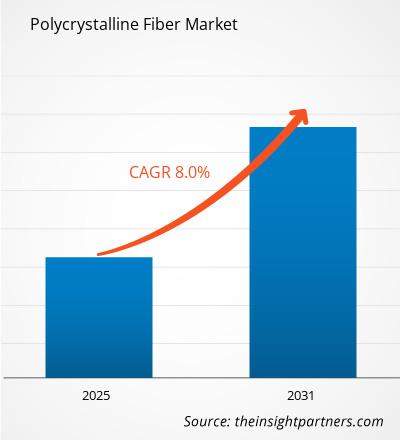
Inside a steel furnace or a ceramic kiln, ordinary insulation gives up long before the process does. Polycrystalline fibres were built for that moment, and industrial buyers are paying closer attention to them as energy costs and efficiency targets rise. According to The Insight Partners, the Polycrystalline Fiber Market is projected to grow from US$ 2.51 billion in 2025 to US$ 5.31 billion by 2034, registering a 8.68% CAGR during the 2026 to 2034 forecast period. That pace is among the stronger ones in high-temperature materials.
The report has been released with 2021 to 2024 as historic data and 2025 as the base year. It examines how producers’ position mullite and high alumina fibres for furnaces, kilns, reactors and transport applications. For plant managers and procurement teams, the polycrystalline fiber market is closely tied to a simple question: how much heat can a lining hold, and for how long?
What Is Polycrystalline Fiber?
Polycrystalline fiber is a high-performance ceramic fibre used as thermal insulation in extreme heat. It offers low thermal conductivity, strong resistance to thermal shock and stability at very high temperatures. Mullite and high alumina grades are the main product families.
Request a Sample Copy of the Report: https://www.theinsightpartners.com/sample/TIPRE00018454
What Is Driving Demand for Polycrystalline Fiber?
Furnace insulation is the anchor of demand. Polycrystalline fibres tolerate extreme temperatures and keep insulating performance over long service periods, so they suit furnaces that run hot and run continuously. As manufacturers push for thermal stability under harsher conditions, the case for these fibres gets stronger.
Superior thermal properties explain why buyers stay loyal once they switch. A furnace lining must survive repeated heating and cooling without cracking, and polycrystalline fibres combine low thermal conductivity with resistance to thermal shock. Because steel, ceramics and glass production are all expanding, the need for reliable insulation expands alongside them.
Energy conservation adds a third push, and regulation sharpens it. Pressure to cut energy use in heavy industry is rising, and policies on energy-efficient manufacturing steer plants towards materials that lose less heat. Better insulation lowers fuel consumption, which makes polycrystalline fibres an investment that pays back through operating costs. That logic keeps replacement and upgrade demand steady even in cautious years.
Beyond that, the report points to opportunity in product development. Customers want fibres with higher temperature resistance, mechanical strength and chemical stability, and suppliers that deliver tailored grades for aerospace, automotive and energy applications can open new niches. Lightweight and flexible insulation products add further room to grow, particularly where space and weight matter.
Segmentation Overview
By Type: Mullite fiber, high alumina fiber and others form the type segmentation. Mullite fiber is expected to record the fastest growth, helped by its heat resistance and stability in demanding furnace environments. High alumina fiber remains a core choice for applications that need strong performance at elevated temperatures, while the others group covers specialised compositions.
By End-User Industry: Ceramics, metals, automotive and others make up the end-user segmentation. Ceramics and metals producers rely on kilns and furnaces that run at extreme temperatures, which makes them natural buyers. Automotive demand comes from heat management in components and processes, and the others group captures aerospace, electronics and wider industrial uses.
Key Market Players
- Unifrax
- Nutec
- Rath Inc.
- 3M
- ZIRCAR Ceramics
- Lynn Manufacturing
- Mitsubishi Chemical Corporation
- Zibo Jucos Co.,Ltd
- ZHEJIANG BANGNI REFRACTORY FIBER CO., LTD.
- Morgan Thermal Ceramics
The report profiles these companies and examines their competitive strategies and innovation developments. The group blends diversified industrial names such as 3M and Mitsubishi Chemical Corporation with insulation and refractory specialists such as Unifrax, Rath Inc., ZIRCAR Ceramics and Morgan Thermal Ceramics. Regional manufacturers, including Zibo Jucos Co.,Ltd and ZHEJIANG BANGNI REFRACTORY FIBER CO., LTD., add competitive pressure, particularly in Asia Pacific.
Sustainability and Innovation Trends
Advanced fibre compositions is the defining trend. Producers are working on fibres with higher thermal stability, greater mechanical strength and better resistance to chemical degradation, and those gains open applications that older products could not serve.
High-performance sectors are the next target. Aerospace, automotive and electronics companies need materials that endure extreme temperatures and harsh conditions, and advanced fibres supply the heat resistance they require. Industrial furnaces, reactors and kilns remain the backbone of demand, and improved structural integrity helps polycrystalline fibres do more in those settings.
New material science, including nanotechnology within fibre compositions, is lifting performance further. Better thermal management also means lower energy use, which links innovation directly to sustainability goals.
Buy Premium Report: https://www.theinsightpartners.com/buy/TIPRE00018454
Regional Outlook
Asia Pacific holds the largest share, supported by large steel, ceramics and glass industries in China, India, Japan and Australia. North America, with the United States as a key market, benefits from furnace insulation demand and energy-saving regulation. Europe, covered through the UK, Germany, France, Russia and Italy, combines mature heavy industry with efficiency standards that favour better insulation. South and Central America, including Brazil and Argentina, completes the regional picture, and the report also evaluates the Middle East and Africa across the forecast period.
Related Reports:
Ceramic Binders Market Challenges, Drivers, Trends and Forecast by 2031
Foam glass Market Growth, Trends & Demand by 2034
Electrical Insulation Materials Market Size, Demand & Growth by 2034
About The Insight Partners
The Insight Partners is among the leading market research and consulting firms in the world. We take pride in delivering exclusive reports along with sophisticated strategic and tactical insights into the industry. Reports are generated through a combination of primary and secondary research, solely aimed at giving our clientele a knowledge-based insight into the market and domain. This is done to assist clients in making wiser business decisions. A holistic perspective in every study undertaken forms an integral part of our research methodology and makes the report unique and reliable.
Contact Us:
If you have any queries about this report or if you would like further information, please contact us:
Contact Person: Ankit Mathur
E-mail: ankit.mathur@theinsightpartners.com
Phone: +1-646-491-9876
Also Available in: Korean | German | Japanese | French | Chinese | Italian | Spanish
