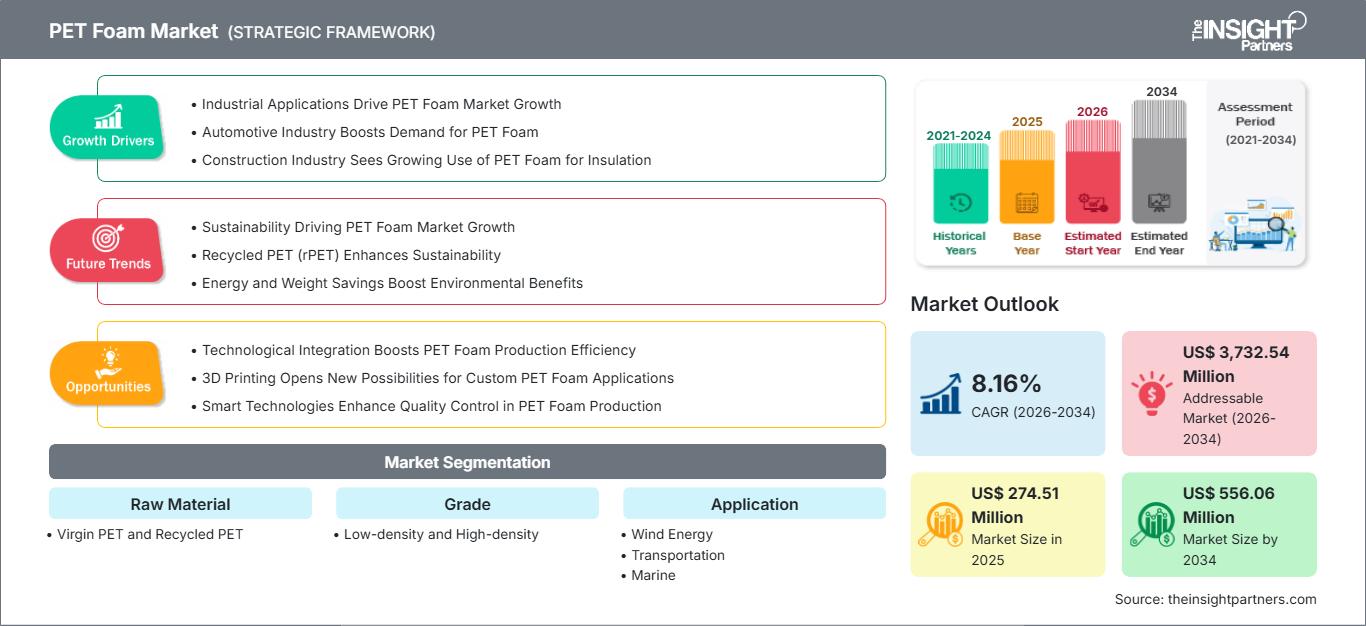
Wind turbine blades keep getting longer, and every extra metre puts more pressure on the core materials inside them. The PET Foam Market is valued at US$ 274.51 Million in 2025 and is projected to reach US$ 556.06 Million by 2034, expanding at a CAGR of 8.16% from 2026 to 2034. That pace reflects the material’s favourable strength-to-weight ratio, its recyclability and its compatibility with advanced manufacturing processes.
What Is PET Foam?
PET foam is a structural core material made from polyethylene terephthalate, placed between composite skins to cut weight without giving up stiffness. Manufacturers value its mechanical performance, dimensional stability, water resistance and compatibility with a wide range of resins. These traits explain why the PET foam market has grown from a niche composites input into an essential part of lightweight engineering.
Request a Sample Copy of the Report: https://www.theinsightpartners.com/sample/TIPRE00020165
What Is Driving Demand in the PET Foam Market?
Wind energy is the biggest engine of demand. Turbine makers use PET foam cores in blades to improve efficiency and reduce weight, and fatigue resistance matters over decades of cyclic loading. As onshore and offshore projects multiply, larger blades call for core materials that add structural integrity without piling on mass.
Transportation adds a second layer. Carmakers, rail builders and commercial vehicle manufacturers use lightweight composites to improve fuel efficiency and cut emissions. In electric vehicles, shedding weight is even more valuable because it stretches battery range.
Sustainability is the third driver, and it may prove the most durable. PET foam can be produced from recycled PET feedstocks, which fits circular economy goals and corporate environmental targets. Customers increasingly treat recyclability as a buying criterion, so suppliers with strong recycled content gain a real competitive edge.
Marine and construction applications round out the picture. Boat hulls and decks need moisture resistance and long-term durability, while green building projects use PET foam in composite panels and insulation systems. These uses are smaller than wind energy, but they widen the base of the PET foam market and reduce its dependence on a single sector.
PET Foam Market Segmentation Overview
By Raw Material:
Virgin PET remains widely used in high-performance applications that demand consistent properties and strict quality specifications. Recycled PET is gaining ground quickly, helped by circular economy initiatives and processing advances that improve consistency and structural performance. Buyers now weigh both options against cost, performance and sustainability targets.
By Grade:
Low-density PET foam suits applications where weight reduction is the main goal and manufacturing flexibility matters. High-density PET foam serves demanding structural uses that need greater compression resistance, strength and durability under harsh operating conditions.
By Application:
Wind Energy is the largest segment, built on the use of foam cores in turbine blades. Transportation, Marine, and Building and Construction follow, each drawing on lightweight performance, moisture resistance or energy efficiency. Packaging uses PET foam for impact-resistant protective solutions, while Others covers industrial composites.
By Geography:
North America, Europe, Asia Pacific, and South and Central America each follow a different growth path, shaped by renewable energy investment and local composites manufacturing.
Key Market Players in the PET Foam Market
- 3A Composites
- Armacell International SA
- Carbon-Core Corp.
- Changzhou Tiansheng New Materials Co., Ltd.
- CoreLite, Inc.
- DIAB Group
- Gurit Holding AG
- Huntsman International LLC
- Petro Polymer Shargh
- Sekisui Plastics Co., Ltd.
Competition centres on technology, production capacity and partnerships with composite fabricators. Armacell showcased its ArmaFix Ecolight PET insulation foam core in June 2026, while DIAB announced a collaboration with CompPair in February 2026 on healable sandwich structures. Gurit’s long-term supply contract with Genesis Products for its Kerdyn PET structural foam shows how suppliers are also locking in application-specific demand.
Sustainability and Innovation Trends in the PET Foam Market
Recycled PET is the clearest trend. Manufacturers are investing in processing technologies that let recycled feedstocks perform much like virgin material while lowering environmental impact. Wind energy, transportation and construction customers increasingly ask for products that help them meet carbon reduction goals, and suppliers that deliver recycled content without a performance penalty will strengthen their position.
Performance engineering is moving just as fast. Producers are optimising foam density, improving load-bearing capacity and tailoring grades to specific applications. Healable sandwich structures and premium foam grades built for stringent conditions suggest that the next wave of products will focus on durability and lower maintenance as much as weight.
Buy Premium Report: https://www.theinsightpartners.com/buy/TIPRE00020165
Regional Outlook
North America benefits from rising investment in renewable energy infrastructure and an established composite manufacturing base. The United States is the dominant national market in the region, supported by wind blade production, transportation manufacturing and infrastructure modernisation.
Europe remains a major regional market, with Germany, the United Kingdom and France leading demand. Offshore and onshore wind expansion, automotive lightweighting and sustainability targets keep PET foam in strong use across the region.
Asia Pacific is expected to be the fastest-growing region. China leads on manufacturing scale and wind capacity, while India, Japan, South Korea and Australia add demand through industrial development, renewable deployment and marine activity.
South and Central America is an emerging opportunity as countries in Latin America raise wind energy capacity as part of wider energy diversification. Regional supply chains and local manufacturing will decide how quickly suppliers can serve these projects.
Related Reports:
CFRTP Market Growth, Trends & Forecast by 2034
Reinforced Plastics Market Size, Growth & Demand by 2034
About The Insight Partners
The Insight Partners is among the leading market research and consulting firms in the world. We take pride in delivering exclusive reports along with sophisticated strategic and tactical insights into the industry. Reports are generated through a combination of primary and secondary research, solely aimed at giving our clientele a knowledge-based insight into the market and domain. This is done to assist clients in making wiser business decisions. A holistic perspective in every study undertaken forms an integral part of our research methodology and makes the report unique and reliable.
Contact Us:
If you have any queries about this report or if you would like further information, please contact us:
Phone: +1-646-491-9876
E-mail: sales@theinsightpartners.com
Also Available in: Korean | German | Japanese | French | Chinese | Italian | Spanish
