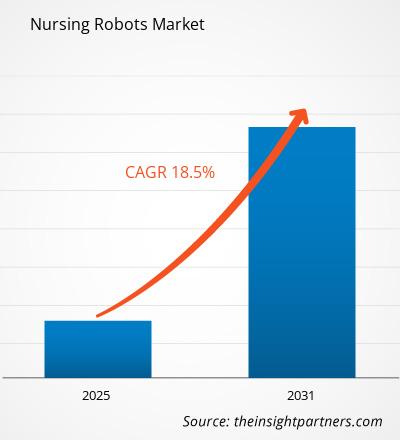
According to The Insight Partners, the Nursing Robots market was valued at US$ 1.67 billion in 2025 and is expected to reach US$ 5.92 billion by 2034. The market is estimated to record a CAGR of 15.1% during 2026-2034. Growing demand for healthcare automation, increasing pressure on nursing staff, and rising adoption of intelligent robotic systems are expected to support market expansion during the forecast period.
Nursing Robots Market Trends and Growth Drivers
Nursing robots are increasingly being integrated into healthcare environments to assist medical professionals with routine activities, patient monitoring, mobility support, and hospital logistics. These systems can help healthcare facilities streamline workflows, reduce the burden of repetitive tasks, and enable nurses to devote more time to direct patient care.
Download Sample PDF – https://www.theinsightpartners.com/sample/TIPRE00040598
One of the major drivers of the nursing robots market is the growing shortage of healthcare professionals. Hospitals and care facilities are under pressure to maintain service quality while managing staffing constraints and increasing patient volumes. Nursing robots can assist with selected non-invasive and repetitive tasks, including delivering medical supplies, transporting equipment, providing reminders, and supporting patient mobility. Their use can improve operational efficiency when integrated appropriately into existing care procedures.
Technological advancements are also influencing market development. Artificial intelligence, machine vision, sensors, and autonomous navigation are enabling robots to operate more effectively in complex healthcare environments. These technologies can help robotic systems navigate hospital corridors, recognize obstacles, interact with patients, and perform designated tasks with greater precision.
The growing elderly population is another important factor supporting demand. Older adults may require assistance with mobility, daily activities, medication reminders, and continuous care. Nursing robots can complement the work of caregivers in hospitals, rehabilitation centers, assisted-living facilities, and residential care environments.
Nursing Robots Market Analysis and Competitive Landscape
The competitive landscape includes robotics manufacturers, healthcare technology companies, and research organizations developing solutions for clinical and long-term care applications. Companies are focusing on improved human-robot interaction, autonomous movement, safety features, and specialized applications to strengthen their market presence.
Partnerships between healthcare providers, robotics developers, and research institutions are helping advance the deployment of nursing robots. However, high initial costs, integration requirements, cybersecurity considerations, and concerns about patient privacy can limit adoption. Healthcare facilities must also ensure that robotic systems meet relevant safety requirements and complement, rather than replace, essential human care.
Key Players in the Nursing Robots Market
- Diligent Robotics
- SoftBank Robotics Corp.
- Aethon Inc.
- RIKEN-SRK
- Toyota Motor Corporation
- PARO Robots U.S., Inc.
- Hanson Robotics
- Fraunhofer IPA
- Hitachi, Ltd.
- Fujisoft Inc.
These companies and organizations represent participants across robotics development, healthcare automation, assistive technologies, and research. Their specific products and level of involvement in nursing robotics may vary by application and geography.
Nursing Robots Market Size, Share, Trends, Analysis, and Forecast by 2034
- Market Size: The market is projected to grow from US$ 1.67 billion in 2025 to US$ 5.92 billion by 2034, reflecting rising interest in robotic assistance across healthcare facilities.
- Growth Rate: The market is expected to register a CAGR of 15.1% during 2026-2034, supported by healthcare automation and increasing demand for patient assistance.
- Key Trends: Artificial intelligence integration, autonomous navigation, human-robot interaction, and smart healthcare infrastructure are shaping product development.
- Major Growth Drivers: Nursing staff shortages, increasing healthcare expenditure, the growing elderly population, and rising patient care demands are encouraging adoption.
- Application Areas: Nursing robots can support patient assistance, mobility, monitoring, medication reminders, supply delivery, and other designated hospital tasks.
- Market Challenges: High implementation costs, maintenance requirements, data privacy concerns, and integration with existing healthcare systems may restrict adoption.
- Future Outlook: Continued technological development and greater acceptance of robotic assistance are expected to create opportunities for manufacturers and healthcare technology providers through 2034.
Regional Analysis
North America is an important market for nursing robots because of its advanced healthcare infrastructure, increasing investments in medical technology, and growing emphasis on hospital efficiency. The region’s healthcare providers are exploring automation to address staffing challenges and improve the delivery of patient services. The adoption of artificial intelligence and robotics in clinical settings is expected to create further opportunities.
The United States is a key contributor to regional demand, supported by substantial healthcare spending, established technology companies, and growing interest in automated patient assistance. Hospitals, rehabilitation centers, and long-term care facilities are potential users of nursing robots for logistical support and selected patient care activities.
Europe offers growth opportunities through healthcare modernization, robotics research, and increasing demand for elderly care. Collaboration among research institutions, technology developers, and medical organizations can support innovation and practical applications.
Asia Pacific is expected to present opportunities as healthcare infrastructure develops and demand for eldercare services increases. Investments in robotics, expanding hospital networks, and technological capabilities in countries such as Japan, China, and South Korea can support regional adoption.
The Rest of the World, including Latin America and the Middle East and Africa, may experience gradual adoption as healthcare facilities invest in modernization. Affordability, infrastructure readiness, workforce training, and access to technical support will influence the pace of implementation.
Get Premium Market Research Report Here: https://www.theinsightpartners.com/buy/TIPRE00040598
Future Outlook
The nursing robots market is positioned for growth as healthcare providers seek solutions that improve efficiency and support patient care. Advances in artificial intelligence, navigation, sensing, and robotic interaction are likely to expand the range of tasks these systems can perform. Successful adoption will depend on affordability, reliability, staff training, regulatory compliance, and effective integration into clinical workflows. Nursing robots are expected to serve as complementary tools that assist healthcare professionals while preserving the human interaction central to quality nursing care.
About Us
The Insight Partners is a one stop industry research provider of actionable intelligence. We help our clients in getting solutions to their research requirements through our syndicated and consulting research services. We specialize in industries such as Semiconductor and Electronics, Aerospace and Defense, Automotive and Transportation, Biotechnology, Healthcare IT, Manufacturing and Construction, Medical Device, Technology, Media and Telecommunications, Chemicals and Materials.
Contact Us
Ankit Mathur | The Insight Partners
Email: ankit.mathur@theinsightpartners.com
Phone: +1-646-491-9876
