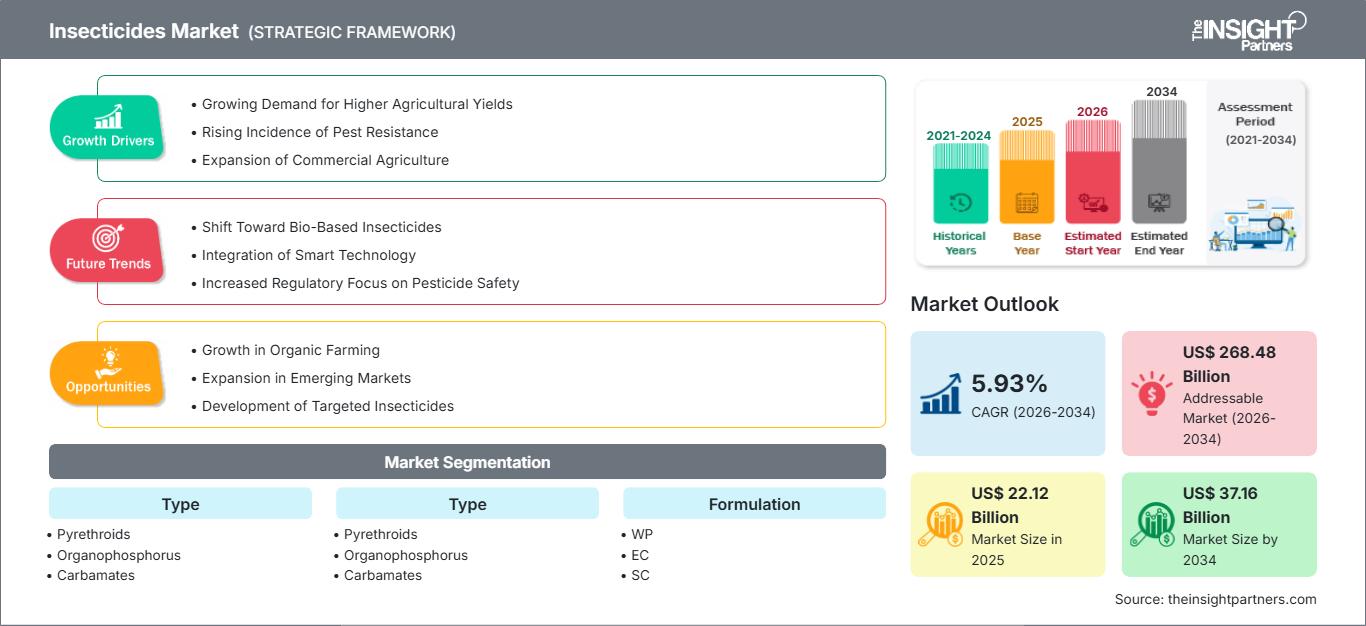
Every growing season, farmers fight a quiet battle against pests that can strip a field of its value. That battle sustains demand for crop protection, and the Insecticides Market is expected to reach US$ 37.16 Billion by 2034 from US$ 22.12 Billion in 2025, based on the data released by The Insight Partners. The report shows a CAGR of 5.93% over 2026 to 2034, with historic data from 2021 to 2024. Food demand, pest resistance and the spread of commercial farming all shape the outlook.
What Are Insecticides?
Insecticides are chemical or biological products used to control insect pests that damage crops and other plants. They come in several chemical families, including pyrethroids, organophosphorus compounds, carbamates, organochlorines and botanicals. Producers sell them in formulations such as wettable powders, emulsifiable concentrates, suspension concentrates and granules.
Request a Sample Copy of the Report: https://www.theinsightpartners.com/sample/TIPRE00040258
Market Drivers
Higher agricultural yields come first. Global food demand keeps rising, and farmers need effective pest control to protect productivity. Insecticides play a direct role in shielding crops from pests that lower yields, so demand follows the pressure on farmers to grow more from the same land.
Pest resistance is the second driver. As pests adapt to conventional treatments, farmers look for new, more effective products. Manufacturers respond by developing insecticides with novel modes of action, which gives the market a steady stream of innovation and keeps the industry moving even in mature farming regions.
Commercial agriculture expansion forms the third pillar. Large-scale farms are spreading in emerging markets, particularly across Asia Pacific and Africa. As these operations grow, efficient pest management becomes critical, and insecticide adoption rises with the need to protect crops and maximise productivity.
The opportunity set is broad. Organic farming invites natural, non-toxic pest control and creates room for biopesticides. Emerging markets in Asia Pacific and Africa offer expansion potential as farmers adopt modern methods. Targeted insecticides, which act on specific pests while sparing beneficial insects, give suppliers a way to improve efficacy and reduce environmental impact across diverse crops.
Segmentation Overview
By Type: Pyrethroids, Organophosphorus, Carbamates, Organochlorine, and Botanicals. Pyrethroids and organophosphorus products serve broad pest control needs, while carbamates and organochlorines fill established roles. Botanicals appeal to buyers who want natural ingredients.
By Formulation: WP, EC, SC, EW, ME, and GR. Wettable powders, emulsifiable concentrates, suspension concentrates, emulsions in water, micro-emulsions and granules suit different crops, application methods and safety needs. The choice affects handling and efficacy in the field.
By Crop Type: The report also assesses cereals and grains, oilseeds and pulses, fruits and vegetables, and others. Cereals and grains are expected to witness the fastest growth during the forecast period.
By Geography: North America, Europe, Asia Pacific, and South and Central America. The report examines each region and its leading countries in detail.
Key Market Players
- BASF
- Bayer Cropscience
- ChemChina
- FMC Corporation
- Corteva Agriscience
- Nufarm Limited
- UPL Limited
- Sumitomo Chemical Co., Ltd.
- Adama Agricultural Solutions
- American Vanguard Corporation
- Syngenta International AG
- Cheminova A/S
- Monsanto
- Makhteshim Agan Industries
- Shandong Weifang Rainbow Chemical Co., Ltd.
This group combines global crop science leaders with regional and generic producers. Competition in the insecticides market turns on research capability, product range and distribution reach with farmers. The report profiles each company and examines competitive strategies and innovation developments.
Sustainability and Innovation Trends
The shift toward bio-based insecticides is the leading trend. Products made from plant extracts, bacteria and essential oils offer an eco-friendly alternative, and farmers in both organic and conventional systems are paying attention. Smart technology is also entering the market, with IoT-based pest monitoring and automated application enabling precise control and less overuse. Regulatory focus on pesticide safety adds a third trend, pushing manufacturers to develop formulations that reduce risks to people, animals and the environment while keeping pest control effective.
Buy Premium Report: https://www.theinsightpartners.com/buy/TIPRE00040258
Regional Outlook
Asia Pacific held the largest share of the insecticides market, helped by the strong growth of the agrochemical sector in the region. North America is anchored by the United States, a key market supported by the push for higher yields, pest resistance and commercial agriculture expansion. Europe brings a strong regulatory focus on pesticide safety and sustainable crop protection. South and Central America adds large commercial farming areas with steady demand for pest control. The report compares these regions in detail.
Related Reports:
Agricultural Biologicals Market Size, Trends & Demand by 2034
About The Insight Partners
The Insight Partners is among the leading market research and consulting firms in the world. We take pride in delivering exclusive reports along with sophisticated strategic and tactical insights into the industry. Reports are generated through a combination of primary and secondary research, solely aimed at giving our clientele a knowledge-based insight into the market and domain. This is done to assist clients in making wiser business decisions. A holistic perspective in every study undertaken forms an integral part of our research methodology and makes the report unique and reliable.
Contact Us:
If you have any queries about this report or if you would like further information, please contact us:
Phone: +1-646-491-9876
E-mail: sales@theinsightpartners.com
Also Available in: Korean | German | Japanese | French | Chinese | Italian | Spanish
