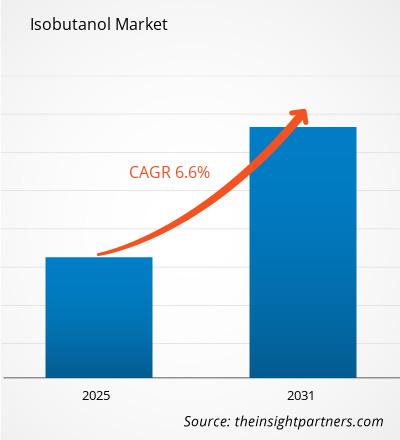
Few chemicals work as quietly behind the scenes as isobutanol. Yet the Isobutanol Market is on course to climb from US$ 1.57 Billion in 2025 to US$ 2.96 Billion by 2034, expanding at a 7.3% CAGR between 2026 and 2034. Coatings formulators, oilfield service providers and chemical producers all depend on it, and a growing push for renewable feedstocks is widening its appeal.
What Is Isobutanol?
Isobutanol is a four-carbon alcohol used as a solvent and as a building block for a wide range of downstream chemicals. Producers make it through synthetic routes based on propylene, or through fermentation of sugars and another biomass. Its balanced evaporation rate and good solvency make it a practical choice across industrial formulations.
Request a Sample Copy of the Report: https://www.theinsightpartners.com/sample/TIPRE00021794
What Is Driving Demand for Isobutanol?
Paints and coatings remain the anchor of demand. Isobutanol helps lacquers, enamels and industrial finishes flow smoothly, level evenly and dry without defects, which matters in automotive refinishing, furniture and construction coatings. As infrastructure spending and housing activity pick up in emerging economies, formulators need dependable solvents in larger volumes. That steady pull gives the isobutanol market a firm base from which to grow at 7.3% CAGR.
Chemical intermediates add a second engine. Isobutanol feeds the production of isobutyl acetate, isobutyl acrylate, plasticisers and lubricant additives, and these derivatives reach packaging, adhesives, textiles and specialty chemicals. What makes this particularly significant is the multiplier effect, because every expansion in downstream capacity translates into additional isobutanol consumption. Asia Pacific, where chemical manufacturing continues to scale up, benefits most from this dynamic.
Oil and gas contribute a more specialised, but growing, slice of demand. Isobutanol appears in oilfield chemical formulations and fuel-related applications, where its solvency and blending properties support performance requirements. Beyond that, its compatibility with existing fuel infrastructure has kept it in the conversation as industries look for cleaner-burning options. Producers that can supply consistent quality to energy customers hold a clear commercial advantage.
Then comes the shift towards renewable sourcing. Governments and corporations alike are setting decarbonisation targets, and biobased isobutanol offers a way to cut the carbon intensity of solvents and intermediates without redesigning formulations. Fermentation technology has matured, and several developers now position renewable isobutanol as a credible complement to conventional supply. Feedstock costs and process efficiency still shape competitiveness, but the direction of travel is unmistakable.
Segmentation Overview
By Type: Synthetic isobutanol benefits from established oxo-process infrastructure, which delivers scale, consistent purity and reliable supply to coatings and chemical customers. Biobased isobutanol, produced from renewable feedstocks, attracts buyers with sustainability goals and appeals to brands seeking lower-carbon ingredients.
By Application: Paints and Coatings use isobutanol as a solvent and coalescing aid in industrial and decorative systems. Oil and Gas applications draw on its role in specialised chemical formulations. Chemical Intermediates convert isobutanol into esters, acrylates and additives. Others cover uses in cleaning products, inks and laboratory or pharmaceutical processes.
By Geography: North America, Europe, Asia Pacific, and South and Central America each show distinct demand patterns, shaped by industrial output, regulation and access to feedstocks.
Key Market Players
- Dow Inc
- BASF SE
- Mitsubishi Chemical Corp
- Grupa Azoty SA
- OXEA GmbH
- Butamax Advanced Biofuels LLC
- Sasol
- TORAY INDUSTRIES INC
- Eastman Chemical Co
These companies compete on production scale, feedstock integration and technical support. Dow, BASF, OXEA, Sasol and Eastman Chemical bring deep experience in oxo chemistry and serve a broad customer base. Butamax Advanced Biofuels stands out for its focus on biobased isobutanol technology, while Mitsubishi Chemical, Toray Industries and Grupa Azoty strengthen regional supply and downstream integration.
Sustainability and Innovation Trends
Sustainability now guides investment decisions across the isobutanol market. Developers are refining fermentation strains and process designs to raise yields and lower costs, while established producers explore renewable feedstocks and energy-efficient operations. Customers increasingly ask for lower-carbon solvents with documented environmental credentials, and low-VOC coating formulations continue to reshape how isobutanol is blended and applied. Companies that pair dependable supply with credible sustainability data are winning longer contracts.
Buy Premium Report: https://www.theinsightpartners.com/buy/TIPRE00021794
Regional Outlook
North America combines strong coatings and energy demand with growing interest in renewable chemicals, supported by policy incentives for lower-carbon products. Europe pairs a mature chemical industry with strict environmental rules that favour cleaner solvents and sustainable sourcing. Asia Pacific stands out for volume growth, driven by expanding manufacturing, construction activity and downstream chemical capacity. South and Central America offer rising potential as industrial development and access to biomass feedstocks support both synthetic and biobased supply.
Related Reports:
Toluene Market Demand, Size & Forecast by 2034
Paint Thinner Market Growth, Demand & Size by 2034
Green Coating Market Size, Share & Demand by 2034
Bio-Based Ethylene Market Size, Share & Demand by 2034
About The Insight Partners
The Insight Partners is among the leading market research and consulting firms in the world. We take pride in delivering exclusive reports along with sophisticated strategic and tactical insights into the industry. Reports are generated through a combination of primary and secondary research, solely aimed at giving our clientele a knowledge-based insight into the market and domain. This is done to assist clients in making wiser business decisions. A holistic perspective in every study undertaken forms an integral part of our research methodology and makes the report unique and reliable.
Contact Us:
If you have any queries about this report or if you would like further information, please contact us:
Phone: +1-646-491-9876
E-mail: sales@theinsightpartners.com
Also Available in: Korean | German | Japanese | French | Chinese | Italian | Spanish
