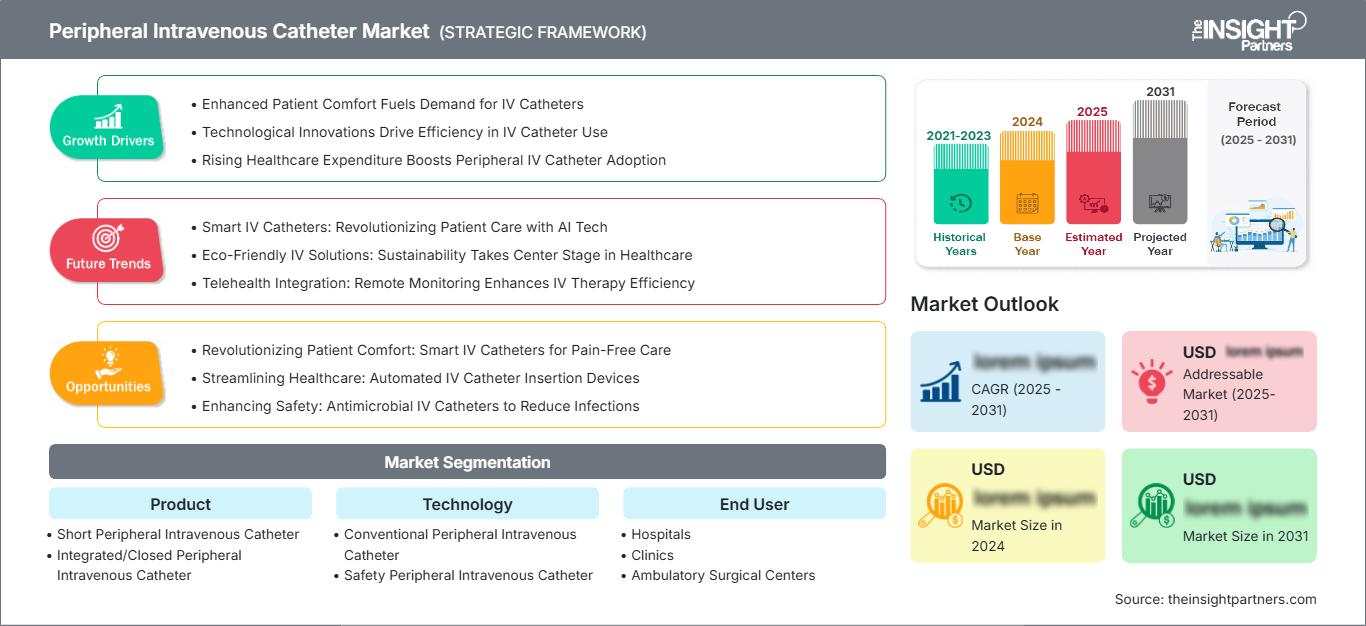
According to The Insight Partners, the Peripheral Intravenous Catheter market size is expected to reach US$ 13.24 billion by 2034 from US$ 6.86 billion in 2025. The market is anticipated to register a CAGR of 7.58% during the forecast period 2026–2034. Increasing hospital admissions, rising demand for intravenous medications and fluids, and advancements in catheter materials and designs are contributing to market expansion.
Peripheral Intravenous Catheter Market Overview
Peripheral intravenous catheters are medical devices inserted into peripheral veins to provide vascular access for administering medications, fluids, blood products, and other therapeutic solutions. They are widely used in hospitals, ambulatory surgical centers, emergency departments, and other healthcare facilities. These devices play an important role in modern patient care by enabling healthcare professionals to deliver treatments directly into the bloodstream.
Download Sample PDF – https://www.theinsightpartners.com/sample/TIPRE00005793
The growing need for intravenous therapy across acute and chronic care settings is driving demand for peripheral intravenous catheters. They are commonly used during surgical procedures, emergency treatment, chemotherapy, hydration therapy, and the management of various medical conditions. Increasing hospital admissions and the rising prevalence of chronic diseases are further contributing to the need for reliable vascular access solutions.
Key Players in the Peripheral Intravenous Catheter Market
Market participants focus on developing safer catheter designs, improving insertion technologies, expanding product portfolios, and strengthening global distribution networks. Key players operating in the market include:
- B. Braun Melsungen AG
- ICU Medical, Inc.
- Smiths Medical
- Lars Medicare Pvt. Ltd.
- BD
- Terumo Medical Corporation
- Argon Medical
- Teleflex Incorporated
- Vigmed AB and Vigmed Holding AB
- General Electric Company
Peripheral Intravenous Catheter Market Drivers and Trends
Increasing Demand for Intravenous Therapies: Peripheral intravenous catheters are essential for delivering medications, fluids, and blood products in hospitals and other healthcare settings. The rising number of surgical procedures, emergency treatments, and inpatient admissions is increasing the need for vascular access devices.
Growing Prevalence of Chronic Diseases: The increasing incidence of cancer, cardiovascular disorders, diabetes, and other chronic conditions is contributing to demand for intravenous treatments. Patients requiring repeated medication administration, hydration, and supportive care often need dependable vascular access.
Focus on Catheter-Related Infection Prevention: Healthcare providers are placing greater emphasis on reducing catheter-related bloodstream infections and other complications. This is encouraging the adoption of safety-engineered catheters, antimicrobial technologies, and improved insertion and maintenance practices.
Technological Advancements: Manufacturers are developing peripheral intravenous catheters with improved materials, flexible designs, safety mechanisms, and features that support easier insertion. These developments aim to improve patient comfort, reduce insertion-related complications, and support better clinical outcomes.
Expansion of Healthcare Infrastructure: Investments in hospitals, emergency care facilities, and ambulatory surgical centers are increasing access to medical treatment. The expansion of healthcare infrastructure, particularly in emerging economies, is creating opportunities for peripheral intravenous catheter manufacturers.
Peripheral Intravenous Catheter Market Size, Share, Trends, Analysis, and Forecast by 2034
- Market Size: The market is projected to grow from US$ 6.86 billion in 2025 to US$ 13.24 billion by 2034.
- Market Growth: The market is anticipated to register a CAGR of 7.58% during the forecast period 2026–2034.
- Key Applications: Peripheral intravenous catheters are used for fluid administration, medication delivery, blood transfusions, and perioperative care.
- Major Growth Drivers: Increasing hospital admissions, rising chronic disease prevalence, and growing demand for intravenous therapies are supporting market expansion.
- Emerging Trends: Safety-engineered devices, improved catheter materials, antimicrobial technologies, and patient-friendly designs are shaping product development.
- Competitive Landscape: Companies are focusing on product innovation, strategic partnerships, manufacturing capabilities, and distribution expansion to strengthen their market positions.
Regional Analysis
North America: North America holds a prominent position due to advanced healthcare infrastructure, high adoption of medical technologies, and strong demand for intravenous treatments. The presence of leading medical device manufacturers and increasing focus on patient safety further supports regional market growth.
United States: The US market is driven by extensive hospital infrastructure, high healthcare expenditure, and widespread use of intravenous therapies. Increasing awareness of catheter-related complications and the adoption of safety-focused devices are supporting demand.
Europe: Europe is supported by established healthcare systems, rising hospital admissions, and increasing demand for advanced vascular access devices. Greater emphasis on infection prevention and patient safety is also contributing to market development.
Asia Pacific: Asia Pacific is expected to offer significant growth opportunities due to expanding healthcare infrastructure, increasing healthcare expenditure, and a rising patient population. Growing hospital capacity and improving access to medical treatment in countries such as China, India, and Japan are supporting demand.
South and Central America: Improvements in hospital infrastructure, increasing access to healthcare services, and growing demand for intravenous treatments are contributing to market development. Investments in medical facilities are expected to create further opportunities.
Middle East and Africa: Healthcare infrastructure development, rising investments in hospitals, and increasing awareness of advanced medical technologies are supporting gradual market growth. The expansion of emergency and critical care services is also contributing to demand for peripheral intravenous catheters.
Future Outlook
The peripheral intravenous catheter market is expected to experience steady growth through 2034 as hospitals and healthcare facilities continue to rely on intravenous therapies for patient treatment. Rising chronic disease prevalence, increasing surgical procedures, and growing demand for safe vascular access devices will remain important growth factors. Furthermore, technological advancements in catheter materials, safety mechanisms, and infection prevention are expected to improve product performance and patient outcomes. Manufacturers focusing on innovation, quality, and broader healthcare access are likely to benefit from emerging market opportunities.
Get Premium Market Research Report Here: https://www.theinsightpartners.com/buy/TIPRE00005793
About Us
The Insight Partners is a one stop industry research provider of actionable intelligence. We help our clients in getting solutions to their research requirements through our syndicated and consulting research services. We specialize in industries such as Semiconductor and Electronics, Aerospace and Defense, Automotive and Transportation, Biotechnology, Healthcare IT, Manufacturing and Construction, Medical Device, Technology, Media and Telecommunications, Chemicals and Materials.
Contact Us
Ankit Mathur | The Insight Partners
Email: ankit.mathur@theinsightpartners.com
Phone: +1-646-491-9876
Also Available in : Korean | German | Japanese | French | Chinese | Italian | Spanish
