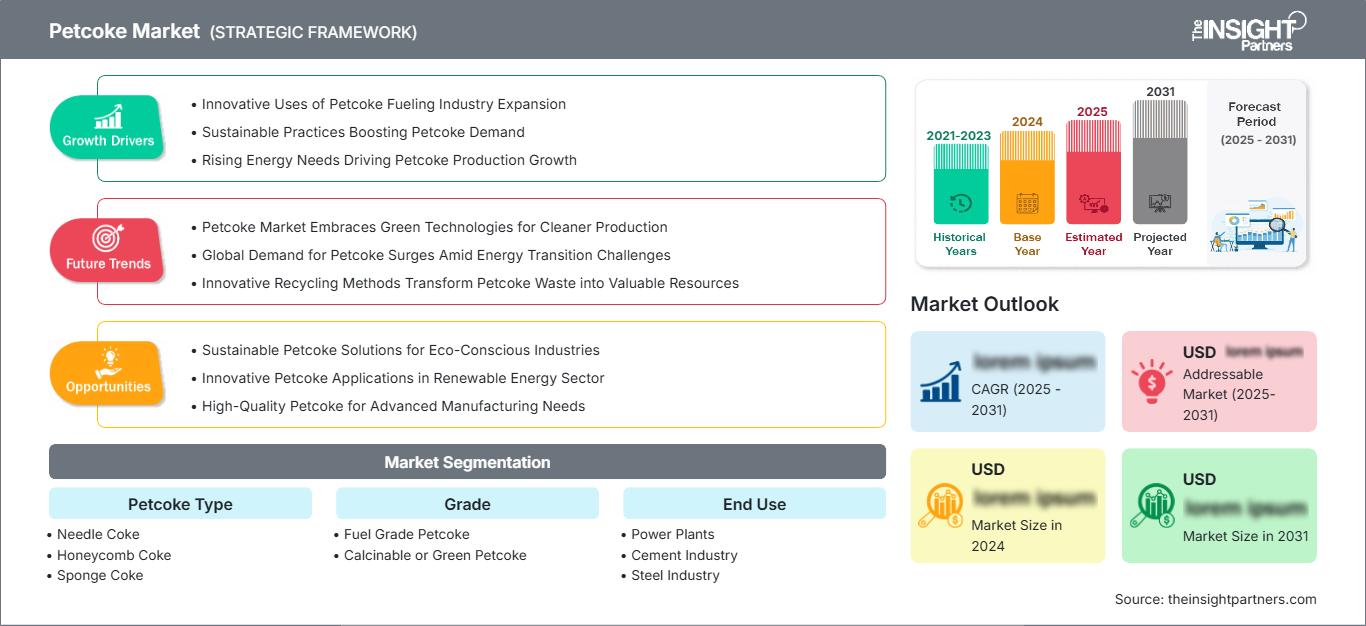
According to The Insight Partners, the Petcoke market size is expected to reach US$ 38.42 billion by 2034 from US$ 23.87 billion in 2025. The market is anticipated to register a CAGR of 5.43% during the forecast period 2026–2034. Increasing demand for industrial fuels, expanding cement production, and the use of petroleum coke in aluminum manufacturing are contributing to market expansion.
Petcoke Market Overview
Petroleum coke, commonly known as petcoke, is a carbon-rich solid material produced as a byproduct of oil refining. It is generated during the processing of heavy crude oil and residual petroleum products through refining processes such as delayed coking and fluid coking. Due to its high carbon content and calorific value, petcoke is widely used as a fuel and as a raw material in several industrial applications.
Download Sample PDF – https://www.theinsightpartners.com/sample/TIPRE00027555
The petcoke market is closely linked to developments in the global oil refining, cement, power generation, and metals industries. Fuel-grade petcoke is primarily used in cement kilns and industrial boilers because of its high energy content. Calcined petcoke is used in aluminum production, steel manufacturing, and other industrial processes. Demand across these applications is influenced by industrial output, energy requirements, petroleum refining activity, and the availability of alternative fuels.
Key Players in the Petcoke Market
Companies operating in the petcoke market include major integrated oil and gas companies and petroleum refiners. These participants focus on refining efficiency, production capacity, product quality, and distribution networks to serve industrial customers. Key players include:
- Indian Oil Corporation Ltd.
- Petrobras
- Royal Dutch Shell PLC
- Chevron Corporation
- Valero Energy Corporation
- BP PLC
- Exxon Mobil Corporation
- British Petroleum
- Marathon Petroleum Corporation
- Reliance Industries
Petcoke Market Drivers and Trends
Growing Demand from the Cement Industry: The cement industry is a major consumer of fuel-grade petcoke. Cement manufacturers use petcoke in kilns because of its high calorific value and ability to support energy-intensive production processes. Increasing construction activity and infrastructure development in emerging economies are supporting cement demand and, in turn, petcoke consumption.
Expansion of Aluminum Production: Calcined petcoke is an important raw material in the manufacture of carbon anodes used in aluminum smelting. Rising demand for aluminum in transportation, construction, packaging, and electrical applications is supporting demand for calcined petcoke. Growth in aluminum production capacity is therefore an important factor influencing the market.
Increasing Petroleum Refining Activities: Petcoke production is closely associated with the processing of heavy crude oil and refinery residues. Changes in refinery capacity, crude oil composition, and coking unit operations influence the availability of petroleum coke. Continued investment in refining infrastructure can support market supply.
High Energy Content and Industrial Applications: Petcoke offers a high carbon content and energy value, making it suitable for selected industrial fuel applications. Its use in cement kilns, power generation, and other industrial processes supports demand from energy-intensive sectors.
Environmental Regulations and Fuel Alternatives: Environmental regulations concerning sulfur emissions, particulate matter, and carbon emissions influence petcoke production, handling, and consumption. Industrial users are increasingly evaluating emission-control technologies and alternative fuels. These developments are shaping product specifications and influencing purchasing decisions across the market.
Petcoke Market Size, Share, Trends, Analysis, and Forecast by 2034
- Market Size: The market is projected to grow from US$ 23.87 billion in 2025 to US$ 38.42 billion by 2034.
- Market Growth: The market is anticipated to register a CAGR of 5.43% during the forecast period 2026–2034.
- Key Applications: Petcoke is used in cement manufacturing, power generation, aluminum production, steel manufacturing, and other industrial processes.
- Major Growth Drivers: Rising cement production, expanding aluminum manufacturing, and demand for industrial fuels are supporting market expansion.
- Emerging Trends: Refinery process improvements, demand for calcined petcoke, and greater attention to sulfur content and emissions are influencing market developments.
- Competitive Landscape: Market participants focus on refining capacity, product quality, supply-chain efficiency, and long-term relationships with industrial buyers.
Regional Analysis
North America: North America benefits from established petroleum refining infrastructure and demand from cement, aluminum, and industrial manufacturing sectors. The availability of petcoke from regional refineries supports supply, while environmental regulations influence its use and handling.
United States: The US market is supported by substantial refinery capacity and demand from cement plants, aluminum producers, and other industrial users. Refinery operations and the country’s established industrial base contribute to its position in the regional market.
Europe: The European market is influenced by industrial fuel demand, petroleum refining activity, and the aluminum and cement industries. Environmental policies and emission standards are important factors shaping petcoke consumption and the adoption of cleaner industrial technologies.
Asia Pacific: Asia Pacific is an important growth region due to expanding cement production, infrastructure development, and rising aluminum manufacturing capacity. Industrialization and increasing energy requirements in countries such as China and India support demand for petroleum coke.
South and Central America: Market development is influenced by petroleum refining activities, industrial production, and demand from cement and metals manufacturers. Infrastructure projects and investments in industrial capacity may create further opportunities.
Middle East and Africa: Refining investments, industrial diversification, and growth in construction and manufacturing are supporting regional market opportunities. The availability of petroleum coke from refineries and demand from cement and other industrial sectors influence market development.
Future Outlook
The petcoke market is expected to grow through 2034, supported by demand from cement manufacturing, aluminum production, and other industrial applications. Refinery operations will continue to influence global petcoke supply, while industrial production and infrastructure development will shape consumption patterns. At the same time, environmental regulations and efforts to reduce industrial emissions are expected to influence product quality requirements and fuel selection. Companies that improve refining efficiency, maintain consistent product specifications, and develop reliable supply networks will be better positioned to serve evolving industrial demand.
Get Premium Market Research Report Here: https://www.theinsightpartners.com/buy/TIPRE00027555
About Us
The Insight Partners is a one stop industry research provider of actionable intelligence. We help our clients in getting solutions to their research requirements through our syndicated and consulting research services. We specialize in industries such as Semiconductor and Electronics, Aerospace and Defense, Automotive and Transportation, Biotechnology, Healthcare IT, Manufacturing and Construction, Medical Device, Technology, Media and Telecommunications, Chemicals and Materials.
Contact Us
Ankit Mathur | The Insight Partners
Email: ankit.mathur@theinsightpartners.com
Phone: +1-646-491-9876
Also Available in : Korean | German | Japanese | French | Chinese | Italian | Spanish
