High-End FPGA Market competition is shaped by device performance, programmable logic capabilities, power consumption, and development ecosystems. Customers evaluate hardware alongside software tools and long-term support. Manufacturers continue to focus on improving product capabilities. These factors influence purchasing and deployment decisions.
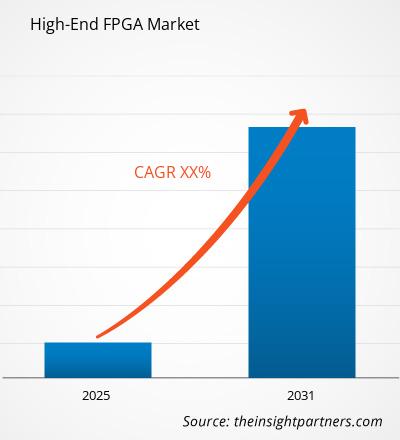
The global High-End FPGA Market is gaining momentum as industries increasingly require flexible, high-performance hardware for complex computing and data processing applications. The High-End FPGA market was valued at US$ 6.42 billion in 2025 and is expected to reach US$ 12.34 billion by 2034. It is estimated to record a CAGR of 7.53% during 2026–2034, according to the market analysis by The Insight Partners.
Field-programmable gate arrays (FPGAs) are semiconductor devices that can be configured after manufacturing to perform specific hardware functions. Unlike fixed-function integrated circuits, FPGAs allow developers to modify logic and processing architectures according to application requirements. High-end FPGAs offer advanced processing capabilities, substantial programmable logic resources, and support for demanding workloads. These characteristics make them relevant to industries requiring customized computing performance.
Rising Demand for High-Performance Computing
The growing need for faster data processing is an important factor supporting high-end FPGA adoption. Organizations are managing larger volumes of information and increasingly rely on computing systems that can process data efficiently. FPGAs support parallel processing and hardware acceleration, allowing selected workloads to be handled through customized architectures.
Get Access Report Sample: https://www.theinsightpartners.com/sample/TIPRE00022917
Data centers and cloud infrastructure providers are evaluating hardware acceleration solutions to improve computing efficiency. High-end FPGAs can be configured for specific processing tasks, including data handling and specialized computational workloads. Their flexibility allows developers to adapt hardware functions as application requirements change.
Artificial intelligence is also creating opportunities for FPGA technology. AI-related applications require substantial processing resources, particularly when handling complex data operations. FPGAs can accelerate selected workloads and provide configurable hardware architectures. Their suitability depends on the requirements of each application, including processing performance, latency, and power consumption.
Expanding Applications in Telecommunications and Industrial Systems
Telecommunications infrastructure is another area supporting market development. Advanced communication networks require high-speed signal processing, data handling, and adaptable hardware. FPGAs can support configurable networking functions and help address evolving system requirements. Their programmability is useful in environments where standards and processing needs continue to develop.
Industrial automation is also contributing to demand. Modern manufacturing facilities use electronic systems for equipment control, monitoring, and real-time processing. High-end FPGAs can be integrated into specialized industrial platforms to support customized functions. Their ability to process data in parallel makes them relevant to applications that require predictable performance.
Aerospace, defense, and automotive applications also require advanced electronic systems. Programmable hardware can support specialized signal processing, communication, and control functions. In these environments, performance, reliability, and long-term product support are important considerations.
Technology Development and Market Opportunities
Advances in semiconductor design are influencing the capabilities of high-end FPGAs. Improvements in logic density, processing resources, connectivity, and power efficiency are helping manufacturers address increasingly complex workloads. Development tools and software ecosystems also play an important role in making these devices accessible to engineers and system designers.
The expansion of edge computing is creating further opportunities. Edge systems process information closer to where it is generated, reducing dependence on centralized computing resources for certain tasks. FPGA-based hardware can provide customized acceleration for applications that require rapid local processing.
However, implementation can involve technical complexity. FPGA development requires specialized engineering skills, hardware design expertise, and verification processes. Development time, software compatibility, power consumption, and overall system costs can influence adoption. Manufacturers and technology providers are working to improve development environments and simplify integration.
Competitive Landscape and Key Players
Companies operating in the high-end FPGA market focus on semiconductor innovation, programmable logic capabilities, processing performance, and development ecosystems. Product reliability, power efficiency, design flexibility, and technical support are important factors influencing competition.
Key players in the high-end FPGA market include:
- Achronix Semiconductor Corporation
- Quick Logic Corporation
- Cobham Limited
- Efinix Inc.
- Flex Logix Technologies, Inc.
- Intel Corporation
- Xilinx
- Aldec, Inc.
- GOWIN Semiconductor Corp.
- Lattice Semiconductor
These companies participate in the broader programmable logic and semiconductor ecosystem, serving applications that require configurable hardware and specialized processing capabilities.
Get Full Copy of This Report- https://www.theinsightpartners.com/buy/TIPRE00022917
Future Outlook
The high-end FPGA market is expected to benefit from continued investment in advanced computing, telecommunications, artificial intelligence, and industrial automation. As workloads become more complex, organizations are likely to evaluate programmable hardware for applications requiring customized processing and acceleration.
Future product development may focus on improving processing capabilities, energy efficiency, connectivity, and design flexibility. The availability of development tools and integration support will also influence adoption. At the same time, addressing design complexity and implementation costs will remain important for expanding the use of high-end FPGA solutions.
About The Insight Partners
The Insight Partners is a leading market research and consulting firm delivering actionable insights through in-depth industry analysis and strategic intelligence. The firm supports clients across various industries in making informed business decisions by providing comprehensive market forecasts, competitive assessments, and growth opportunities.
Contact Us:
If you have any queries about this report or if you would like further information, please contact us:
Contact Person: Ankit Mathur
E-mail: sales@theinsightpartners.com
Phone: +1-646-491-9876
Also Available in :
