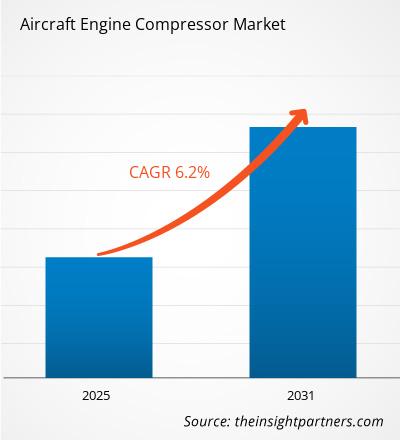
The global Aircraft Engine Compressor Market is experiencing dynamic expansion, driven by surging commercial air travel, accelerated defense sector modernization, and an intense industry-wide focus on fuel efficiency and emission reductions. Valued at US$ 9.88 Billion in 2025, the market is projected to reach US$ 18.89 Billion by 2034, expanding at a steady Compound Annual Growth Rate (CAGR) of 7.46% over the forecast period from 2026 to 2034.
As the central power unit of modern gas-turbine and turbofan propulsion systems, aircraft engine compressors play a critical role in determining overall engine thermal efficiency, fuel burn rates, and operational surge margins. Rising delivery rates of next-generation commercial narrow-body and wide-body aircraft are compelling original equipment manufacturers (OEMs) and tier-1 aerospace suppliers to scale production of advanced axial-flow and variable-geometry compressor systems.
Key Market Drivers & Industry Dynamics
Focus on Fuel Efficiency and Reduced Carbon Footprint- With stringent environmental mandates targeting net-zero carbon emissions, airlines and engine builders are prioritizing structural weight reduction and higher overall pressure ratios. Advanced compressor designs incorporating 3D-milled integrally bladed rotors (blisks), ceramic-matrix composites (CMCs), and additive manufacturing enable higher thermodynamic performance while lowering overall block fuel consumption.
Surge in Global Commercial Fleet Deliveries & Maintenance Demand- Rebounding global passenger traffic, especially across the Asia-Pacific and Middle East regions, has spurred historical backlogs for modern commercial jets. This surge not only drives demand for initial engine builds but also creates lucrative opportunities in the aftermarket maintenance, repair, and overhaul (MRO) segment as existing compressor modules undergo routine overhauls and stator blade replacements.
Technological Advancements in Variable-Geometry & Axial Systems- Axial-flow compressors continue to dominate the market share owing to their ability to stack multiple compression stages while minimizing frontal drag. Simultaneously, variable-geometry stator actuation is gaining significant traction in adaptive-cycle fighter jet programs and high-altitude unmanned aerial vehicles (UAVs), offering optimal performance across varying flight regimes.
Get a PDF Sample- https://www.theinsightpartners.com/sample/TIPRE00020695
Competitive Landscape & Key Industry Players
The global aircraft engine compressor ecosystem is characterized by strategic partnerships, heavy R&D investments, and localized supply chain developments. Key industry leaders and prominent manufacturers actively shaping the competitive landscape include:
Bharat Forge
CFM International
GE Aerospace
Honeywell Aerospace Inc.
Melrose Industries plc
MTU Aero Engines AG
Rolls-Royce Holdings plc
Safran SA
Turbocam Inc.
Collins Aerospace
These industry leaders are increasingly adopting digital twin modeling, automated blisk machining, and advanced surface-coating technologies to mitigate erosion and extend component time-on-wing. Collaborations between raw material suppliers, forging specialists, and prime propulsion manufacturers remain key to overcoming supply chain bottlenecks and meeting production schedules.
Get Full Copy of This Report- https://www.theinsightpartners.com/buy/TIPRE00020695
Future Outlook (2026–2034)
Looking ahead to 2034, the Aircraft Engine Compressor Market is poised for structural technological transformation:
Integration with Hybrid-Electric & SAF Architectures:
As alternative propulsion concepts mature, compressor designs are evolving to accommodate higher thermal loads associated with 100% Sustainable Aviation Fuel (SAF) burn profiles and hybrid-electric turbogenerator integration.
Adoption of Next-Gen Lightweight Materials:
The transition from traditional titanium and nickel-based superalloys toward ultra-light ceramic matrix composites (CMCs) and carbon-fiber reinforced polymer matrix components will accelerate. This shift is set to optimize thrust-to-weight ratios dramatically across both commercial and military aviation platforms.
Expansion of Regional MRO & Localized Manufacturing Hubs:
To hedge against global supply disruptions, major engine builders are expanding smart overhaul facilities and forging regional supplier networks across emerging aerospace corridors.
With strong macro-tailwinds from commercial fleet replacement cycles and defense modernization programs, the Aircraft Engine Compressor Market presents robust long-term expansion potential through 2034.
Related Reports-
Aircraft Engine Blade Market Trends, Share & Demand by 2034
Aircraft Engine Mro Market Size, Share & Demand by 2034
Aircraft Micro Turbine Engines Market Forecsat, Share & Demand by 2034
Aircraft Engine Component Market Scope, Share & Demand by 2034
Aircraft Engine Seals Market Analysis, Share & Demand by 2034
About The Insight Partners
The Insight Partners is a leading market research and consulting firm delivering actionable insights through in-depth industry analysis and strategic intelligence. The firm supports clients across various industries in making informed decisions by providing comprehensive market forecasts, competitive assessments, and growth opportunities.
Contact Us:
If you have any queries about this report or if you would like further information, please contact us:
Contact Person: Ankit Mathur
E-mail: sales@theinsightpartners.com
Phone: +1-646-491-9876
Also Available in : Korean| German| Japanese| French| Chinese| Italian| Spanish
