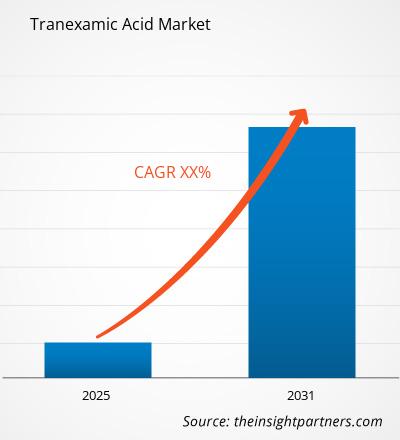
Heavy bleeding is among the oldest problems in medicine, and a low-cost molecule first developed in the 1960s still sits at the centre of how clinicians manage it. Looking ahead, the Tranexamic Acid Market is projected to reach US$ 116.28 million by 2034, up from US$ 89.81 million in 2025. That trajectory equates to a CAGR of 2.91% across the 2026 to 2034 forecast period, built on historic data from 2021 to 2024 and a 2025 base year.
What Is Tranexamic Acid?
Tranexamic acid is a synthetic derivative of the amino acid lysine that stops blood clots from breaking down too early. Clinicians use it as an antifibrinolytic to reduce bleeding in surgery, trauma and heavy menstrual cycles. Dermatology has given the molecule a second life, where it features in whitening cosmetics aimed at melasma and uneven skin tone.
Request a Sample Copy of the Report:
https://www.theinsightpartners.com/sample/TIPRE00017994
Market Drivers
Surgical volume anchors demand across the tranexamic acid market. Surgeons use the drug before and during orthopaedic, cardiac, spinal and gynaecological procedures to reduce blood loss, and anaesthetists have built it into routine protocols. Because transfusions are expensive, carry clinical risk and depend on limited donor supply, a low-cost injection that cuts their frequency is easy for hospital pharmacy committees to approve.
Trauma care adds a second, more urgent layer of demand. Large clinical trials in trauma and postpartum haemorrhage showed that early administration improves survival, and emergency services in many countries now carry the injection in ambulance and field kits. Military medical programmes and disaster-response stockpiles also hold supplies, which creates steady institutional purchasing outside the operating theatre.
Cosmetics supply the most distinctive thread in the story. Brands position the ingredient in serums and creams aimed at melasma and uneven skin tone, and consumer interest in targeted spot treatments keeps growing. Because cosmetic grades can carry different pricing and branding from generic hospital injections, even a small shift in volume can change the revenue mix.
A growth rate below 3% also needs context. Tranexamic acid is an off-patent molecule with many suppliers, so price competition holds value growth below volume growth. Mature markets in North America and Europe already use it widely, which means expansion leans on new indications, cosmetic uptake and wider access in emerging economies.
Segmentation Overview
By Form: Tablets, Injections and Oral Liquid. Injections serve operating theatres and emergency care, where intravenous delivery acts quickly and dosing can be controlled. Tablets cover outpatient needs such as heavy menstrual bleeding, while oral liquid offers an option for patients who struggle to swallow tablets and for dental use.
By Application: Surgery, Trauma, Whitening Cosmetics and Others. Surgery provides the widest clinical base because procedure volumes are large and protocols are well established. Trauma depends on emergency readiness and guideline adoption, while whitening cosmetics move with consumer trends and brand launches. The Others group captures uses such as heavy menstrual bleeding management and dental care.
By Geography: North America, Europe, Asia Pacific, and South and Central America. Each region differs in healthcare spending, generic penetration and regulatory approach, which shapes both pricing and product mix.
Key Market Players
- Asahi Kasei Finechem
- Cipla
- FDC Limited
- Hunan Dongting Pharmaceutical
- Mascot Industries
- Pfizer
- Taicang Pharmaceutical Factory
- Taj Pharmaceutical Limited
- Vega Group company limited
- Wockhardt Ltd
Pfizer brings a long-established injectable presence in hospitals worldwide. Cipla, FDC Limited, Taj Pharmaceutical Limited and Wockhardt Ltd contribute strong generic manufacturing from India, while Asahi Kasei Finechem, Hunan Dongting Pharmaceutical and Taicang Pharmaceutical Factory represent the Japanese and Chinese production base. Mascot Industries and Vega Group company limited complete the profiled group, and competition centres on supply reliability, regulatory approvals and price.
Sustainability and Innovation Trends
Pharmaceutical purity sits at the heart of innovation in this market. Suppliers are paying closer attention to cleaner synthesis routes, impurity control and consistent batch quality, since hospital buyers and regulators both scrutinise these factors. Reliable supply has become a selling point in its own right, particularly for injectable grades.
Formulation work is widening the use of the molecule. Topical and oral products, including combinations with other skincare actives, extend its reach beyond the operating theatre. Ready-to-use vials and prefilled formats are also gaining attention because they reduce dosing errors in emergencies.
Procurement rules shape adoption as well. Hospital formularies and tender systems increasingly favour suppliers that document quality and delivery performance, which rewards manufacturers with strong regulatory files. For smaller producers, partnerships with distributors and contract manufacturers offer a route into new geographies.
Buy Premium Report:
https://www.theinsightpartners.com/buy/TIPRE00017994
Regional Outlook
North America and Europe are mature, well-regulated markets where surgical protocols and emergency care guidelines already include the drug. Asia Pacific combines large patient populations, expanding hospital capacity and a deep generic manufacturing base in China and India, which makes it both a major consumer and a supply hub. South and Central America offers growth tied to improving surgical access and trauma care, and the report extends its coverage to the Middle East and Africa as well.
Pricing pressure remains a common theme across regions, since public tenders and generic competition limit premium pricing. Manufacturers that combine injectable capacity with a cosmetic-grade offering have the most room to diversify revenue, particularly where cosmetic demand is rising alongside hospital use. The report evaluates growth across each region, so buyers can compare where hospital demand, cosmetic demand and manufacturing capacity line up.
Related Reports:
Bioresorbable Polymers Market Size, Share & Trends by 2034
Sterilization Pouch Market Share, Size & Demand by 2034
Nitrile Gloves Market Demand, Size & Forecast by 2034
Pyridine and Pyridine Derivatives Market Trends, Share & Demand by 2034
About The Insight Partners
The Insight Partners is among the leading market research and consulting firms in the world. We take pride in delivering exclusive reports along with sophisticated strategic and tactical insights into the industry. Reports are generated through a combination of primary and secondary research, solely aimed at giving our clientele a knowledge-based insight into the market and domain. This is done to assist clients in making wiser business decisions. A holistic perspective in every study undertaken forms an integral part of our research methodology and makes the report unique and reliable.
Contact Us:
If you have any queries about this report or if you would like further information, please contact us:
Phone: +1-646-491-9876
Also Available in: Korean | German | Japanese | French | Chinese | Italian | Spanish
