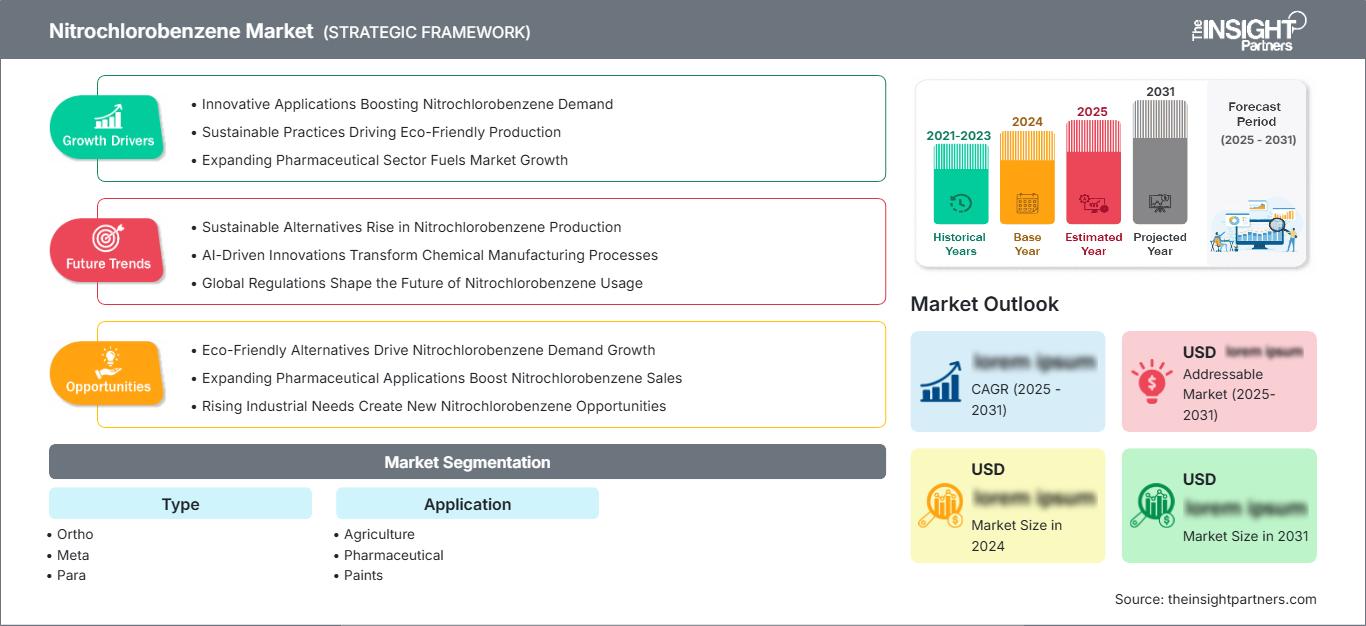
Behind many medicines, crop protection products and dyes sit a humble aromatic intermediate that few end users ever hear about. The Nitrochlorobenzene Market shows how much value hides in that corner of chemistry, with a valuation of US$ 4.13 billion in 2025 and an expected rise to US$ 8.57 billion by 2034. The report released by The Insight Partners projects a 8.45% CAGR across 2026 to 2034.
Growth rests on pharmaceutical and agrochemical intermediate demand, specialty chemical consumption and integrated manufacturing. Rising downstream synthesis volumes and the push for dependable, high-purity intermediates reinforce that outlook. Historic data from 2021 to 2024 anchors the forecast.
What Is Nitrochlorobenzene?
Nitrochlorobenzene is an aromatic intermediate made by nitrating chlorobenzene, and it exists as ortho, meta and para isomers. Producers use it to make drugs, agrochemicals, dyes, pigments and rubber chemicals. Purification and isomer control decide product quality, which is why the nitrochlorobenzene market rewards technical depth.
Request a Sample Copy of the Report: https://www.theinsightpartners.com/sample/TIPRE00015906
What Is Driving Demand for the Nitrochlorobenzene Market?
Pharmaceutical manufacturing leads the list. Nitrochlorobenzene can enter synthesis routes that lead to active pharmaceutical ingredients, so expansion in drug production lifts consumption of this intermediate. Growth across India and the wider Asia Pacific region creates demand for reliable aromatic inputs that meet tight impurity specifications.
Localisation sharpens that effect. Buyers increasingly favour regional suppliers that can cut delivery times, support audits and reduce exposure to long logistics chains. Producers respond by investing in purification, quality systems and raw material supply rather than competing on price alone.
Agrochemical production adds recurring demand. Nitrochlorobenzene derivatives serve as intermediates in crop protection chemistry, and consumption follows pesticide manufacturing cycles and agricultural output. Asia Pacific plays a central role here, because it combines a huge farming base with strong pesticide manufacturing capability.
Integration provides the third pillar. Producers that link chlorination, nitration, purification and downstream conversion use feedstock more efficiently and depend less on outside supply. Aarti Industries Limited illustrates the point through its integrated benzene chain and nitrochlorobenzene operations, and Seya Industries Limited shows how captive consumption improves economics.
Segmentation Overview
By Type: The report covers Ortho, Meta and Para. Para is the largest type, holding roughly 43% of the market in 2025 with a modelled 9% CAGR through 2034. It feeds established pharmaceutical, dye, pigment and agrochemical chains, and integrated producers can optimise isomer recovery. Ortho serves pharmaceutical, dye, pigment, agrochemical and rubber chemical pathways, while meta occupies a narrower niche tied to specific substitution patterns.
By Application: Agriculture, Pharmaceutical, Paints and Coatings industries make up the application base. Pharmaceutical applications hold roughly 31% share in 2025 and are expected to grow at about 10% CAGR through 2034, supported by controlled purity and qualified supply requirements. Agriculture follows crop protection cycles, while paints and coatings link to pigment inputs and industrial finishes.
By Geography: The report analyses North America, Europe, Asia Pacific, and South and Central America. Asia Pacific is the largest and fastest growing region.
Key Market Players
- Akzo Nobel N.V.
- BASF SE
- Dow Inc.
- Eastman Chemical Company
- Evonik Industries AG
- LG Chem, Ltd.
- Mitsubishi Chemical Corporation
- Mitsui Chemicals, Inc.
- Bayer AG
- Aarti Industries Limited
- Seya Industries Limited
Competition blends diversified chemical groups with specialist aromatic intermediate producers. BASF SE, Dow Inc., Eastman Chemical Company, Evonik Industries AG, LG Chem, Ltd., Mitsubishi Chemical Corporation and Mitsui Chemicals, Inc. add integrated chemical capability. Aarti Industries Limited and Seya Industries Limited hold visible positions in India, while Akzo Nobel N.V. and Bayer AG broaden the downstream competitive set.
Sustainability and Innovation Trends
Higher purity grades are gaining importance. Pharmaceutical and specialty chemical customers keep tightening controls on impurities, moisture and batch consistency, and qualification processes now shape supplier choice. Producers with strong analytical laboratories and process control can hold customers even when cheaper material is available.
Efficiency and containment guide investment. Regulation supports reduced waste, closed handling and better qualification, so capital flows toward debottlenecking, backward integration and process improvements rather than blind capacity additions. Industrial decarbonisation efforts, such as hydrogen integration at large chemical sites, show how the wider sector is changing.
Downstream integration offers the clearest opportunity. Producers can use existing nitration assets as platforms for higher-value pharmaceutical, agrochemical, dye and specialty molecules. That move improves value capture and reduces exposure to spot pricing.
Buy Premium Report: https://www.theinsightpartners.com/buy/TIPRE00015906
Regional Outlook
Asia Pacific held roughly 49% of the nitrochlorobenzene market in 2025 and is modelled to expand at about 10% CAGR through 2034. China leads on capacity and downstream depth, India strengthens its position through pharmaceutical and specialty chemical manufacturing, and Japan and South Korea add high specification demand.
North America represented roughly 18% of the market and Europe about 24%, with both modelled at about 7% CAGR. The United States accounts for around 86% of North American revenue, driven by pharmaceutical manufacturing and buyers who demand purity, traceability and delivery reliability. Germany leads Europe, supported by an integrated chemical industry, while South and Central America adds smaller but growing demand to the nitrochlorobenzene market.
Related Reports:
Pyridine and Pyridine Derivatives Market Trends, Share & Demand by 2034
Aromatic Solvents Market Demand, Share & Growth by 2034
Carbon Tetrachloride Market Share, Growth & Demand by 2034
Chlorpyrifos Market Size, Growth & Trends by 2034
About The Insight Partners
The Insight Partners is among the leading market research and consulting firms in the world. We take pride in delivering exclusive reports along with sophisticated strategic and tactical insights into the industry. Reports are generated through a combination of primary and secondary research, solely aimed at giving our clientele a knowledge-based insight into the market and domain. This is done to assist clients in making wiser business decisions. A holistic perspective in every study undertaken forms an integral part of our research methodology and makes the report unique and reliable.
Contact Us:
If you have any queries about this report or if you would like further information, please contact us:
Phone: +1-646-491-9876
E-mail: sales@theinsightpartners.com
Also Available in: Korean | German | Japanese | French | Chinese | Italian | Spanish
