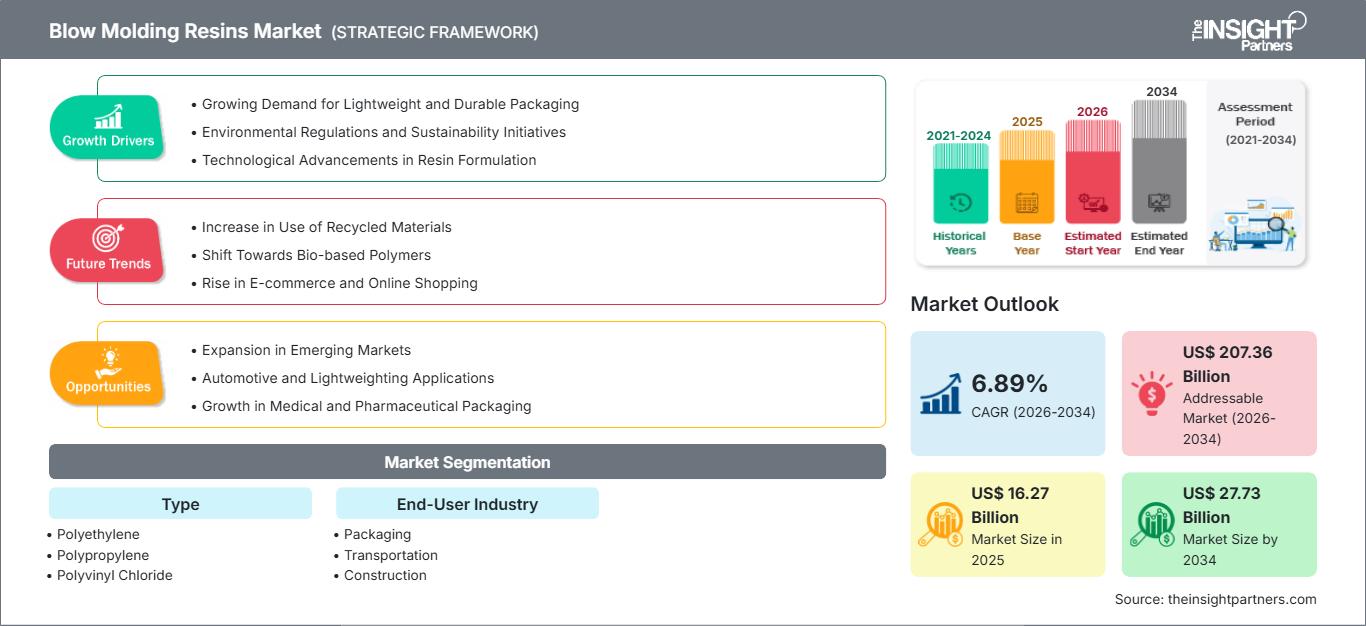
The Blow Molding Resins Market is growing at a steady pace. It was valued at US$ 16.27 billion in 2025. It is expected to reach US$ 27.73 billion by 2034. That works out to a CAGR of 6.1% between 2026 and 2034. Blow molding resins are plastics that are melted and inflated inside a mold to make hollow items. Bottles, containers, fuel tanks, and many other products are made this way. The process is fast and suits large production runs. The total addressable market is projected at about US$ 199.19 billion across 2026 to 2034.
What Is Driving the Market?
Demand for lightweight, durable packaging is the first big driver. Consumer goods, food and beverage, and pharmaceutical makers all want packs that are strong yet light. Blow-molded plastics such as polyethylene, polypropylene, and PET offer an excellent strength-to-weight ratio. They also keep costs in check, which makes them a natural fit for everyday packaging.
Environmental rules and sustainability goals are the second driver. More regulations now target single-use plastics. This pushes makers toward recyclable and biodegradable resins and toward renewable feedstocks. Bio-based PET and recycled PET are gaining ground because they fit green goals without giving up performance.
Get exclusive insights into the Blow Molding Resins Market – https://www.theinsightpartners.com/sample/TIPRE00040360
Better resin technology is the third driver. Advances in polymer science have improved heat resistance, barrier properties, and impact strength. These gains let blow molding move beyond basic packaging. Resins now go into automotive parts, medical devices, and high-performance containers.
The United States stands out as a key market. Its strong packaging sector, tight environmental rules, and active resin research all support steady demand.
There are challenges too. Resin prices follow oil and gas markets, so costs can swing. Plastic waste draws public attention. Producers that invest in recycled content and cleaner formulas can answer these concerns.
Which Segment Leads?
The market is split by type and by end-user industry.
By type, the groups are polyethylene, polypropylene, polyvinyl chloride, and polyethylene terephthalate. Polyethylene is widely used for bottles, drums, and tanks because it is tough and easy to process. Polypropylene offers good heat resistance and is common in food and personal care packs. Polyvinyl chloride suits items that need clarity and chemical resistance. PET is prized for clarity and barrier strength, which is why it is used so often for beverage bottles.
By end-user industry, the groups are packaging, transportation, construction, and electronics. Packaging is the core user, with demand from food, drinks, household goods, and healthcare. Transportation uses blow-molded parts such as fuel tanks and ducts. Construction relies on durable, weather-resistant parts. Electronics needs protective housings and components.
Which Region Leads?
The study looks at North America, Europe, Asia Pacific, and South and Central America. North America is a mature region, with the United States at its center. Strong packaging demand, high sustainability awareness, and active research help keep growth steady.
Europe is shaped by firm rules on plastic waste, which favors recycled and bio-based resins. Asia Pacific is a major manufacturing base. Industrial growth, urban expansion, and rising incomes there lift demand for packaged goods, vehicles, and consumer products. South and Central America offers room to grow as local industries develop.
Which Companies Are Prominent?
- Chevron Corp
- Dow Inc
- Eastman Chemical Co
- Exxon Mobil Corp
- Formosa Plastics Corp
- INEOS
- LyondellBasell Industries Holdings BV
- Qenos Pty Ltd
- SABIC
- Versalis SpA
These companies are large chemical and petrochemical producers. Many of them make the base polymers from raw materials such as oil and gas. That gives them scale and strong supply chains.
Competition rests on resin quality, price, and technical support. Players invest in high-performance grades and in recycled and bio-based lines. They also work closely with bottle and container makers to tune resins for specific machines and uses.
Buy the Full Report https://www.theinsightpartners.com/buy/TIPRE00040360
What Is Changing in 2026?
Recycled content is on the rise. Companies are using post-consumer recycled plastics and recycled PET in their blow molding processes. This cuts reliance on virgin plastic and supports a circular economy. Rules and corporate goals are speeding the shift.
Bio-based polymers are gaining momentum. Materials such as polylactic acid and bio-based PET offer an alternative to petroleum-based plastics. Concern over plastic pollution is pushing makers to invest in these options.
E-commerce is also changing demand. Online shopping needs safe, low-cost packaging for shipping. Blow-molded bottles, containers, and clamshell packs are widely used for food and beverage, personal care, and electronics products.
What Are the Investment Opportunities?
Emerging markets offer a clear opening. Asia Pacific, Latin America, and parts of Africa are industrializing and urbanizing. Rising incomes lift demand for packaged goods, vehicle parts, and consumer products. Suppliers can tap this with cost-effective, sustainable resins tailored to local needs.
Automotive lightweighting is another area to watch. Carmakers want lighter vehicles to improve fuel efficiency and cut emissions. Blow molding resins already go into fuel tanks, bumpers, and exterior panels. High-performance polymers with better mechanical strength can win new business.
Medical and pharmaceutical packaging also holds promise. Drug containers, device housings, and diagnostic kits need safe, sterilizable, tamper-evident packs. Resins with strong barrier properties and durability can serve this growing need.
Taken together, these trends point to a market with solid room to grow through 2034.
Related Reading / Reports
Explore additional research from The Insight Partners covering related plastics markets:
- Bottle and CSD Grade PET Market — covers the PET grades used for beverage bottles.
- Polyethylene Rotational Molding Market — looks at another molding route for hollow plastic parts.
- Polyethylene Masterbatch Market — tracks color and additive concentrates for plastics.
- Plastic Pipes Market — explores plastic piping used in building and infrastructure.
About US:
The Insight Partners is among the leading market research and consulting firms in the world. We take pride in delivering exclusive reports along with sophisticated strategic and tactical insights into the industry. Reports are generated through a combination of primary and secondary research, solely aimed at giving our clientele a knowledge-based insight into the market and domain. This is done to assist clients in making wiser business decisions. A holistic perspective in every study undertaken form an integral part of our research methodology and makes the report unique and reliable.
Contact US
If you have any queries about this report or if you would like further information, please contact us:
Phone: +1-646-491-9876
E-mail: sales@theinsightpartners.com
Also Available in : Korean | German | Japanese | French | Chinese | Italian | Spanish
