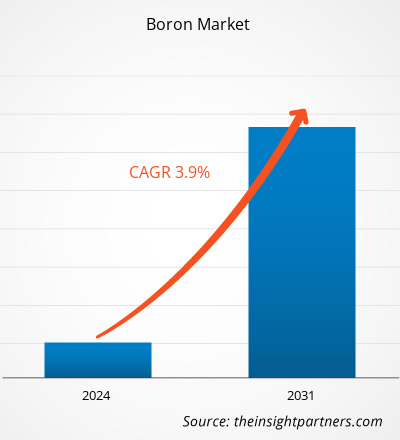
Boron may be a modest element on the periodic table, but its footprint across modern industry is anything but small. According to The Insight Partners, the Boron Market is projected to reach US$ 7.65 billion by 2031 from US$ 5.64 billion in 2023, registering a 3.9% CAGR during 2023 to 2031. Demand for borax, boric acid and boron nitride keeps climbing as farmers, glassmakers, electronics manufacturers and drug developers look for materials that perform reliably under pressure. The boron market may not expand at breakneck speed, but its steady growth reflects structural demand that rarely fades with economic cycles.
What Is Boron?
Boron is a metalloid that rarely appears on its own in nature. It is mined as borate minerals and refined into derivatives such as borax, boric acid, boron oxide, boron nitride and boron carbide. Each derivative serves a distinct purpose, from strengthening glass and enriching soils to conducting heat away from electronic components.
Request a Sample Copy of the Report: https://www.theinsightpartners.com/sample/TIPRE00005834
What Is Driving Demand in the Boron Market?
Start with the farm. Boron is an essential micronutrient, and crops such as fruit, oilseeds and vegetables yield poorly when soils run short of it. As food security pressures mount and growers chase better output from limited arable land, agrochemical demand for borates rises with them. This single end-use gives the boron market a dependable base that follows planting seasons rather than industrial downturns.
Glass and ceramics add a second pillar. Borosilicate glass resists thermal shock, which is why it appears in laboratory ware, cookware, pharmaceutical vials and fibreglass insulation. Ceramic makers use boron compounds as fluxes that lower firing temperatures and improve glaze quality. Construction activity and housing demand across emerging economies keep both segments busy, and that feeds directly into boron market volumes.
What makes this particularly significant is the shift towards advanced derivatives. Boron nitride, prized for combining high thermal conductivity with electrical insulation, is finding a home in power electronics, semiconductors and thermal management components. Boron carbide, one of the hardest materials available, protects people through lightweight armour and serves abrasive and nuclear applications. These higher value derivatives lift revenue per tonne even when volume growth is modest.
Beyond that, detergents rely on borates as buffering and bleaching agents, while pharmaceuticals use boric acid in antiseptic and ophthalmic preparations. So why does the boron market grow at 3.9% rather than faster? Mature uses such as glass and detergents expand slowly, and mineral supply is concentrated in a handful of regions. The balance between steady incumbents and fast rising specialities defines the outlook through 2031.
Segmentation Overview
By Derivative: The report covers borax, boric acid, boron nitride, boron carbide, boron oxide and others. Borax and boric acid anchor volumes thanks to their broad use in glass, detergents and agriculture. Boron nitride and boron carbide command premium pricing in electronics, abrasives and protective applications, while boron oxide supports specialty glass and fibre production.
By End-Use Industry: Agrochemicals, glass, ceramics, detergents, pharmaceuticals, electrical and electronics, and others form the end-use view. Agrochemicals and glass supply the bulk of steady consumption, with ceramics and detergents adding consistent demand. Pharmaceuticals and electrical and electronics are smaller but technically demanding, rewarding suppliers that deliver purity and consistency.
By Geography: The study examines North America, Europe, Asia Pacific, South and Central America, and the Middle East and Africa. Each region strikes a different balance between mining, refining and consumption.
Key Market Players
- Nippon Denko Co., Ltd
- Hoganas AB
- 3M Co
- Ube Corporation
- Arkema SA
- JFE Mineral & Alloy Co Ltd
- Tokyo Chemical Industry Co Ltd
- Rio Tinto Ltd
- Compagnie de Saint Gobain SA
- Eti Maden
- Stella Chemifa Corporation
- FREEMAN (JAPAN) Co Ltd
- KROSAKI HARIMA CORPORATION
- Washington Mills Electro Minerals Limited
- Boron Specialties, LLC
Rio Tinto and Eti Maden sit close to the mineral source, which gives them real influence over supply and pricing. Arkema, 3M and Compagnie de Saint Gobain bring deep downstream expertise in advanced materials, while Nippon Denko, Ube Corporation and Tokyo Chemical Industry serve precision applications in electronics and chemicals. Across the boron market, application know-how counts as much as access to ore.
Sustainability and Innovation Trends
Producers face growing pressure to cut water and energy use in mining and refining, and many are exploring cleaner processing routes and better recovery of borate residues. Regulatory attention on certain borates in Europe is also nudging formulators towards careful handling and substitution studies. Sustainability is now part of the commercial case, not an afterthought.
Innovation is moving just as quickly. Researchers are pushing boron nitride into thinner, more efficient thermal management materials for compact electronics, and boron-based compounds are attracting interest in lightweight composites and energy storage. These advances suggest the boron market will lean increasingly on specialised derivatives to sustain growth.
Buy Premium Report: https://www.theinsightpartners.com/buy/TIPRE00005834
Regional Outlook
Asia Pacific leads consumption, powered by glass, ceramics, electronics and agriculture across China, India, Japan and South Korea. North America pairs established borate mining with steady demand from glass and agrochemicals. Europe leans on advanced ceramics, electronics and specialty chemicals, all under strict chemical regulation. South and Central America, along with the Middle East and Africa, are smaller markets but offer room to grow as farming and construction expand.
Related Reports:
Ceramic Binders Market Challenges, Drivers, Trends and Forecast by 2031
Superabrasive Market Growth, Trends & Demand by 2034
Thermal Interface Materials Market by Expert Industry Analysis 2031
Electrical Insulation Materials Market Size, Demand & Growth by 2034
About The Insight Partners
The Insight Partners is among the leading market research and consulting firms in the world. We take pride in delivering exclusive reports along with sophisticated strategic and tactical insights into the industry. Reports are generated through a combination of primary and secondary research, solely aimed at giving our clientele a knowledge-based insight into the market and domain. This is done to assist clients in making wiser business decisions. A holistic perspective in every study undertaken forms an integral part of our research methodology and makes the report unique and reliable.
Contact Us:
If you have any queries about this report or if you would like further information, please contact us:
Phone: +1-646-491-9876
E-mail: sales@theinsightpartners.com
Also Available in: Korean | German | Japanese | French | Chinese | Italian | Spanish
