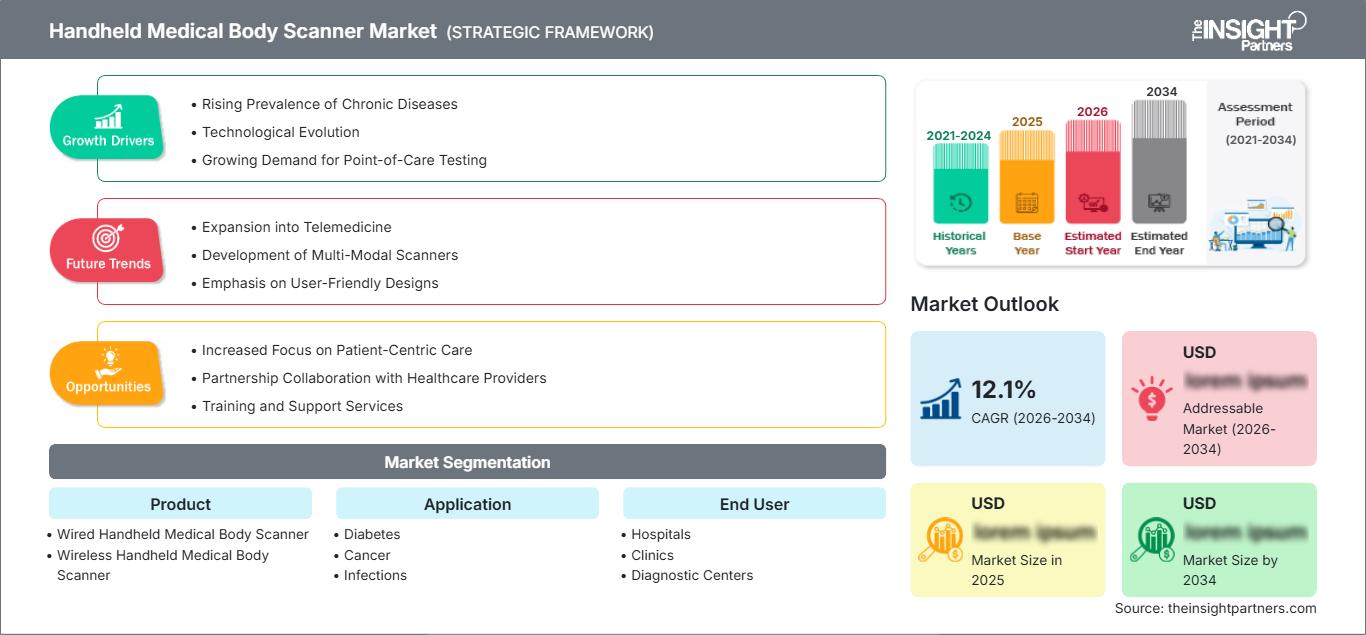
According to The Insight Partners, the Handheld Medical Body Scanner Market is expected to reach US$ 3.54 billion by 2034 from US$ 1.37 billion in 2025, registering a CAGR of 11.12% during 2026–2034. The market is witnessing substantial growth due to increasing demand for portable diagnostic equipment, rapid advancements in medical imaging technologies, and the expanding adoption of point-of-care diagnostics across hospitals, emergency departments, and home healthcare settings.
Handheld medical body scanners have transformed diagnostic imaging by offering compact, lightweight, and highly efficient alternatives to traditional imaging equipment. These devices provide healthcare professionals with immediate access to diagnostic information at the patient’s bedside, enabling faster treatment decisions and improving workflow efficiency. Their portability makes them particularly valuable in emergency medicine, critical care units, rural healthcare facilities, ambulatory surgical centers, and military medical operations.
Download Sample PDF – https://www.theinsightpartners.com/sample/TIPRE00015573
The increasing burden of chronic diseases such as cardiovascular disorders, cancer, musculoskeletal conditions, and respiratory illnesses continues to fuel demand for early and accurate diagnostic tools. Handheld medical body scanners allow physicians to perform quick examinations without requiring patients to visit dedicated imaging departments. This capability significantly reduces waiting times while improving patient convenience and healthcare accessibility.
Technological advancements are playing a pivotal role in shaping the market landscape. Manufacturers are integrating artificial intelligence (AI), cloud connectivity, wireless communication, and advanced image processing capabilities into handheld scanners. AI-powered software assists clinicians in image interpretation, automated measurements, and clinical decision support, helping improve diagnostic accuracy while reducing operator dependency. Cloud-enabled platforms further facilitate secure storage, remote consultation, and seamless integration with hospital information systems.
Handheld Medical Body Scanner Market Size, Share, Trends, Analysis, and Forecast by 2034
– Market Size: The global Handheld Medical Body Scanner Market is projected to reach US$ 3.54 billion by 2034, increasing from US$ 1.37 billion in 2025. The market is expected to register a CAGR of 11.12% from 2026 to 2034.
The Insight Partners
– Market Share: North America holds the largest revenue share, supported by advanced healthcare infrastructure, increasing adoption of portable diagnostic technologies, and rising demand for point-of-care testing solutions.
The Insight Partners
– Market Trends: Growing adoption of wireless handheld scanners, AI-enabled diagnostic technologies, real-time imaging, and portable scanning solutions is shaping market developments. Increasing demand for convenient and efficient diagnostic procedures is also supporting technological innovation.
– Market Analysis: The market is segmented by product into wired and wireless handheld medical body scanners. By application, it covers diabetes, cancer, infections, and other conditions. Hospitals, clinics, and diagnostic centers represent key end-user segments.
The Insight Partners
– Market Forecast: The market is expected to witness strong growth through 2034, driven by technological advancements, increasing chronic disease prevalence, expanding point-of-care diagnostics, and rising demand for patient-centric healthcare solutions. Asia Pacific is anticipated to register the fastest regional growth during the forecast period.
Artificial intelligence integration remains one of the most transformative trends in the market. AI algorithms assist healthcare professionals in identifying anatomical structures, detecting abnormalities, and generating standardized reports. This reduces examination variability while enabling less experienced clinicians to perform accurate diagnostic evaluations with greater confidence.
Wireless connectivity has become a standard feature in modern handheld medical body scanners. Many devices now connect directly to smartphones, tablets, or cloud-based platforms, allowing physicians to review images instantly and share diagnostic findings with specialists remotely. This capability enhances collaborative healthcare and supports teleconsultation services across geographically dispersed regions.
The increasing demand for affordable healthcare solutions is encouraging healthcare facilities to adopt handheld imaging devices instead of investing in expensive conventional imaging systems. Smaller clinics and rural hospitals particularly benefit from these portable scanners due to their lower acquisition costs, minimal maintenance requirements, and operational flexibility.
Emerging economies are presenting substantial growth opportunities for manufacturers. Improving healthcare infrastructure, rising healthcare expenditure, expanding medical insurance coverage, and increasing awareness regarding early disease diagnosis are contributing to higher adoption of portable medical imaging technologies in developing countries.
Despite strong growth prospects, the market faces certain challenges. High initial investment costs for advanced handheld scanners, data security concerns associated with cloud-connected devices, and regulatory compliance requirements may limit market expansion in certain regions. Additionally, proper training remains essential to ensure accurate image acquisition and interpretation by healthcare professionals.
Nevertheless, continuous innovation, expanding clinical applications, and increasing government initiatives supporting digital healthcare are expected to create favorable market conditions throughout the forecast period. Companies are actively focusing on product innovation, software enhancements, strategic partnerships, and geographic expansion to strengthen their competitive positions in the global market.
The future of the handheld medical body scanner market will be shaped by ongoing developments in artificial intelligence, machine learning, wireless imaging, miniaturization, and cloud-based healthcare ecosystems. As healthcare providers continue prioritizing early diagnosis, personalized medicine, and decentralized healthcare delivery, handheld medical body scanners will become indispensable tools across multiple clinical specialties.
Key Players
- CREAFORM
- Butterfly Network, Inc.
- Clarius Mobile Health.
- Koninklijke Philips N.V.
- FUJIFILM Sonosite, Inc.
- Healcerion Co., Ltd.
- Meditech Equipment Co.,Ltd
- TERASON DIVISION TERATECH CORPORATION.
- Sonostar Technologies Co., Limited
- GENERAL ELECTRIC COMPANY
The future outlook for the handheld medical body scanner market remains highly promising, supported by continuous advancements in medical imaging technologies, artificial intelligence (AI), and portable healthcare solutions. As healthcare systems increasingly prioritize early disease detection, point-of-care diagnostics, and patient-centered care, handheld medical body scanners are expected to become an integral component of modern clinical practice.
Get Premium Market Research Report Here: https://www.theinsightpartners.com/buy/TIPRE00015573
About Us
The Insight Partners is a one stop industry research provider of actionable intelligence. We help our clients in getting solutions to their research requirements through our syndicated and consulting research services. We specialize in industries such as Semiconductor and Electronics, Aerospace and Defense, Automotive and Transportation, Biotechnology, Healthcare IT, Manufacturing and Construction, Medical Device, Technology, Media and Telecommunications, Chemicals and Materials.
Contact Us
Ankit Mathur | The Insight Partners
E-mail: ankit.mathur@theinsightpartners.com
Phone: +1-646-491-9876
Also Available in : Korean | German | Japanese | French | Chinese | Italian | Spanish
