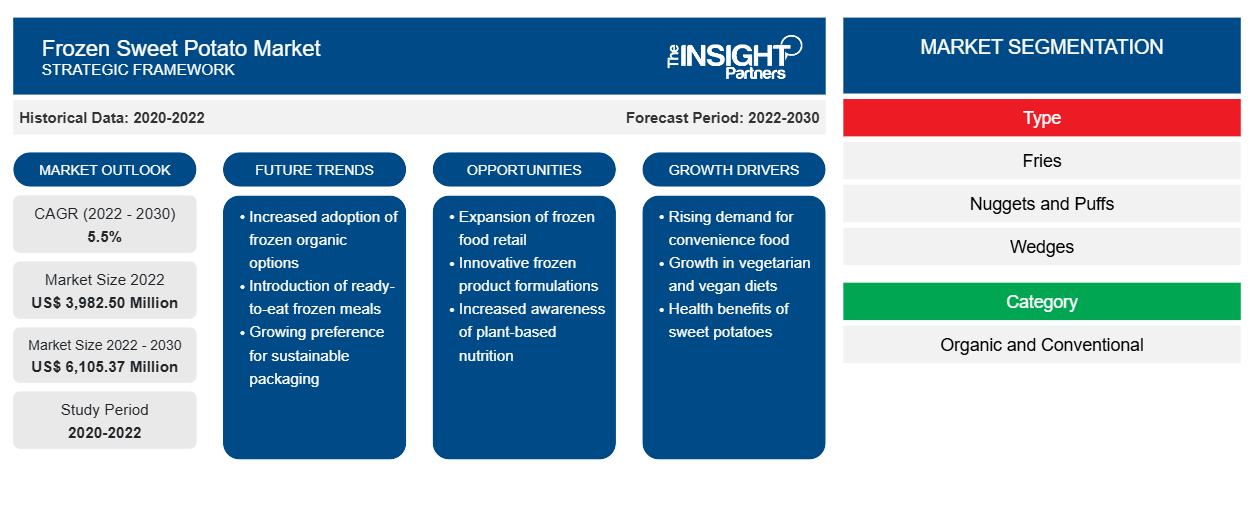
The Frozen Sweet Potato Market was valued at US$ 3,982.50 million in 2022 and is projected to reach US$ 6,105.37 million by 2030, registering a CAGR of 5.5% during 2022–2030. The market is experiencing notable growth due to rising consumer demand for convenient food products, increasing awareness regarding the nutritional benefits of sweet potatoes, and the expanding popularity of frozen vegetables worldwide. Frozen sweet potato products offer consumers year-round availability, extended shelf life, and ease of preparation, making them a preferred choice among households, foodservice operators, and food manufacturers. The growing trend toward healthy eating and convenient meal solutions continues to support the expansion of the market across global regions.
Market Analysis and Overview
- Growing Demand for Convenient and Ready-to-Cook Food Products
One of the primary drivers of the frozen sweet potato market is the increasing demand for convenient food products. Modern consumers seek meal solutions that save preparation time while maintaining nutritional quality. Frozen sweet potatoes provide convenience through easy storage, quick cooking, and minimal preparation requirements. This convenience factor is helping boost demand among busy households and working professionals.
- Rising Popularity of Nutrient-Rich Vegetable Products
Sweet potatoes are widely recognized for their nutritional profile, containing fiber, vitamins A and C, antioxidants, and essential minerals. As health-conscious consumers increasingly prioritize nutrient-dense foods, frozen sweet potato products are gaining popularity as healthy alternatives to traditional potato-based products and processed snacks.
Get Sample PDF – https://www.theinsightpartners.com/sample/TIPRE00038960
- Expanding Applications in Foodservice and Processed Foods
The foodservice sector remains a major consumer of frozen sweet potato products. Restaurants, quick-service chains, hotels, and catering businesses increasingly incorporate sweet potato fries, wedges, cubes, and purees into menus due to strong consumer demand. In addition, food manufacturers utilize frozen sweet potatoes in soups, frozen meals, bakery products, snacks, and prepared food applications.
- Growing Consumer Preference for Healthy Snacking
Consumers are increasingly shifting toward healthier snack alternatives with better nutritional profiles. Frozen sweet potato fries and baked sweet potato snacks are becoming popular options due to their natural sweetness, high fiber content, and perceived health benefits. This trend is encouraging manufacturers to expand their sweet potato-based snack portfolios.
- Advancements in Freezing and Preservation Technologies
Technological advancements in freezing methods have enabled manufacturers to maintain the texture, flavor, color, and nutritional value of sweet potatoes more effectively. Improved cold chain logistics and storage infrastructure have further enhanced product quality and distribution efficiency, supporting market growth worldwide.
Key Market Drivers
Rising demand for convenient and ready-to-cook food products.
Growing consumer awareness regarding the nutritional benefits of sweet potatoes.
Increasing popularity of healthy frozen vegetable products.
Expansion of foodservice and hospitality industries.
Rising consumption of frozen snacks and side dishes.
Growth in retail distribution and e-commerce food sales.
Improved freezing and food preservation technologies.
Increasing preference for plant-based and vegetable-rich diets.
Major Market Trends
- Rising Demand for Sweet Potato Fries
Sweet potato fries have become one of the most popular product segments within the market. Consumers increasingly choose sweet potato fries as a healthier alternative to conventional French fries due to their nutritional advantages and unique flavor profile.
- Growth of Organic Frozen Sweet Potato Products
The demand for organic food continues to grow as consumers seek products free from synthetic pesticides and artificial additives. Organic frozen sweet potato products are gaining traction among health-conscious buyers and premium food consumers.
- Expansion of Plant-Based Food Categories
The increasing adoption of vegetarian, vegan, and flexitarian lifestyles is supporting demand for frozen vegetables and plant-based meal ingredients. Frozen sweet potatoes serve as versatile ingredients in a variety of plant-based food formulations.
- Sustainable Packaging Initiatives
Food manufacturers are investing in environmentally friendly packaging materials to align with sustainability trends. Recyclable and reduced-plastic packaging solutions are becoming increasingly important within the frozen food industry.
Market Segmentation Insights
By Product Type
Frozen Sweet Potato Fries
Frozen Sweet Potato Wedges
Frozen Sweet Potato Cubes
Frozen Sweet Potato Puree
Other Frozen Sweet Potato Products
Frozen sweet potato fries account for a significant share of the market due to their widespread adoption in foodservice establishments and household consumption.
By Nature
Conventional Frozen Sweet Potatoes
Organic Frozen Sweet Potatoes
Conventional frozen sweet potatoes continue to dominate the market due to their affordability, broad availability, and extensive retail presence.
By Distribution Channel
Supermarkets and Hypermarkets
Convenience Stores
Specialty Food Stores
Online Retail
Foodservice Distribution
Supermarkets and hypermarkets remain the primary distribution channels because of strong product visibility and extensive consumer foot traffic.
By End User
Households
Restaurants
Quick-Service Restaurants
Hotels and Catering Services
Food Manufacturers
The foodservice segment represents a substantial market share due to increasing use of frozen sweet potato products in restaurant chains, cafés, and hospitality operations.
Regional Market Insights
North America holds a significant share of the frozen sweet potato market due to high frozen food consumption, strong awareness regarding healthy eating habits, and growing demand for sweet potato fries in the foodservice industry. The United States remains one of the largest consumers of frozen sweet potato products globally.
Europe continues to show strong market growth driven by increasing preference for healthy convenience foods, rising demand for frozen vegetables, and expanding plant-based food consumption. Countries such as Germany, the United Kingdom, France, and the Netherlands are key contributors to market demand.
Asia Pacific is expected to witness robust growth during the forecast period. Rising urbanization, increasing disposable incomes, growing frozen food consumption, and expanding retail infrastructure are driving demand across China, India, Japan, South Korea, and Australia.
Top Players in the Frozen Sweet Potato Market
Some of the leading companies operating in the frozen sweet potato market include:
Lamb Weston Holdings, Inc.
McCain Foods Limited
Aviko B.V.
Farm Frites International B.V.
Ardo Group
Greenyard NV
Simplot Company
Bonduelle Group
B&G Foods, Inc.
Pizzoli S.p.A.
Agristo NV
Ore-Ida
These companies focus on product innovation, capacity expansion, sustainable sourcing practices, strategic partnerships, and distribution network enhancement to strengthen their positions in the global frozen sweet potato market.
Get the Premium Research Report @ https://www.theinsightpartners.com/buy/TIPRE00038960
Future Outlook
The frozen sweet potato market is expected to maintain steady growth through 2030, supported by increasing demand for nutritious convenience foods, expanding foodservice applications, and rising consumer preference for healthier snack alternatives. Manufacturers are likely to continue investing in premium product development, organic offerings, advanced freezing technologies, and sustainable packaging solutions to capture emerging opportunities. The growing popularity of plant-based diets, expanding frozen food categories, and increasing retail penetration are expected to further accelerate market development. As consumers continue to seek convenient, flavorful, and nutrient-rich food products, the market is projected to grow from US$ 3,982.50 million in 2022 to US$ 6,105.37 million by 2030, registering a CAGR of 5.5% during 2022–2030.
FAQs
- What is the projected size of the Frozen Sweet Potato Market by 2030?
The Frozen Sweet Potato Market is projected to reach US$ 6,105.37 million by 2030, growing from US$ 3,982.50 million in 2022.
- What is the expected CAGR of the Frozen Sweet Potato Market?
The market is expected to register a CAGR of 5.5% during 2022–2030.
- What factors are driving the growth of the Frozen Sweet Potato Market?
Major growth drivers include increasing demand for convenient food products, rising awareness of sweet potato nutrition, expanding foodservice applications, growing healthy snacking trends, and advancements in freezing technologies.
- Which product segment holds a significant share of the Frozen Sweet Potato Market?
Frozen sweet potato fries hold a significant share of the market due to their popularity in restaurants, quick-service chains, and household meal preparation, as well as their reputation as a healthier alternative to traditional fries.
Trending Report –
About The Insight Partners
The Insight Partners is a global leader in market research, delivering comprehensive analysis and actionable insights across diverse industries. The company empowers decision-makers with data-driven intelligence to navigate evolving markets and accelerate growth.
Contact Us:
Contact Person: Ankit Mathur
E-mail: ankit.mathur@theinsightpartners.com
Phone: +1-646-491-9876
Also Available in : Korean | German | Japanese | French | Chinese | Italian | Spanish
