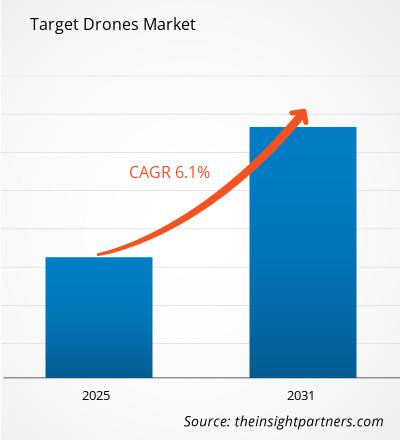
The global target drones market is experiencing sustained expansion as defense forces worldwide accelerate investments in live-fire military training, weapons testing, and next-generation threat simulation. The global Target Drones Market size is projected to reach US$ 8.49 billion by 2034 from US$ 4.44 billion in 2025. The market is anticipated to register a CAGR of 7.47% during the forecast period 2026–2034.
Escalating geopolitical tensions and rapid advancements in aerial warfare have transformed how armed forces prepare for modern combat. Rather than relying solely on traditional static targets or costly manned aircraft for exercises, military branches across North America, Europe, Asia-Pacific, and the Middle East are increasingly deploying unmanned target systems. These platforms replicate the radar signatures, infrared profiles, speeds, and evasive maneuvers of hostile fighter jets, cruise missiles, hypersonic vehicles, and loitering munitions, providing a cost-effective and realistic environment to validate air defense and interceptor networks.
Key Market Drivers and Technological Shifts
Rising global defense budgets and the proliferation of unmanned aerial systems (UAS) on modern battlefields are primary catalysts behind market demand. Modern air and missile defense systems ranging from shipborne naval interceptors to ground-based anti-aircraft batteries require rigorous, repeatable testing against complex, multi-vector threats. Target drones bridge this gap by offering configurable threat-replication capabilities, including sea-skimming flight profiles, high-G maneuvers, and electronic warfare payloads.
Furthermore, the rapid rise of counter-UAS operations has generated substantial demand for smaller, agile target drones capable of mimicking hostile drone swarms and low-altitude saturation attacks. Simultaneously, advancements in autonomous flight controls, telemetry, and real-time scoring instrumentation are enhancing mission efficiency while reducing operator workload on test ranges.
Get a PDF Sample- https://www.theinsightpartners.com/sample/TIPRE00017942
Competitive Landscape and Key Players
The global target drones market is characterized by continuous innovation, defense contract awards, and strategic product development among established aerospace and defense contractors. Leading companies operating in the global target drones market include:
AeroTargets International LLC.
Denel Dynamics
Griffon Aerospace
Kratos Defense and Security Solutions, Inc.
Leonardo S.p.A.
Lockheed Martin Corporation
Northrop Grumman Corporation
QinetiQ
Saab AB
Thales Group
Industry leaders are actively expanding their portfolios to address emerging defense requirements. For instance, manufacturers are developing reusable, recoverable high-speed jet targets alongside expendable low-cost platforms to support high-tempo training exercises. Recent defense procurement initiatives also highlight growing investments in hypersonic test targets and subsonic anti-ship cruise-missile simulators to ensure allied forces maintain operational readiness against evolving aerial and maritime threats.
Regional Insights
North America continues to hold a leading share of the global market, underpinned by substantial defense spending, ongoing modernization programs by the U.S. Department of Defense, and frequent joint military exercises. Europe represents another major market as nations strengthen regional air defense architectures and collaborative defense research. Meanwhile, the Asia-Pacific region is poised for rapid growth, driven by rising military expenditures, domestic drone manufacturing initiatives, and naval fleet expansions across countries such as India, Japan, Australia, and South Korea.
Get Full Copy of This Report- https://www.theinsightpartners.com/buy/TIPRE00017942
Future Outlook
Looking ahead through 2034, the target drones market is expected to undergo a major technological evolution toward artificial intelligence (AI)-driven autonomy, swarm simulation, and multi-domain operations. Future target systems will increasingly incorporate AI-enabled flight algorithms capable of executing unpredictable evasive maneuvers and dynamic tactical responses during live-fire drills, moving beyond pre-programmed flight paths.
Additionally, the integration of Live, Virtual, and Constructive (LVC) training architectures will allow physical target drones to seamlessly interact with digital simulations, enabling armed forces to conduct large-scale, multi-threat combat exercises at a fraction of traditional operational costs. Demand for dual-purpose platforms capable of serving both as training targets and tactical decoys or electronic warfare assets is also anticipated to rise, cementing target drones as indispensable components of global defense readiness over the next decade.
Related Reports-
Nano Drones Market Size, Trends & Growth by 2034
Firefighting Drones Market Share, Trends & Growth by 2034
About The Insight Partners
The Insight Partners is a leading market research and consulting firm delivering actionable insights through in-depth industry analysis and strategic intelligence. The firm supports clients across various industries in making informed decisions by providing comprehensive market forecasts, competitive assessments, and growth opportunities.
Contact Us:
If you have any queries about this report or if you would like further information, please contact us:
Contact Person: Ankit Mathur
E-mail: sales@theinsightpartners.com
Phone: +1-646-491-9876
Also Available in : Korean| German| Japanese| French| Chinese| Italian| Spanish
