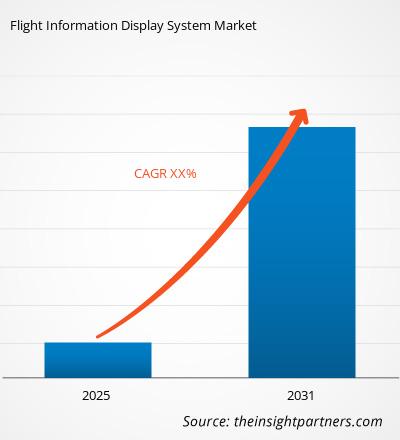
The global Flight Information Display System Market size is projected to reach US$ 1,116.56 million by 2034 from US$ 639.54 million in 2025. The market is anticipated to register a CAGR of 6.39% during the forecast period 2026–2034, driven by surging international air passenger traffic, large-scale airport terminal expansion programs, and the global transition toward automated, cloud-connected aviation hubs.
As global air travel continues to expand, airports are under mounting pressure to streamline terminal operations, minimize passenger congestion, and deliver seamless, real-time journey updates. Flight Information Display Systems serve as the central visual communication backbone of modern aviation facilities, aggregating live operational data including gate assignments, boarding statuses, flight delays, baggage carousel allocations, and weather advisories and broadcasting them across terminals, concourses, lounges, and mobile interfaces.
Key Market Drivers and Industry Trends
A primary catalyst fueling market expansion is government-backed investment in aviation infrastructure and smart-airport modernization. Aviation authorities across North America, Europe, and Asia-Pacific are channeling substantial capital into upgrading aging terminals and constructing greenfield airports. For instance, ongoing federal terminal development initiatives and regional airport expansion blueprints require integrated digital wayfinding and dynamic display networks to manage rising passenger throughput efficiently.
Simultaneously, the industry is experiencing a decisive technological shift from legacy on-premise hardware toward cloud-based and Software-as-a-Service (SaaS) FIDS architectures. Cloud-native FIDS platforms enable airport operators to manage multi-terminal display networks centrally, reduce local server maintenance burdens, and deploy real-time software updates rapidly. Furthermore, airports are increasingly leveraging high-resolution LED and OLED display panels not only for operational flight data, but also as dynamic digital signage platforms to generate non-aeronautical revenue through targeted retail promotions, concession advertising, and emergency communications.
Get a PDF Sample- https://www.theinsightpartners.com/sample/TIPRE00018342
Market Restraints and Operational Challenges
Despite strong growth momentum, the market faces notable headwinds, particularly high upfront hardware and system integration costs. Modern FIDS deployments must ingest and synchronize real-time data streams from disparate aviation ecosystems, including Airport Operational Databases (AODB), airline departure control systems, baggage handling networks, and air traffic management feeds. Integrating modern display software with legacy airport IT infrastructure often requires complex, costly middleware upgrades. Additionally, as display networks become increasingly interconnected via cloud and IoT frameworks, safeguarding critical operational data against cybersecurity vulnerabilities remains a top priority for aviation stakeholders.
Competitive Landscape and Key Players
The global Flight Information Display System market is moderately consolidated, characterized by continuous product innovation, strategic airport partnerships, and investments in AI-driven passenger flow analytics. Leading vendors are focusing on energy-efficient display hardware, multilingual passenger interfaces, and seamless API integrations with broader airport management suites.
Key players profiled in the global Flight Information Display System market include:
ADB SAFEGATE
Amadeus IT Group SA
Collins Aerospace, a Raytheon Technologies Corporation
Flyte Systems
Indra Sistemas
InterSystems
NEC Corporation
RESA AIRPORT DATA SYSTEMS
TAV Technologies
Terminal Systems International
Get Full Copy of This Report- https://www.theinsightpartners.com/buy/TIPRE00018342
Future Outlook
Looking ahead through 2034, the Flight Information Display System market is poised to evolve from passive informational screens into intelligent, interactive passenger engagement ecosystems. Over the next decade, the integration of artificial intelligence, predictive analytics, and Internet of Things (IoT) sensors will enable FIDS platforms to display personalized, context-aware guidance such as live security checkpoint wait times, dynamic gate-to-gate walking durations, and automated disruption rebooking prompts.
Emerging aviation markets across Asia-Pacific and the Middle East are expected to represent the fastest-growing regional opportunities as nations invest heavily in mega-hub airports designed to accommodate next-generation fleets. Meanwhile, sustainability mandates will accelerate the adoption of low-power display technologies and automated brightness-control software capable of significantly reducing terminal energy consumption. As airports prioritize operational resilience, passenger satisfaction, and non-aeronautical monetization, advanced FIDS solutions will remain an indispensable pillar of global aviation infrastructure.
Related Reports-
Electronic Flight Instrument System (EFIS) Market Size, Trends & Growth by 2034
About The Insight Partners
The Insight Partners is a leading market research and consulting firm delivering actionable insights through in-depth industry analysis and strategic intelligence. The firm supports clients across various industries in making informed decisions by providing comprehensive market forecasts, competitive assessments, and growth opportunities.
Contact Us:
If you have any queries about this report or if you would like further information, please contact us:
Contact Person: Ankit Mathur
E-mail: sales@theinsightpartners.com
Phone: +1-646-491-9876
Also Available in : Korean| German| Japanese| French| Chinese| Italian| Spanish
