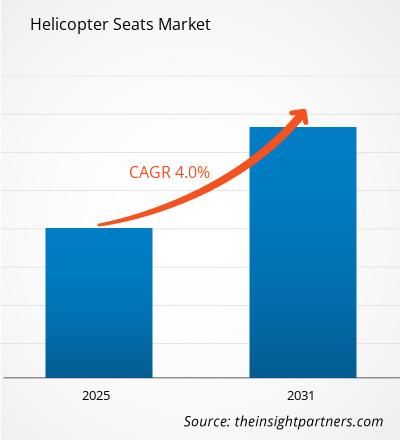
The global Helicopter Seats market is entering a period of steady expansion, fueled by ongoing military fleet modernization programs, increasing commercial rotorcraft deliveries, and stringent aviation safety mandates. According to the latest industry analysis, the Helicopter Seats Market was valued at US$ 1.27 billion in 2025 and is expected to reach US$ 1.75 billion by 2034; it is estimated to record a CAGR of 3.63% during 2026-2034.
Escalating Defense Modernization and Commercial Rotorcraft Demand
The primary catalyst propelling the global helicopter seats market is the sustained procurement of new rotorcraft across both defense and civil aviation sectors. Governments worldwide are actively upgrading aging military helicopter fleets to bolster tactical transport, search and rescue (SAR), border surveillance, and medical evacuation capabilities. These defense programs require specialized, armored, and energy-absorbing crew and troop seating engineered to withstand extreme operational environments and high-impact landings.
Simultaneously, the commercial sector is witnessing robust demand from offshore oil and gas operations, emergency medical services (EMS), aerial firefighting, and corporate VIP transport. Operators are increasingly prioritizing cabin ergonomics, vibration dampening, and modular seating configurations that allow rapid conversion between passenger transport and utility missions. Furthermore, the expanding maintenance, repair, and overhaul (MRO) ecosystem is driving aftermarket retrofits, as fleet operators replace legacy seats with modern, compliant alternatives to extend the operational lifespan of existing helicopters.
Get a PDF Sample- https://www.theinsightpartners.com/sample/TIPRE00022350
Shift Toward Crashworthy and Lightweight Composite Designs
Stringent airworthiness regulations from aviation authorities such as the Federal Aviation Administration (FAA) and the European Union Aviation Safety Agency (EASA) have made occupant crashworthiness a central focus of seat engineering. Manufacturers are heavily investing in advanced energy-absorbing structures, multi-point restraint systems, and fire-retardant upholstery to maximize occupant survivability during emergency landings.
At the same time, weight reduction remains critical to rotorcraft fuel efficiency, payload capacity, and range. To balance robust crash protection with lower mass, seating suppliers are transitioning from traditional metal alloys to high-strength carbon fiber composites and lightweight aluminum-lithium structures. In the VIP and executive helicopter segments, manufacturers are also integrating bespoke aesthetics, advanced lumbar support, and low-profile actuators to deliver business-jet comfort within compact rotorcraft cabins.
Key Players in the Helicopter Seats Market
The competitive landscape of the global helicopter seats market is characterized by established aerospace Tier-1 suppliers and specialized seating manufacturers competing on certification compliance, weight optimization, and customization capabilities. Key companies operating in the market include:
Moog Inc
ORO Manufacturing Company
Collins Aerospace
RECARO Aircraft Seating GmbH & Co. KG
Safran
Textron Inc.
Thompson Aero Seating Ltd
Acro Aircraft Seating
HAECO Americas
STELIA Aerospace
These industry leaders are focusing on strategic partnerships with major helicopter OEMs, expanding regional MRO and refurbishment capabilities, and advancing proprietary energy-attenuation technologies to secure long-term supply contracts.
Get Full Copy of This Report- https://www.theinsightpartners.com/buy/TIPRE00022350
Future Outlook
Looking ahead toward 2034, the Helicopter Seats market is poised for transformative technological evolution. The emergence of Advanced Air Mobility (AAM) and electric vertical takeoff and landing (eVTOL) aircraft represents a major long-term growth frontier. Because electric propulsion systems are highly sensitive to payload weight, eVTOL and hybrid-electric rotorcraft developers require ultra-lightweight, slim-profile seating that still meets rigorous commercial crash-safety standards.
Additionally, the integration of smart cabin technologies is expected to gain traction over the forecast period. Future seating platforms will increasingly incorporate embedded sensors for real-time occupant weight and posture monitoring, predictive maintenance diagnostics for seat actuators, and active vibration-cancellation systems designed to reduce pilot and passenger fatigue on long-range missions. Combined with rising rotorcraft adoption across rapidly developing aviation markets in Asia-Pacific and the Middle East, continuous innovation in sustainable materials and modular safety systems will sustain steady market momentum through 2034.
Related Reports-
Helicopter Engines Market Share, Trends & Growth by 2034
Air Crane Helicopter Market Forecast, Trends & Growth by 2034
Helicopter Blades Market Size, Trends & Growth by 2034
Helicopter Mast Market Scope, Trends & Growth by 2034
About The Insight Partners
The Insight Partners is a leading market research and consulting firm delivering actionable insights through in-depth industry analysis and strategic intelligence. The firm supports clients across various industries in making informed decisions by providing comprehensive market forecasts, competitive assessments, and growth opportunities.
Contact Us:
If you have any queries about this report or if you would like further information, please contact us:
Contact Person: Ankit Mathur
E-mail: sales@theinsightpartners.com
Phone: +1-646-491-9876
Also Available in : Korean| German| Japanese| French| Chinese| Italian| Spanish
