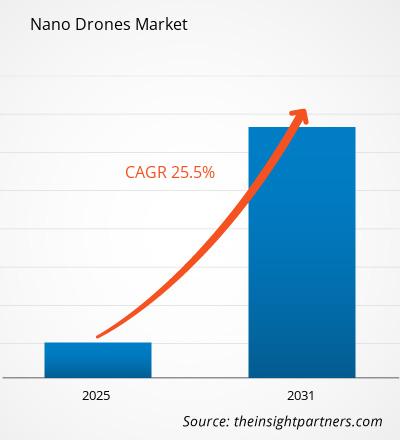
The global Nano Drones market is entering a transformative phase of expansion, driven by rapid hardware miniaturization, advancements in edge artificial intelligence, and escalating demand across defense, industrial inspection, and commercial sectors. According to the latest industry analysis, the Nano Drones Market was valued at US$ 3.31 billion in 2025 and is expected to reach US$ 10.17 billion by 2034; it is estimated to record a CAGR of 13.28% during 2026-2034.
Surging Demand Across Defense and Tactical Operations
A primary catalyst fueling this trajectory is the widespread integration of ultra-compact unmanned aerial vehicles (UAVs) into modern military and homeland security frameworks. Weighing under 250 grams with significant innovation occurring in the sub-50g and 50–100g categories nano drones provide frontline troops with covert, pocket-sized Intelligence, Surveillance, and Reconnaissance (ISR) capabilities. Unlike larger aerial platforms, these nimble systems can navigate dense urban environments, subterranean structures, and indoor spaces without detection, delivering real-time situational awareness while keeping personnel out of harm’s way. Defense ministries across North America, Europe, and Asia-Pacific are actively increasing procurement budgets to equip infantry squads with autonomous, low-signature reconnaissance tools and lightweight electronic warfare payloads.
Get a PDF Sample- https://www.theinsightpartners.com/sample/TIPRE00022352
Commercial, Industrial, and Consumer Adoption Accelerates
Beyond the battlefield, commercial enterprises are rapidly adopting nano drones to streamline complex operations. Because their lightweight airframes pose minimal safety risks, nano drones often benefit from more flexible aviation regulations compared to heavier commercial UAVs, lowering barriers to deployment in populated areas.
Key commercial and industrial applications driving adoption include:
Confined-Space Industrial Inspection: Energy, utilities, and manufacturing firms utilize nano drones equipped with high-definition RGB cameras, thermal sensors, and LiDAR to inspect boilers, pipelines, wind turbines, and warehouse interiors eliminating the need for costly scaffolding or hazardous human entry.
Precision Agriculture and Environmental Monitoring: Farmers and researchers deploy compact drones to monitor crop health, soil moisture, and irrigation efficiency at granular levels, improving resource management and overall yields.
Public Safety and Search-and-Rescue: Emergency responders rely on rapid-deployment nano platforms to locate survivors in collapsed buildings or disaster zones where larger aircraft cannot maneuver.
Content Creation and Recreation: Falling component costs and improved 4K camera stabilization have spurred strong consumer uptake for aerial photography, social media content creation, and educational STEM programs.
Competitive Landscape and Key Players
The competitive ecosystem is characterized by intense research and development, strategic defense contracts, and ongoing innovation in battery density, micro-propulsion, and obstacle-avoidance sensors. Leading organizations shaping the global Nano Drones market include:
AeroVironment, Inc.
Drona Aviation Pvt Ltd
Elbit Systems Ltd.
Hubsan Technology Company Ltd
Lockheed Martin Corporation
MICRODRONES
Parrot Drone SAS
Saab AB
Thales Group
TRNDlabs
These industry leaders are focusing heavily on ruggedizing miniature airframes for all-weather performance, enhancing encrypted communication links, and expanding manufacturing capacity to meet surging global order books.
Get Full Copy of This Report- https://www.theinsightpartners.com/buy/TIPRE00022352
Future Outlook
Looking ahead toward 2034, the future of the Nano Drones market will be defined by autonomous swarm intelligence, GPS-denied navigation, and ultra-miniaturized sensor fusion. As onboard neural processing units become smaller and more energy-efficient, nano drones will transition from remotely piloted tools into fully autonomous, collaborative aerial networks. In both defense and disaster-response scenarios, coordinated swarms of nano drones will be capable of dynamically mapping unknown interiors, sharing real-time target data, and adapting flight paths without continuous human intervention.
Furthermore, breakthroughs in solid-state micro-batteries and bio-inspired propulsion such as flapping-wing ornithopters are expected to overcome historical limitations in flight endurance and payload capacity. Coupled with expanding “Drone-as-a-Service” (DaaS) business models and supportive regulatory frameworks for low-weight UAVs across emerging economies in Asia-Pacific and the Middle East, the nano drone ecosystem is poised to unlock unprecedented operational efficiencies across global industries over the next decade.
Related Reports-
Target Drones Market Share, Trends & Growth by 2034
Firefighting Drones Market Forecast, Trends & Growth by 2034
About The Insight Partners
The Insight Partners is a leading market research and consulting firm delivering actionable insights through in-depth industry analysis and strategic intelligence. The firm supports clients across various industries in making informed decisions by providing comprehensive market forecasts, competitive assessments, and growth opportunities.
Contact Us:
If you have any queries about this report or if you would like further information, please contact us:
Contact Person: Ankit Mathur
E-mail: sales@theinsightpartners.com
Phone: +1-646-491-9876
Also Available in : Korean| German| Japanese| French| Chinese| Italian| Spanish
