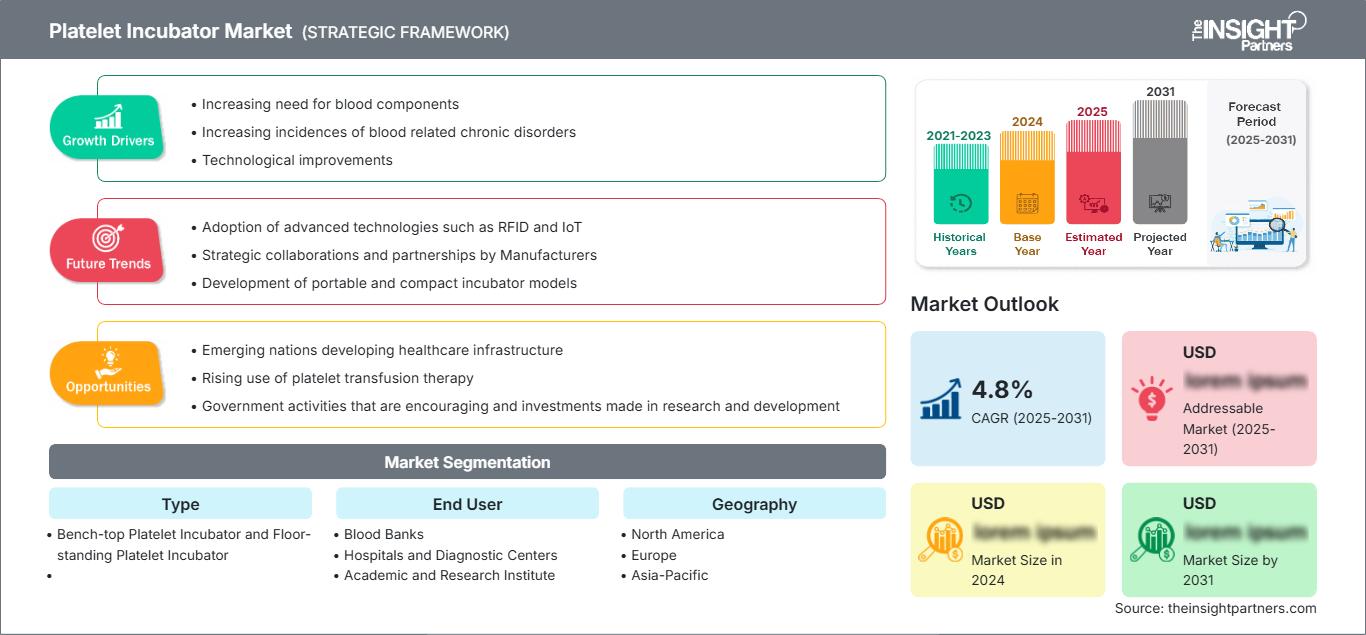
The Platelet Incubator Market is growing at a steady pace as blood banks and hospitals need safer ways to store platelets. It was valued at US$ 439.16 million in 2024. It is expected to reach US$ 613.83 million by 2031. That works out to a CAGR of 4.9% between 2025 and 2031. Platelets are tiny blood cells that help blood clot. They have a short shelf life and must be kept at a steady temperature while being gently agitated. A platelet incubator does that job. Without proper storage, platelets lose their value before they reach the patient.
What Is Driving the Market?
Demand for blood components is the first driver. Platelet transfusions are common in surgery, in cancer care, and in pediatric practice. Hospitals and blood banks often struggle to keep enough platelets on hand. Proper storage and handling have become a top priority.
Blood-related chronic disorders are the second driver. Leukemia, anemia, and thrombocytopenia are seen more often today. Platelet transfusion is a routine part of care for many of these patients. Reliable storage helps protect the safety and quality of each unit.
Get exclusive insights into the Platelet Incubator Market – https://www.theinsightpartners.com/sample/TIPRE00002879
Technology is the third driver. Better temperature control keeps platelets in good condition for longer. New models also use less energy, which lowers running costs for healthcare facilities. Smarter designs help incubators perform better and make them more important in blood banks and hospitals.
Every market has limits. The report points out that a few valid concerns exist. Even so, the overall benefits outweigh the drawbacks.
Which Segment Leads?
The market is divided by type and by end user.
By type, it covers bench-top platelet incubators and floor-standing platelet incubators. Bench-top platelet incubators dominate the product segment. They are compact and suit labs and clinics with limited space. Floor-standing units hold more and suit busy blood banks.
By end user, the report looks at blood banks, hospitals and diagnostic centers, academic and research institutes, and other end users. Blood banks and hospitals are the main buyers because they handle platelets every day. Research institutes use incubators for study and testing. The full report gives a detailed view of how each segment performs through 2031.
Which Region Leads?
North America accounts for the highest market share. The United States is a key market, helped by a rising need for blood components, more chronic blood disorders, and better technology. A well-developed network of hospitals and blood banks supports steady demand.
Asia Pacific is the fastest-growing region. Healthcare infrastructure is expanding, and the need for safe blood storage is rising with it. Large populations add to the long-term potential.
The report also covers Europe, South and Central America, and the Middle East and Africa. Countries such as Canada, Mexico, the UK, Germany, France, China, India, Japan, and Brazil are among those analyzed.
Which Companies Are Prominent?
Helmer Scientific, SARSTEDT AG & Co. KG, and Boekel Scientific accounted for major market shares in 2023. The report profiles these players:
- Helmer Scientific
- SARSTEDT AG & Co. KG
- Boekel Scientific
- LABCOLD
- Biolab Scientific
- REMI GROUP
- EMSA Elektrik Malzemeleri San. ve Tic. A.Ş.
- Biobase
- TERUMO CORPORATION
- SM Scientific Instruments Pvt. Ltd. India
The list mixes laboratory equipment makers with firms known for blood and transfusion products. Some serve large blood banks. Others serve smaller labs and clinics. That range shows how many settings need reliable platelet storage.
Competition centers on temperature accuracy, reliability, and ease of use. Companies also look at energy savings and compact designs. The report studies their strategies and innovation efforts so buyers and investors can see who is moving ahead.
Buy the Full Report https://www.theinsightpartners.com/buy/TIPRE00002879
What Is Changing in 2026?
Connected technology is the biggest shift. IoT lets staff watch temperature, humidity, and other key readings in real time. That helps keep storage conditions ideal and protects the safety of the platelets. RFID helps track inventory, stock levels, and expiry dates. Together they can cut waste and improve timely restocking.
Partnerships are the second shift. Manufacturers are working with research institutes to bring in new designs and technology. Company-to-company deals also help firms enter new markets by using each other’s distribution networks and local knowledge.
Portable and compact models are the third. Portable incubators make it easier to use platelets in emergencies, remote areas, and during transfers between facilities. Compact designs fit into tight spaces in hospitals while keeping the right storage conditions.
What Are the Investment Opportunities?
The report puts the total addressable market for 2025 to 2031 at about US$ 3,739.46 million. That shows how much room is left for new products and new buyers.
Emerging nations are one opening. Many countries are building new hospitals and blood banks and expanding old ones. Each of these needs proper platelet storage. Partnerships among governments, NGOs, and private groups are helping fund blood storage technology.
Platelet transfusion therapy is another. Rising needs in surgery and in cancer and blood disorder care are lifting demand for transfusions. Stronger blood donation programs bring in more platelets, which raises the need for storage to match.
Government support is the third path. Many governments are setting budgets to improve hospitals and blood banks. Grants for research and development also help firms design better platelet storage devices.
Taken together, these paths point to steady, broad-based growth through 2031.
Related Reading / Reports
Explore additional research from The Insight Partners covering related blood and lab equipment markets:
- Medical Refrigerators Market — coverage of cold storage used for blood and medicines.
- Blood Collection Tubes for Liquid Biopsy Market — insights on tubes used to collect blood samples.
- Arterial Blood Gas Kits Market — analysis of kits used to test blood gases.
- Medical Tubing Market — a look at tubing used across clinical settings.
About US:
The Insight Partners is among the leading market research and consulting firms in the world. We take pride in delivering exclusive reports along with sophisticated strategic and tactical insights into the industry. Reports are generated through a combination of primary and secondary research, solely aimed at giving our clientele a knowledge-based insight into the market and domain. This is done to assist clients in making wiser business decisions. A holistic perspective in every study undertaken form an integral part of our research methodology and makes the report unique and reliable.
Contact US
If you have any queries about this report or if you would like further information, please contact us:
Phone: +1-646-491-9876
E-mail: sales@theinsightpartners.com
Also Available in : Korean | German | Japanese | French | Chinese | Italian | Spanish
