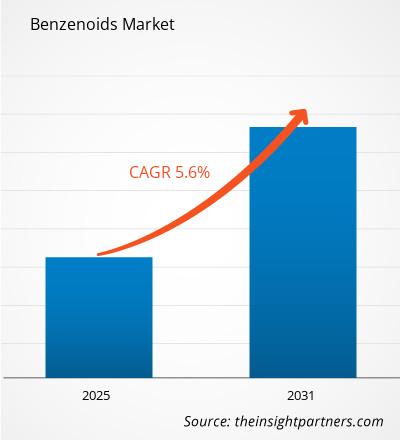
The Benzenoids Market is expanding as fragrance houses, food and beverage formulators, pharmaceutical manufacturers, and specialty chemical producers increasingly rely on aromatic compounds for scent, flavor, preservation, and chemical synthesis. Growth is supported by rising consumer demand for fine fragrances and personal care products, expanding packaged-food consumption, and advancements in bio-based and sustainable production methods.
The Benzenoids market was valued at US$ 798.55 million in 2025 and is expected to reach US$ 1087.31 million by 2034; it is estimated to record a CAGR of 3.49% during 2026-2034.
What is driving the market?
Expanding fragrance and flavor consumption, pharmaceutical formulation growth, and rising demand for naturally derived aroma chemicals are the principal growth drivers. Manufacturers across personal care, household goods, and food processing increasingly rely on benzenoid compounds such as benzaldehyde, benzoic acid, and benzyl derivatives to achieve consistent sensory profiles and extend product shelf life.
The industry is shifting beyond conventional petrochemical synthesis toward cleaner, bio-based, and catalytic production pathways. Suppliers are investing in biotechnology, green chemistry, and high-purity extraction to meet clean-label and sustainability expectations. However, stringent environmental and health regulations regarding volatile organic compounds (VOCs), raw material price volatility, and competition from non-aromatic substitutes remain important constraints.
Which region leads?
Asia Pacific leads the market, accounting for an estimated 44.0% revenue share in 2025. Growth is supported by a massive chemical manufacturing base, cost-competitive production capabilities, and rapidly expanding food processing, personal care, and pharmaceutical industries. China and India present significant opportunities as rising domestic consumption coincides with expanding specialty chemical and aroma-ingredient manufacturing capacity.
North America and Europe hold substantial market shares, supported by mature fine fragrance, cosmetics, and pharmaceutical sectors. In both regions, demand is increasingly shaped by regulatory compliance, sustainability initiatives, and higher adoption of natural and bio-derived benzenoid ingredients. Meanwhile, the Middle East & Africa is projected to be the fastest-growing regional market through 2034, propelled by petrochemical downstream expansion and growing consumer goods demand.
Which segment leads?
By product type, Benzaldehyde is the leading segment, representing an estimated 41.0% of market revenue in 2025. Its position is supported by widespread use as a foundational almond-cherry flavoring agent, a key fragrance building block, and an intermediate in pharmaceutical and agrochemical synthesis. By source, the Natural segment leads with an estimated 55.0% revenue share in 2025, driven by consumer preference for botanical and essential-oil-derived ingredients.
By application, Flavor & Fragrance leads with an estimated 34.0% share in 2025, reflecting strong uptake in perfumes, cosmetics, and household scents. Food & Beverages and Pharmaceuticals also represent major, high-value application segments, fueled by demand for food preservatives like benzoic acid and active pharmaceutical intermediates.
Which companies are prominent?
Prominent market participants include BASF SE, International Flavors & Fragrances Inc. (IFF), Givaudan, dsm-firmenich, Symrise, Merck KGaA, Takasago International Corporation, Sensient Technologies Corporation, Eastman Chemical Company, and Lanxess AG.
These companies compete across aroma chemical synthesis, natural ingredient extraction, pharmaceutical intermediates, and specialty solvents. Strategic differentiation increasingly depends on catalytic efficiency, bio-based R&D capabilities, regulatory compliance, backward integration of feedstocks, and the ability to supply consistent, high-purity grades at commercial scale.
What is changing in 2026?
The market is transitioning toward stricter regulatory compliance, supply-chain traceability, and low-impact manufacturing. Regulatory frameworks overseen by bodies such as the European Chemicals Agency (ECHA) under REACH and the International Fragrance Association (IFRA) are tightening restrictions on hazardous aromatic derivatives and allergens, compelling formulators to reformulate and verify safety profiles.
Manufacturers are accelerating investments in green chemistry, fermentation-derived benzenoids, and closed-loop solvent recovery. Procurement decisions are increasingly tied to sustainability credentials, carbon-footprint transparency, and clean-label certification rather than unit price alone, driving closer collaboration between chemical producers and consumer goods brands.
What are the major investment opportunities?
The strongest opportunities lie in bio-based benzenoid production, green catalytic synthesis, high-purity pharmaceutical intermediates, and natural extraction technologies. Investment in biotechnology and precision fermentation can reduce reliance on volatile petrochemical feedstocks while capturing premium pricing in the natural flavor and fragrance sectors.
Additional opportunities include expanding specialty aroma-chemical capacity in high-growth Asian and Middle Eastern hubs, as well as developing safer, regulatory-compliant benzenoid derivatives for cosmetics, personal care, and food preservation. Investors should prioritize manufacturers that combine scalable green chemistry, strong intellectual property, and end-to-end regulatory readiness.
Future Outlook
Looking ahead toward 2034, the Benzenoids Market will be defined by the convergence of biotechnology, regulatory stringency, and emerging-market consumption. While petrochemical-derived benzenoids will remain essential for high-volume industrial and polymer applications, bio-based and naturally sourced variants will capture a growing share of high-margin consumer goods. Companies that successfully decarbonize their synthesis pathways, secure sustainable botanical supply chains, and adapt swiftly to evolving global chemical safety standards will lead the next decade of industry growth.
About The Insight Partners
The Insight Partners is a leading market research and consulting firm delivering actionable insights through in-depth industry analysis and strategic intelligence. The firm supports clients across various industries in making informed decisions by providing comprehensive market forecasts, competitive assessments, and growth opportunities.
Contact Us:
If you have any queries about this report or if you would like further information, please contact us:
Contact Person: Ankit Mathur
E-mail: sales@theinsightpartners.com
Phone: +1-646-491-9876
