The Potassium Metabisulfite Market is expanding as food and beverage processors, winemakers, pharmaceutical manufacturers, and industrial operators rely on the compound ($K_2S_2O_5$) for antimicrobial protection, oxidation control, and shelf-life extension. Growth is supported by expanding global wine and beer production, rising demand for packaged and processed foods, increasing water treatment initiatives, and preference for sodium-free preservative alternatives.
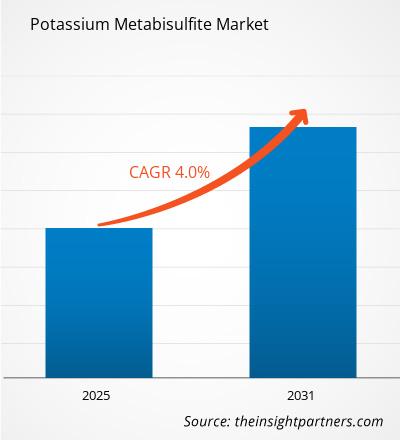
The global potassium metabisulfite market size is projected to reach US$ 194.13 million by 2034 from US$ 120.93 million in 2025. The market is anticipated to register a CAGR of 5.40% during the forecast period 2026-2034.
What is driving the market?
Rising demand for food preservation, global alcoholic beverage production, and pharmaceutical stabilization are the principal growth drivers. Food and beverage manufacturers are increasingly required to prevent microbial spoilage, preserve color, and extend product durability across global supply chains without adding dietary sodium giving potassium metabisulfite a functional advantage over sodium metabisulfite in specific formulations. Meanwhile, pharmaceutical producers rely on its reducing properties to protect sensitive active ingredients.
The industry is moving beyond basic bulk supply toward high-purity grades and greener manufacturing processes. Suppliers are investing in low-residue formulations, eco-friendly chemical synthesis, and strict quality assurance to meet food-safety standards. However, stringent regulatory limits on sulfur dioxide ($SO_2$) levels in food and wine, consumer shifts toward clean-label preservative-free products, raw material price volatility, and competition from substitutes such as sodium metabisulfite and natural antioxidants remain key restraints.
Which region leads?
Europe and Asia Pacific represent the core pillars of global demand, with Europe holding a dominant market position at an estimated 30%–35% share due to its massive winemaking and brewing heritage. France, Germany, Italy, and Spain drive substantial consumption across wine production, food processing, and strict quality-controlled manufacturing.
Asia Pacific accounts for an estimated 28%–33% share and stands out as the fastest-growing regional market. Growth is propelled by rapid urbanization, rising disposable incomes, expanding packaged-food consumption, and major chemical manufacturing capacity in China and India. North America holds approximately 24%–28% of the market, supported by industrial and artisanal winemaking in the United States, established processed-food sectors, and municipal water treatment applications.
Which segment leads?
Food Grade is the leading grade segment, representing roughly 48%–52% of market revenue. Its dominance is underpinned by widespread adoption as an antioxidant, antimicrobial agent, and color stabilizer across wines, beers, dried fruits, and juices. Pharmaceutical Grade is forecast to be the fastest-growing grade segment, driven by expanding biologics, vaccine production, and stringent purity requirements in drug stabilization.
By application, Food & Beverages leads with an estimated 42%–46% share, with winemaking and brewing serving as the largest end-use sub-segments due to the compound’s essential role in halting fermentation and preventing oxidation. Water Treatment and Pharmaceuticals are high-growth application areas as sanitation infrastructure and healthcare manufacturing expand worldwide.
Which companies are prominent?
Prominent market participants include BASF SE, Aditya Birla Chemicals, LAFFORT, Alkaloid AD Skopje, Esseco USA LLC, Murphy & Son Ltd., Merck KGaA, Brenntag AG, Fuso Chemical Co., Ltd., and Lanxess AG.
These companies compete across food-grade, pharmaceutical-grade, and technical-grade production, enological supply, and specialty chemical distribution. Competitive differentiation increasingly depends on ultra-high purity standards, regulatory compliance across international food-safety frameworks, backward supply-chain integration, and customized formulation support for winemakers and food processors. This list reflects the competitive landscape rather than a revenue-ranked market-share table.
What is changing in 2026?
In 2026, the market is shifting toward stricter residue compliance, cleaner production technologies, and specialized high-purity formulations. Regulatory scrutiny across North America and the European Union continues to tighten allowable sulfite thresholds and allergen labeling requirements, pushing food and beverage brands to optimize dosing precision and minimize sulfur dioxide residues.
Manufacturers are responding with green chemistry initiatives, lower-waste production footprints, and tailored blends that pair potassium metabisulfite with complementary antioxidants to meet clean-label expectations. Concurrently, capacity expansions and strategic acquisitions particularly in Asia Pacific are reshaping global supply chains to ensure reliable bulk and packaged delivery.
What are the major investment opportunities?
The strongest opportunities lie in high-purity pharmaceutical-grade manufacturing, Asia Pacific capacity expansion, and low-residue food-grade innovations. Investing in advanced purification and quality-control infrastructure enables producers to capture higher margins in biopharmaceuticals and strict export markets.
Additional opportunities include developing precision-dosing tablets and liquid formulations for craft winemaking and brewing, expanding bulk supply agreements for municipal water treatment plants, and adopting backward integration to insulate operations from raw material price swings. Emerging markets in Asia Pacific and Latin America offer compelling expansion potential as packaged-food consumption and sanitation investments accelerate.
Future Outlook
Through 2034, the Potassium Metabisulfite Market is expected to maintain steady, resilient growth anchored by irreplaceable functional performance in winemaking, food preservation, and pharmaceutical stabilization. While clean-label trends and natural preservative alternatives will gradually pressure conventional food applications, rising global wine exports, expanding processed-food demand in developing economies, and growing healthcare and water-treatment infrastructure will sustain long-term consumption. Market leaders that invest in sustainable manufacturing, ultra-pure grades, and technical application support will be best positioned to capture value over the next decade.
About The Insight Partners
The Insight Partners is a leading market research and consulting firm delivering actionable insights through in-depth industry analysis and strategic intelligence. The firm supports clients across various industries in making informed decisions by providing comprehensive market forecasts, competitive assessments, and growth opportunities.
Contact Us:
If you have any queries about this report or if you would like further information, please contact us:
Contact Person: Ankit Mathur
E-mail: sales@theinsightpartners.com
Phone: +1-646-491-9876
