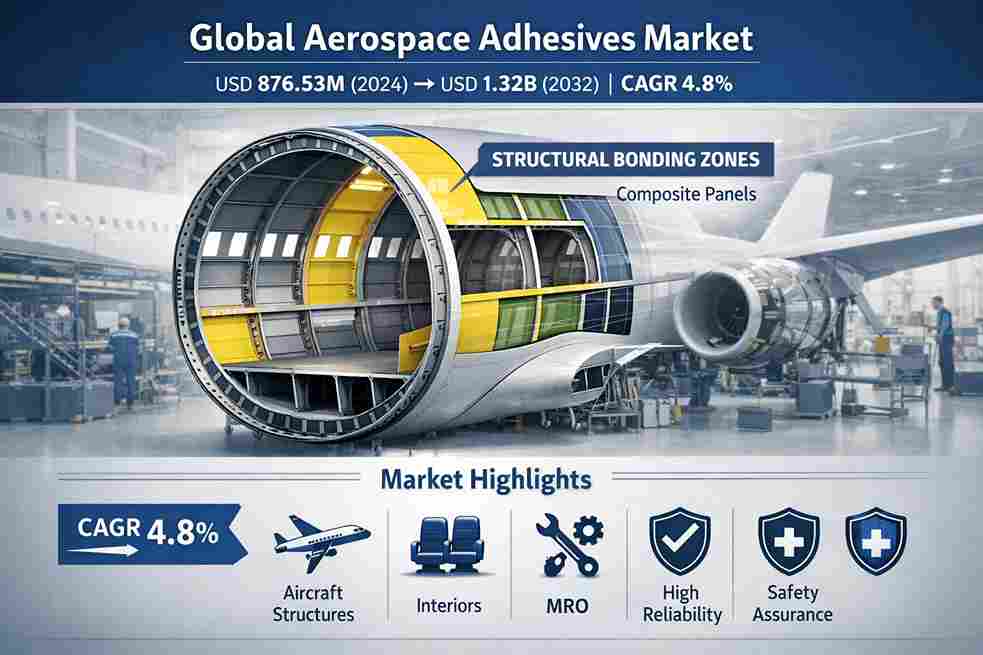
Global aerospace adhesives market, valued at USD 876.53 million in 2024, is set for a period of steady and reliable growth. It is projected to reach USD 1.32 billion by 2032, advancing at a compound annual growth rate (CAGR) of 4.8%. This expansion is underpinned by the aerospace industry’s relentless pursuit of lightweight, fuel-efficient aircraft, which increasingly rely on advanced composite materials bonded with high-performance adhesives. With Boeing and Airbus backlogs exceeding 7,000 aircraft orders, sustained demand from both original equipment manufacturing (OEM) and maintenance, repair, and overhaul (MRO) sectors is assured.
Download a Free Sample Report PDF: 24chemicalresearch.com
➤ Regional Analysis: North America Maintains Technological Leadership
The global market is led by established aerospace manufacturing hubs, with North America holding the dominant position. The following table outlines the key regional dynamics:
Region | Market Position & Key Characteristics |
North America | Dominant leader (38% revenue share). Driven by the presence of major OEMs (Boeing, Lockheed Martin), strong defense spending, and leadership in advanced material R&D. |
Europe | Second-largest market. Characterized by Airbus’s production ramp-up, stringent environmental regulations (REACH), and specialization in high-performance film adhesives for composites. |
Asia-Pacific | Fastest-growing market (5.2% CAGR). Fueled by expanding commercial fleets, indigenous aircraft programs (COMAC, HAL), and growing MRO activities. |
Rest of World | Emerging opportunities. Growth in South America (Embraer) and the Middle East is driven by regional aviation hubs and investments in maintenance infrastructure. |
➤ Key Market Drivers and Opportunities
Several powerful trends are propelling the market forward. The composite material revolution is paramount, with modern aircraft like the Boeing 787 and Airbus A350 comprising over 50% composites by weight. This necessitates specialized adhesives, with recent nanotechnology-enhanced formulations offering 30% higher shear strength. Furthermore, global military modernization programs, with defense spending exceeding $2.2 trillion annually, are fueling demand for adhesives used in stealth and ballistic protection systems.
Beyond traditional aviation, emerging frontiers present substantial growth opportunities. The nascent Urban Air Mobility (UAM) and eVTOL sector represents a potential $15-30 billion addressable market for specialized adhesives by 2032. Simultaneously, the rapid commercialization of space, with the space economy projected to reach $1.4 trillion, is driving the need for space-grade formulations resistant to extreme thermal cycling and radiation.
➤ Challenges & Restraints
Manufacturers must navigate significant hurdles. The stringent and lengthy certification process mandated by authorities like the FAA and EASA can take 3-5 years for new formulations, creating high barriers to entry. Volatility in raw material prices (e.g., epoxy resins) also impacts production economics. Additionally, the industry faces technical performance gaps for next-generation applications like hypersonic flight and competition from alternative joining technologies like friction stir welding.
➤ Market Segmentation
- By Type: Epoxy Film Adhesives are the dominant product type, holding nearly 65% of applications due to their exceptional balance of strength, temperature resistance, and reliability. Other key types include BMI and Polyimide film adhesives for very high-temperature areas.
- By Application: The market is split between OEM (Original Equipment Manufacturing) for new aircraft production and MRO (Maintenance, Repair, and Overhaul) for sustaining existing fleets, with both segments showing robust demand.
- By End-Use Industry: Commercial Aviation is the largest segment, followed by Military Aviation and the high-growth Space sector.
➤ Competitive Landscape
The market features a mix of global specialty chemical giants and focused material science firms. Leading companies include Solvay S.A., Henkel AG & Co. KGaA (LOCTITE), and Hexcel Corporation. Competition is driven by strategic partnerships with aircraft OEMs, continuous R&D in sustainable and high-performance solutions, and vertical integration to secure supply chains. Notable recent developments include Henkel’s partnership with Airbus and H.B. Fuller’s launch of a bio-based adhesive line.
Conclusion
The aerospace adhesives market is on a clear growth path to 2032, fundamentally supported by the aviation industry’s needs for efficiency, performance, and sustainability. While innovation in composites, urban air mobility, and space exploration opens new horizons, success for market players will depend on overcoming stringent regulatory landscapes, supply chain volatility, and intense technological competition.
Get Full Report Here: 24chemicalresearch.com
Contact:
International: +1(332) 2424 294 | Asia: +91 9169162030
Website: https://www.24chemicalresearch.com/
Follow us on LinkedIn: 24chemicalresearch