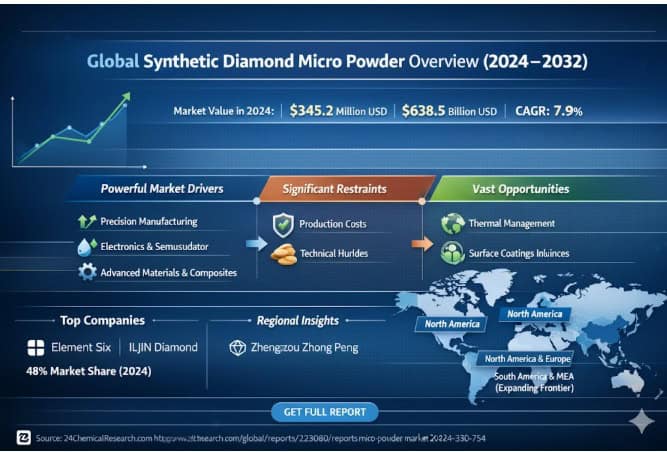
Global synthetic diamond micro powder market size was valued at USD 345.2 million in 2024. The market is projected to grow from USD 372.8 million in 2025 to USD 638.5 million by 2032, exhibiting a CAGR of 7.9% during the forecast period.
Synthetic Diamond Micro Powder, engineered through high-pressure, high-temperature (HPHT) or chemical vapor deposition (CVD) processes, has moved beyond niche applications to become an indispensable industrial material. Its defining characteristics—extreme hardness, superior thermal conductivity, and exceptional chemical inertness—make it a critical component across numerous high-tech and precision manufacturing sectors
Get Full Report Here: https://www.24chemicalresearch.com/reports/223080/global-synthetic-diamond-micro-powder-market-2024-2030-754
Market Dynamics:
The market’s trajectory is shaped by a dynamic interplay of powerful growth drivers, significant technological and economic hurdles, and vast, emerging opportunities that promise to redefine multiple industries.
Powerful Market Drivers Propelling Expansion
- Exponential Growth in Precision Manufacturing and Tooling: The integration of synthetic diamond micro powder into grinding wheels, cutting tools, and precision lapping compounds represents the primary engine of market growth. The global machine tools industry, valued at approximately $85 billion, is undergoing a fundamental shift towards ultra-precision machining. Diamond-based micro powders deliver cutting performance that is 5 to 8 times superior to conventional abrasives like silicon carbide or aluminum oxide.
- Revolutionizing Electronic and Semiconductor Fabrication: The semiconductor industry’s relentless pursuit of smaller feature sizes has made synthetic diamond micro powder indispensable for wafer dicing, substrate polishing, and chip packaging. The global semiconductor capital equipment market, projected to exceed $150 billion by 2026, relies on diamond powders for critical processes like chemical-mechanical planarization (CMP).
- Advanced Materials and Composite Enhancement: The composites industry is being fundamentally upgraded by the incorporation of diamond micro powders. When used as a filler in polymer matrices at concentrations as low as 0.5-3% by volume, these powders can increase composite wear resistance by 300-500% and enhance thermal conductivity by 150-200%. These property enhancements are driving rapid adoption in the aerospace sector, where a 1% weight reduction in aircraft components can yield millions in fuel savings annually. For example, diamond-enhanced polymer composites in satellite components have demonstrated operational lifespan extensions of 3-5 years, creating enormous value for space infrastructure projects where replacement costs are prohibitively high.
Download FREE Sample Report: https://www.24chemicalresearch.com/download-sample/223080/global-synthetic-diamond-micro-powder-market-2024-2030-754
Significant Market Restraints Challenging Adoption
Despite its exceptional performance, the market faces considerable obstacles that must be navigated to achieve mainstream adoption across all potential sectors.
- Substantial Production Costs and Energy-Intensive Synthesis: The advanced synthesis methods required, particularly for high-quality powders below 0-1 micron, involve highly specialized equipment like cubic presses for HPHT or plasma reactors for CVD. This results in manufacturing costs that are 50-80% higher than those for conventional abrasive materials.
- Technical Processing Hurdles and Integration Complexities: Effective dispersion of diamond micro powder into various binders and matrices is notoriously difficult. In up to 35% of composite manufacturing attempts, poor dispersion leads to particle clustering, which creates stress concentration points that can reduce the overall component strength by 20-40%. Overcoming this requires sophisticated surface functionalization techniques, which can add an additional 10-15% to the final product cost.
Critical Market Challenges Requiring Innovation
Scaling up from pilot-scale production to industrial volumes capable of supplying global demand presents its own unique set of difficulties. Producing consistent quality at scales above 500 kg per month is a non-trivial engineering feat. Current industrial-scale processes for sub-micron powders achieve acceptable quality consistency in only 65-75% of output. Furthermore, the post-processing steps—such as milling, classification, and surface treatment—can consume 25-35% of the total production energy.
Vast Market Opportunities on the Horizon
- Next-Generation Thermal Management Solutions: The escalating thermal loads in high-performance electronics, particularly in 5G infrastructure, data centers, and power modules for electric vehicles. Synthetic diamond micro powder is poised to revolutionize thermal interface materials (TIMs). Early adopters in the power electronics sector report junction temperature reductions of 15-25°C in IGBT modules when diamond-filled thermal greases replace conventional silicone-based compounds.
- Advanced Surface Engineering and Protective Coatings: Innovative diamond composite coatings are achieving breakthroughs in extreme environment protection. Applications in the oil and gas industry for valve and pump components demonstrate service life extensions of 4-7 years in corrosive and abrasive service conditions. The global market for wear-resistant coatings, valued at approximately $9 billion, is increasingly adopting diamond solutions for critical components.
- Strategic Alliances and Vertical Integration as a Growth Multiplier: The market is experiencing unprecedented collaboration between material producers and equipment manufacturers. More than 40 major strategic partnerships have been formed in the past two years alone to co-develop application-specific diamond powder formulations. These collaborations are proving essential for traversing the commercialization “valley of death.”
In-Depth Segment Analysis: Where is the Growth Concentrated?
By Type:
The market is segmented into Polycrystalline Structure and Monocrystalline Structure powders. Polycrystalline Diamond (PCD) powders currently command a larger market share, favored for their multi-faceted cutting edges and greater toughness, which makes them ideal for machining non-ferrous metals and abrasive composite materials.
By Aplication:
Aplication segments include Machinery, Optical Instruments, Glass and Ceramics, Electronics, and others. The Machinery segment currently holds the dominant position, propelled by incessant demand from the global automotive industry for precision grinding of hardened steel components and camshafts.
By End-User Industry:
The end-user ecosystem spans Electronics, Automotive, Aerospace, Healthcare, and Energy. The Automotive industry is the largest consumer, utilizing diamond powders for everything from CV joint finishing to turbocharger component machining.
Download FREE Sample Report: https://www.24chemicalresearch.com/download-sample/223080/global-synthetic-diamond-micro-powder-market-2024-2030-754
Competitive Landscape:
The global Synthetic Diamond Micro Powder market is moderately consilidated and characterized by fierce competition and continuous technological progression. The top three companies—Element Six (Luxembourg/U.K.), ILJIN Diamond (South Korea), and Zhengzhou Zhong Peng (China)—collectively account for approximately 48% of the global market share as of 2024. Their leadership is sustained by comprehensive intellectual property estates, state-of-the-art manufacturing infrastructure, and deeply entrenched global customer relationhips.
List of Key Synthetic Diamond Micro Powder Companies Profiled:
- Element Six (Luxembourg/U.K.)
- ILJIN Diamond (South Korea)
- Zhengzhou Zhong Peng (China)
- Engis Corporation (U.S.)
- Pureon (Switzerland)
- Sandvik Hyperion (U.S.)
- Industrial Abrasives (U.S.)
- Soham Industrial Diamonds (India)
- LANDS Superabrasives (U.S.)
- Zhecheng Huifeng Diamond Technology (China)
- Henan Liliang Diamond (China)
- Henan Huanghe Whirlwind (China)
- Funik Ultrahard Material (China)
- Henan Yalong Superhard Materials (China)
Regional Analysis: A Global Footprint with Distinct Leaders
- Asia-Pacific: Is the undeniable market leader, commanding a 52% share of the global market. This regional supremacy is powered by enormous manufacturing bases in China, South Korea, and Japan, coupled with aggressive government support for advanced materials development. China alone is responsible for over 70% of the global production capacity for synthetic diamond micro powders.
- North America & Europe: Together, they constitute a highly advanced and innovation-driven secondary market block, representing 38% of global consumption. Europe’s position is reinforced by strong public-private partnerships and a world-leading machine tools industry, particularly in Germany, Italy, and Switzerland.
Download FREE Sample Report: https://www.24chemicalresearch.com/download-sample/223080/global-synthetic-diamond-micro-powder-market-2024-2030-754
CONTACT US :
International: +1(332) 2424 294 | Asia: +91 9169162030
Website: https://www.24chemicalresearch.com/
➤See Related Report :
Global External Wall Cladding (EWC) Market
Nickel Boride Sputtering Target Market
High Purity Sodium Silicate Market
Global Pyrazole market
China 3C Coating market
Global Phosphorus Pentasulfide (P4S10) market
Global Geotechnical Grating Network market
Global Tetrakis(dimethylamido)titanium (TDMAT) market