Introduction
Activated Carbon Market has emerged as one of the most versatile materials used in modern industrial processes. Renowned for its exceptional adsorption capabilities, activated carbon plays a critical role in water purification, air treatment, industrial processing, food and beverage production, pharmaceuticals, and environmental remediation. As industries worldwide focus on improving operational efficiency, meeting environmental regulations, and ensuring product quality, the demand for activated carbon continues to rise.
Activated carbon is produced from carbon-rich raw materials such as coconut shells, coal, wood, peat, and agricultural residues. Through specialized activation processes, these materials develop a highly porous structure with an extensive surface area capable of trapping contaminants, impurities, gases, and dissolved substances. This unique characteristic has made activated carbon an indispensable component in numerous industrial applications.
The market is witnessing significant growth due to increasing environmental awareness, stringent pollution control regulations, expanding water treatment infrastructure, and rising industrialization. As sustainability becomes a central focus across sectors, activated carbon solutions are gaining greater importance in supporting cleaner production processes and environmental protection initiatives.
Understanding Activated Carbon and Its Properties
Activated carbon is a specially processed form of carbon designed to maximize its adsorption capacity. The material contains millions of microscopic pores that create an enormous internal surface area. In some cases, a single gram of activated carbon can possess a surface area exceeding 1,000 square meters.
The adsorption process enables activated carbon to attract and retain a wide range of organic compounds, volatile chemicals, odors, colors, and pollutants. This capability makes it highly effective for purification and filtration applications.
Download Free PDF Brochure: https://www.stellarmr.com/report/req_sample/Activated-Carbon-Market/298
Several forms of activated carbon are available in the market, including:
- Powdered Activated Carbon (PAC)
- Granular Activated Carbon (GAC)
- Extruded Activated Carbon (EAC)
- Activated Carbon Fiber
- Impregnated Activated Carbon
Each type is designed for specific applications depending on particle size, adsorption requirements, filtration systems, and operational conditions.
Growing Importance in Water Treatment Applications
Water treatment remains one of the largest application segments for activated carbon worldwide. Municipal water treatment facilities, industrial wastewater treatment plants, and residential filtration systems rely heavily on activated carbon technology to remove contaminants and improve water quality.
Activated carbon effectively removes:
- Chlorine and chloramine
- Organic pollutants
- Pesticides and herbicides
- Pharmaceutical residues
- Industrial chemicals
- Taste and odor-causing compounds
The increasing scarcity of clean water resources and growing concerns regarding water contamination have encouraged governments and industries to invest in advanced treatment technologies. Activated carbon serves as a vital component in these systems due to its effectiveness and reliability.
Rapid urbanization and population growth are further increasing pressure on water infrastructure, creating sustained demand for activated carbon products across both developed and emerging economies.
Rising Demand from Air Purification and Emission Control
Air pollution has become a major global concern, driving the adoption of activated carbon solutions in air purification systems. Industrial facilities, commercial buildings, healthcare institutions, and residential environments increasingly utilize activated carbon filters to remove harmful airborne contaminants.
Activated carbon is highly effective in capturing:
- Volatile Organic Compounds (VOCs)
- Toxic gases
- Industrial emissions
- Smoke particles
- Odors
- Chemical vapors
Manufacturing industries such as chemicals, petrochemicals, automotive, electronics, and mining employ activated carbon systems to comply with stringent emission standards and workplace safety regulations.
The growing popularity of indoor air quality solutions and air purification equipment has also contributed significantly to market expansion. Consumers are becoming increasingly aware of the health impacts associated with poor air quality, leading to greater adoption of activated carbon-based filtration technologies.
Download Free PDF Brochure: https://www.stellarmr.com/report/req_sample/Activated-Carbon-Market/298
Expanding Applications in Food and Beverage Processing
The food and beverage industry represents another important market for activated carbon. Manufacturers utilize activated carbon to enhance product purity, improve color, remove unwanted compounds, and ensure compliance with quality standards.
Common applications include:
- Sugar refining
- Beverage purification
- Edible oil processing
- Alcohol production
- Food ingredient purification
- Flavor and fragrance manufacturing
Activated carbon helps eliminate impurities without affecting the desired characteristics of the final product. Its ability to deliver high-quality purification has made it a preferred solution among food processing companies seeking consistent production standards.
As consumer demand for premium-quality food and beverages continues to rise, the adoption of advanced purification technologies is expected to grow correspondingly.
Critical Role in Pharmaceutical and Healthcare Industries
The pharmaceutical sector relies extensively on activated carbon for various manufacturing and purification processes. High product purity is essential in pharmaceutical production, and activated carbon plays a crucial role in achieving stringent quality requirements.
Applications include:
- Drug ingredient purification
- Solvent recovery
- Decolorization processes
- Toxin removal
- Medical filtration systems
- Pharmaceutical wastewater treatment
In healthcare settings, activated carbon is also used in emergency medicine to treat certain types of poisoning and drug overdoses by adsorbing toxins within the digestive system.
The continued expansion of pharmaceutical manufacturing capabilities and increasing investments in healthcare infrastructure are creating new growth opportunities for activated carbon suppliers worldwide.
Industrial Processing and Chemical Manufacturing Applications
Activated carbon serves as a valuable purification and separation medium across numerous industrial sectors. Chemical manufacturers use activated carbon to remove contaminants from process streams, recover valuable solvents, and improve product quality.
Industrial applications include:
- Catalyst support
- Solvent recovery
- Chemical purification
- Metal recovery
- Industrial wastewater treatment
- Process stream purification
Many industrial facilities are adopting activated carbon systems as part of broader sustainability and resource-efficiency initiatives. By enabling solvent recovery and waste reduction, activated carbon contributes to both economic and environmental benefits.
The growing emphasis on circular economy practices is further strengthening demand for advanced adsorption technologies in industrial operations.
Mercury Removal and Environmental Remediation
Environmental remediation represents one of the most rapidly expanding application areas for activated carbon. Governments and environmental agencies are implementing stricter regulations targeting hazardous pollutants, including mercury emissions from industrial facilities and power plants.
Activated carbon injection systems are widely used to capture mercury from flue gases generated during coal combustion and industrial processes. These systems help facilities meet regulatory requirements while reducing environmental impact.
In addition to mercury removal, activated carbon is employed in the remediation of contaminated soil and groundwater. Its adsorption properties enable effective removal of organic pollutants, hydrocarbons, and hazardous substances from affected environments.
Growing environmental protection initiatives are expected to support continued market growth in remediation applications.
Sustainability Trends Influencing Market Development
Sustainability has become a major factor shaping the future of the activated carbon industry. Manufacturers are increasingly focusing on renewable and environmentally friendly raw materials to reduce environmental impact.
Coconut shell-based activated carbon has gained significant popularity due to its renewable nature and excellent adsorption performance. Agricultural waste-derived activated carbon is also attracting attention as industries seek more sustainable production methods.
Additional sustainability trends include:
- Carbon regeneration technologies
- Resource-efficient manufacturing processes
- Reduced energy consumption
- Waste minimization strategies
- Circular economy integration
Regenerated activated carbon solutions are becoming increasingly attractive because they allow users to restore adsorption capacity while reducing disposal costs and environmental impact.
These developments align with broader sustainability objectives pursued by governments and industries worldwide.
Technological Advancements Driving Innovation
Continuous innovation is transforming activated carbon production and application technologies. Manufacturers are investing in research and development to improve adsorption efficiency, product durability, and operational performance.
Key technological developments include:
- Advanced pore structure engineering
- High-performance activated carbon fibers
- Specialized impregnation technologies
- Enhanced regeneration systems
- Nanotechnology-based carbon materials
- Customized application-specific products
These innovations enable activated carbon products to address increasingly complex purification challenges across various industries.
The integration of advanced manufacturing techniques and digital process monitoring systems is also helping producers optimize product quality and operational efficiency.
Regional Market Dynamics
Demand for activated carbon varies across regions based on industrial development, environmental regulations, and infrastructure investments.
North America remains a significant market due to strong environmental compliance requirements, advanced water treatment systems, and widespread adoption of air purification technologies.
Europe continues to demonstrate robust demand driven by sustainability initiatives, stringent emission standards, and increasing investments in environmental protection projects.
The Asia-Pacific region is experiencing rapid growth due to industrial expansion, urbanization, rising population levels, and growing concerns regarding air and water pollution. Countries across the region are investing heavily in environmental infrastructure and industrial modernization programs.
Latin America, the Middle East, and Africa are also witnessing increased adoption of activated carbon technologies as industrial development and environmental awareness continue to advance.
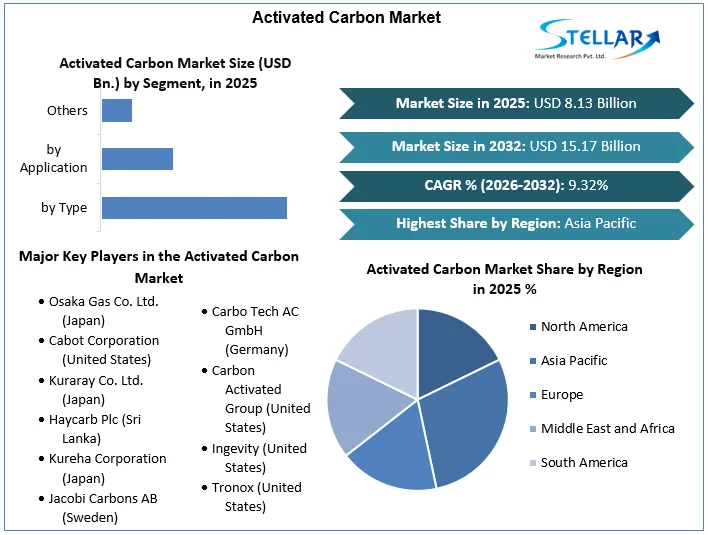
Activated Carbon Market Key Players
- Osaka Gas Co. Ltd. (Japan)
- Cabot Corporation (United States)
- Kuraray Co. Ltd. (Japan)
- Haycarb Plc (Sri Lanka)
- Kureha Corporation (Japan)
- Jacobi Carbons AB (Sweden)
- Calgon Carbon Corporation (United States)
- Carbo Tech AC GmbH (Germany)
- Carbon Activated Group (United States)
- Ingevity (United States)
- Tronox (United States)
- Genuine Shell Carb (India)
- James Cumming & Sons (Australia)
- Indo German Carbons (India)
Challenges Facing the Industry
Despite strong growth prospects, the activated carbon market faces several challenges.
Raw material price fluctuations can impact manufacturing costs and profitability. Availability of high-quality feedstocks such as coconut shells and coal may vary due to changing market conditions and environmental regulations.
Additional challenges include:
- Energy-intensive production processes
- Supply chain disruptions
- Competition from alternative filtration technologies
- Regulatory compliance requirements
- Disposal and regeneration management
Manufacturers must continuously invest in innovation and operational improvements to remain competitive while addressing evolving customer expectations.
Future Outlook
The future of the activated carbon market appears highly promising as industries increasingly prioritize environmental sustainability, resource efficiency, and regulatory compliance. Growing investments in water treatment infrastructure, air pollution control systems, and industrial purification technologies are expected to create substantial opportunities for market participants.
Emerging applications in renewable energy, advanced manufacturing, carbon capture, and environmental remediation may further expand the scope of activated carbon utilization. Technological advancements and sustainable production methods will likely enhance product performance while reducing environmental impact.
As governments strengthen environmental regulations and industries pursue cleaner operations, activated carbon will continue to serve as a critical solution for purification, filtration, and pollution control challenges across the global economy.
About Stellar Market Research:
Stellar Market Research is a multifaceted market research and consulting company with professionals from several industries. Some industries we cover include medical devices, pharmaceutical manufacturers, science and engineering, electronic components, industrial equipment, technology and communication, cars and automobiles, chemical products and substances, general merchandise, beverages, personal care, and automated systems.
Contact Stellar Market Research:
S.no.8, h.no. 4-8 Pl.7/4,
Pinnacle Memories Fl. No. 3,
Pune, Maharashtra, 411029
sales@stellarmr.com
+91 9607365656
https://www.stellarmr.com/
