Key Highlights
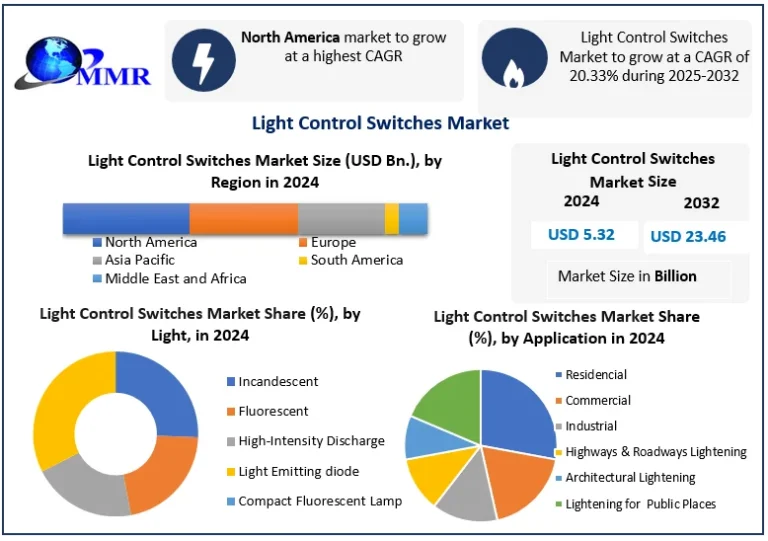
- The global Light Control Switches Market was valued at USD 5.32 billion in 2024.
- The market is forecast to reach USD 23.46 billion by 2032.
- The forecast CAGR stands at 20.33% during 2025–2032.
- Growth is being fueled by smart lighting adoption, integrated control systems, LED deployment, and connected building infrastructure.
- Wireless technologies and IoT-enabled building automation are reshaping competitive dynamics across residential, commercial, and industrial applications.
Why This Matters Now
The race to modernize buildings has shifted from lighting hardware to intelligent control systems. As enterprises pursue energy savings, carbon-reduction targets, and digital building management, light control switches have become a critical node in connected infrastructure rather than a simple electrical component.
The transformation mirrors a broader shift across electronics markets. Sensors, wireless connectivity, edge intelligence, and software-enabled controls are converging inside lighting networks. For manufacturers, the opportunity is no longer tied solely to switch volumes. It is increasingly linked to smart-building ecosystems, recurring software value, and integration with broader automation platforms.
Market Overview
The global Light Control Switches Market reached USD 5.32 billion in 2024 and is projected to expand to USD 23.46 billion by 2032 at a CAGR of 20.33%. That growth rate signals one of the fastest transitions occurring within building electronics and intelligent infrastructure categories.
What changed is the role of lighting itself. Lighting systems have evolved into data-generating assets connected to occupancy sensors, automation software, energy management platforms, and wireless networks. Every new lighting installation increasingly becomes part of a larger digital infrastructure strategy.
Why now? Governments, businesses, and consumers are under pressure to reduce electricity consumption while improving operational efficiency. Smart city initiatives, sustainable construction practices, and digital transformation programs are accelerating adoption of advanced lighting controls. These trends create opportunities for component manufacturers, electronics suppliers, software developers, and infrastructure investors alike.
Key Trends Driving Growth
The first major trend is the rapid migration from conventional switching systems to intelligent lighting environments. Organizations are increasingly investing in automated controls that optimize illumination based on occupancy, daylight availability, and usage patterns. This improves energy performance while reducing operational costs.
A second trend is the rise of wireless communication technologies. Traditional wired installations remain important, but wireless deployment reduces installation complexity and enables retrofitting of existing buildings. For building owners, lower deployment costs improve return on investment and accelerate adoption cycles.
The third trend is integration with IoT ecosystems. Lighting controls are becoming part of broader smart-building architectures that connect HVAC systems, security platforms, occupancy monitoring, and facility management software. This convergence expands the value proposition far beyond simple lighting control.
LED adoption is another catalyst. As LED penetration rises globally, users increasingly seek advanced dimming, scheduling, and automation capabilities. The combination of LED efficiency and intelligent control creates measurable energy savings, making the business case stronger across residential and commercial applications.
Sustainability goals are also reshaping purchasing decisions. Companies pursuing carbon-reduction objectives increasingly deploy automated lighting management systems as a relatively fast and cost-effective path to energy optimization.
Get a sample of the report: https://www.maximizemarketresearch.com/request-sample/32793/
Segment Insights
- Dominant Segment: Product Type – Switches. The category continues to form the foundation of market demand because of widespread deployment across residential, commercial, industrial, and public infrastructure environments.
- Fastest-Growing Segment: The report identifies expanding demand across Integrated Light Control Solutions, supported by smart-building adoption and increasing requirements for centralized lighting management.
- Communication Technology: Wired and wireless technologies both participate in market growth, with wireless solutions benefiting from easier installation and retrofit opportunities.
- Application Areas: Residential, commercial, industrial, highways and roadways, architectural lighting, and public-place lighting all contribute to market expansion.
- Light Sources Covered: LED, fluorescent, compact fluorescent lamps, incandescent lighting, and high-intensity discharge technologies remain part of the addressable ecosystem.
Regional Growth Story
North America remains a critical market because of mature smart-building adoption, advanced building automation systems, and strong energy-efficiency regulations. Organizations increasingly view lighting controls as part of digital infrastructure investments rather than standalone electrical upgrades.
Europe benefits from stringent sustainability targets and building-efficiency initiatives. Energy-management regulations continue to encourage deployment of intelligent lighting systems across commercial and public infrastructure projects.
Asia-Pacific represents one of the most significant long-term opportunities. Rapid urbanization, infrastructure development, smart-city programs, and expanding construction activity are creating favorable conditions for advanced lighting controls. Major economies including China, Japan, South Korea, and India continue investing in connected infrastructure and energy-efficient technologies.
The competitive implication is clear: regions investing heavily in smart infrastructure will attract the next wave of electronics manufacturing, system integration, and building-technology deployment.
Competitive Landscape
Competition is shifting from product specifications toward ecosystem positioning. The leading players are increasingly competing on interoperability, software integration, wireless connectivity, and automation capabilities rather than switch functionality alone.
This signals a broader transformation across the electronics industry. Vendors that can connect lighting controls with building-management systems, IoT platforms, and energy-optimization software gain stronger pricing power and customer retention.
The emergence of integrated solutions also raises barriers to entry. As customers prioritize seamless operation across multiple building systems, technology providers with broader portfolios and established integration capabilities are positioned to capture larger shares of project spending.
The market’s evolution further favors companies investing in digital platforms, sensor integration, wireless communications, and intelligent automation. In practical terms, lighting control providers are becoming infrastructure technology companies rather than component suppliers.
Recent Developments
- Growing deployment of integrated lighting control systems across commercial and institutional facilities.
- Increased adoption of wireless communication technologies for retrofit and modernization projects.
- Expansion of smart-city initiatives supporting intelligent lighting infrastructure.
- Rising integration of lighting controls with building automation and IoT platforms.
- Accelerating use of LED-compatible dimming and control solutions to improve energy efficiency.
Strategic Implications
For electronics manufacturers, the market offers a path into high-value smart-building ecosystems. Success will increasingly depend on software compatibility, connectivity standards, and integration capabilities.
For OEMs, lighting controls create opportunities to participate in broader building modernization projects. Product differentiation will come from user experience, interoperability, and energy-management functionality.
For investors, the strongest opportunities lie where lighting, IoT, automation, and sustainability intersect. Markets tied to recurring software value and connected infrastructure typically generate stronger long-term economics than hardware-only segments.
For governments and urban planners, intelligent lighting systems represent one of the most practical methods of reducing energy consumption while improving public infrastructure performance.
Future Outlook
The next phase of growth will be defined by the convergence of lighting controls, IoT networks, building automation platforms, and AI-enabled energy management systems. As buildings become increasingly connected and data-driven, light control switches will evolve into intelligent endpoints within larger digital ecosystems.
The companies that build interoperable, software-connected lighting platforms will shape the future of smart infrastructure, while those that remain focused solely on traditional hardware risk losing relevance in an increasingly intelligent and automated built environment.
Analyst Perspective
“The market is entering a phase where intelligent control, connectivity, and energy optimization are becoming essential purchasing criteria. Organizations are no longer evaluating lighting systems as isolated assets but as strategic components of digital building infrastructure,” said Rucha Deshpande.
About Maximize Market Research
Maximize Market Research Pvt. Ltd. (MMR) is a global market research and consulting company that provides reliable, data-focused, and practical business insights. The firm serves a wide range of industries, including healthcare, pharmaceuticals, technology, automotive, electronics, chemicals, personal care, and consumer goods. Through market forecasts, competitive analysis, strategic consulting, and industry impact assessments, MMR helps organizations understand changing market conditions, identify growth opportunities, and make informed business decisions for long-term success.
Contact Maximize Market Research:
2nd Floor, Navale IT Park Phase 3
Pune Banglore Highway, Narhe
Pune, Maharashtra 411041, India
+91 9607365656
sales@maximizemarketresearch.com
